Russia warns Washington that its support for Ukrainian attacks prolongs war and does not end it
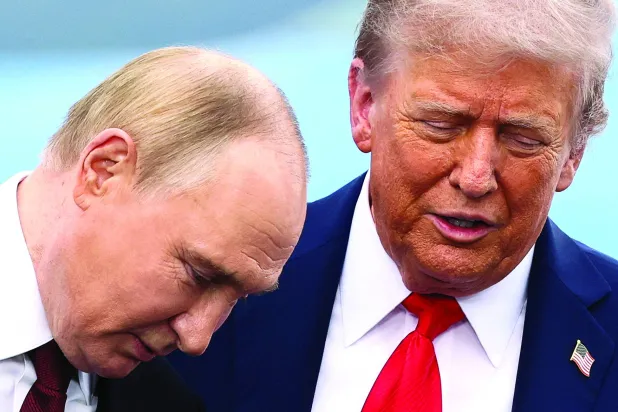
Russia warns Washington that its support for Ukrainian attacks prolongs war, and sources close to Putin say there is a 'strong possibility' of escalation and establishment of a 'larger buffer zone'.
The Kremlin said on Thursday that Ukraine's intensification of its strikes on Russia will only prolong the war, after US President Donald Trump said these strikes could push Moscow to negotiate an end to hostilities. Russian presidential spokesman Dmitry Peskov told journalists: 'The more the Kiev regime attacks our infrastructure, the more we will be forced to expand the security zone' on the front. He added: 'Any new escalation could prolong the special military operation,' referring to Russia's offensive in Ukraine that began in February 2022.
A frame from a video published yesterday shows smoke and flames rising after an explosion in Bandar Abbas (Reuters)... And in the frame, Trump speaks at a NATO summit in Ankara yesterday (AP)
Dmitry Peskov spoke on Thursday about 'miscalculations' on Washington's part, specifically its belief 'that escalation and military pressure would enhance a return to the path of peaceful settlement'.
He added: 'It's a mistaken idea... That is why escalating tensions and measures that push for escalation will in no way contribute to the peace process.'
Group photo of NATO leaders at the conclusion of their summit in Ankara on July 8 (AP)
Ukraine has intensified its drone strikes in recent months, targeting particularly oil refineries, storage depots, and shipping vessels at sea, causing fuel shortages in Russia.
US Secretary of State Marco Rubio said during a NATO summit in Turkey on Wednesday that Russia is finding increasing difficulty in protecting its airspace, considering that this could open more room for negotiations to end the war. US President Donald Trump said: 'It's an escalation, but it's also an escalation that could help reach an end to the conflict.'
Three sources close to the Kremlin told Reuters that Russian President Vladimir Putin rejects calls for peace negotiations with Kyiv, and that the latest Ukrainian drone attacks on Russian oil refineries and ports have strengthened his conviction that fighting must continue for now. Two of these sources added that Putin is likely to instead escalate the conflict.
Trump speaks aboard the presidential plane on July 8, 2026 (AFP)
One of them, a source who meets the Russian president regularly, said there is a 'strong possibility' of escalation in the coming months. When Peskov was asked about Trump's decision to allow Ukraine to produce Patriot interceptor air defense missiles under license, he said Moscow has no doubts about the continuation of US arms supplies to Kyiv.
Trump's efforts to end the war in Ukraine have stalled in recent months, amid Washington's focus on the Iran war, but Peskov said the Kremlin still hopes for a resumption of US mediation after resolving the crisis in the Middle East.
Part of a meeting with Trump and Zelensky on the sidelines of the NATO summit in Ankara on July 8 (AP)
Ukraine has intensified its attacks on Russian energy infrastructure in recent weeks, with operations not limited to targeting fuel tankers but also including oil refineries, in an attempt to reduce Russian fuel production and increase pressure on the Kremlin to enter negotiations. These attacks have led to the closure of many major refineries, exacerbating the gasoline shortage crisis across Russia.
In response, the Russian government imposed a ban on exports of most types of gasoline, jet fuel, and diesel, aiming to retain larger quantities of fuel to meet domestic market needs.
The General Staff of the Ukrainian Armed Forces said on Thursday that the country targeted 12 Russian tankers in the Sea of Azov overnight Wednesday-Thursday, in the latest attack in a series aimed at isolating Crimea. The General Staff added in a Telegram post that these tankers were used to supply fuel to the Russian army and transport oil and petroleum products in an attempt to circumvent international sanctions. It also mentioned that a tugboat and a dry cargo ship were also attacked.
A drone image shows flames and smoke rising after an attack targeted an oil depot in the city of Kerch in Crimea on Sunday (Reuters)
Ukrainian President Volodymyr Zelensky said that in addition to targeting oil facilities in Stavropol and Tver, Ukrainian forces also targeted a reserve fuel storage facility about 800 kilometers (500 miles) from the front line, and an oil pumping station in the city of Ufa about 1,500 kilometers (930 miles) from the Ukrainian border, as reported by the Associated Press.
Zelensky added that Ukrainian forces also targeted an oil loading terminal in the Rostov region about 200 kilometers (125 miles) from the front line.
Emergency services carry out firefighting operations in Crimea after the peninsula was attacked by Ukrainian drones (archive - AP)
The governor of the Rostov region on the Russian coast of the Sea of Azov, Yuri Slyusar, said on Thursday that two tankers were attacked in Taganrog Bay and suffered mechanical damage, without revealing their names, according to Bloomberg News. Slyusar added that both tankers caught fire, but the fire on one of them has already been extinguished.
Zelensky described the attacks as part of Kyiv's campaign to impose 'long-range sanctions,' in response to Russian attacks and Moscow's refusal to end the war.
Smoke rises from an oil refinery following a Ukrainian drone attack in Moscow on June 18, 2026 (Reuters)
Zelensky said: 'We have long proposed that Russia end this war, and every day of delay should make it feel the war in the place where it started, inside Russia.'
Separately, Italy on Thursday ordered the expulsion of two Russian military attachés with diplomatic status, as announced by Foreign Minister Antonio Tajani, denouncing 'serious and unacceptable interference' by Moscow. The expulsion of the military attachés came two days after police announced the arrest of two former Italian intelligence officers, who according to reports leaked secret information to Russia regarding military aid to Ukraine.
Cars line up for fuel at a Rosneft station in Moscow on June 30, 2026 (AFP)
Foreign Minister Antonio Tajani wrote on platform X: 'The Italian government has decided to expel two military attachés from the Embassy of the Russian Federation in Italy, for their involvement in espionage activities uncovered by the Rome Prosecutor's Office.' Tajani added: 'Moscow continues to use hybrid warfare to attack the West and Italy, which are serious and unacceptable acts of interference in Italian institutions and national security.'
Italian police said on Tuesday that the main suspect, aged 59, had been in contact with a Russian intelligence officer 'enjoying diplomatic immunity on Italian soil.' The statement explained that the suspect 'obtained the requested information and disclosed it to him through six sources, including four active-duty military personnel holding highly confidential positions.'
Smoke rises following a Ukrainian drone attack on an oil refinery in Moscow on June 18, 2026 (Reuters)
Original source: Asharq Al-Awsat



Comments (0)
Be the first to comment.