‘Pending Files’ Postpone Agreement Paving Way for Upcoming Libyan Elections
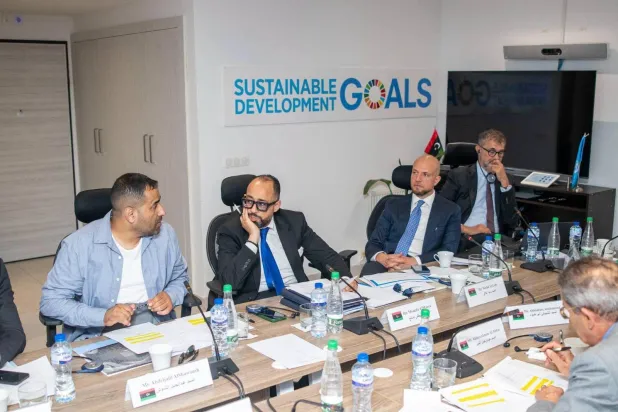
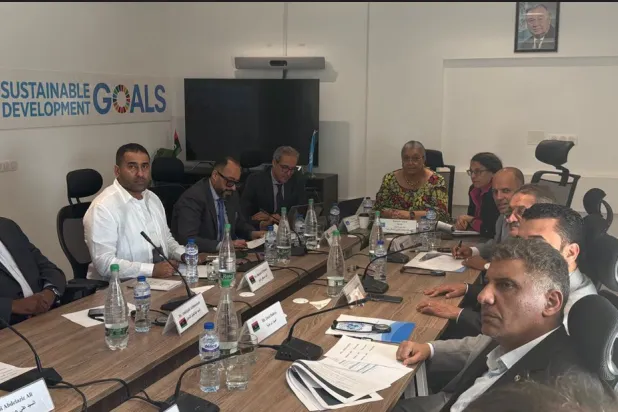
The postponement of signing a final agreement between Libyan political factions kept the door open for a new round of negotiations, after a UN-sponsored meeting in Tunis on Tuesday ended without resolving the issue of the presidency of the High National Elections Commission and some contentious issues related to the legal framework for the electoral process, despite expectations of announcing a final agreement paving the way for presidential and parliamentary elections.
In the view of politicians and analysts, this postponement appeared to reflect ‘complex political calculations’ governing the positions of the parties in the ‘4 + 4’ committee. The statement issued by the United Nations mission, which spoke of adopting a new mechanism for selecting the head of the commission and including most of the agreed points in the draft final agreement for the legal framework for the elections, was not enough to dispel questions about the reasons for delaying the signing until a meeting to be held in the first week of August.
UN envoy to Libya Hanna Tetteh and her deputy Stephanie Khoury during their participation in the ‘4 + 4’ meeting in Tunis (UN mission)
Ashraf Boudouara, a member of the structured dialogue sponsored by the United Nations, considered that ‘it is natural for such understandings to see some postponement if there are points still under discussion, because reaching a consensual and implementable formula is more important than adhering to a timeline that does not achieve the required consensus.’
Boudouara did not rule out in his interview with Asharq Al-Awsat that there might be ‘complex political calculations, whether at the domestic level or regarding the positions of some regional and international parties,’ but he believed that the most important thing is for the agreement to emerge in a balanced formula that enjoys wide acceptance and is applicable on the ground.
The postponement came after high expectations among participants in this track, as members of the ‘4 + 4’ committee, after five rounds between Rome and Tunis, spoke of addressing most of the obstacles contained in previous electoral laws and reaching solutions to contentious points. In fact, the representative of the Government of National Unity on the committee, Abdul Jalil al-Shaoush, had earlier announced that ‘there is no longer any room to postpone or obstruct the holding of elections.’
In Boudouara’s estimation, the success of any understanding will not be measured by its signing date, but by its ability to end division, unify institutions, and lead the country towards free and fair elections within a clear timeline, adding that Libya ‘can no longer tolerate new agreements added to the archive of initiatives without implementation.’
The ‘4 + 4’ committee includes representatives from the Libyan National Army in eastern Libya and the Government of National Unity in the west, along with two members from the House of Representatives and two from the High Council of State. It was launched by the UN mission as an alternative to overcome the stalled consensus between the two councils on electoral laws and the reconstitution of the board of the High National Elections Commission.
Before extending the negotiation rounds, the committee’s previous stops in Rome and Tunis witnessed gradual agreements that included the reconstitution of the commission’s board and reaching understandings on the presidential election law, before the track reached the stage of reviewing the final draft of the agreement.
Here, political researcher Abdullah al-Dibani sees that the postponement does not merely reflect a procedural disagreement, but reveals the continued complexities related to implementation mechanisms and the necessary guarantees to complete a settlement paving the way for the electoral process. He explained in a post on Facebook that the introduction of a new mechanism for selecting the head of the commission opened additional discussion about the authority entitled to make the decision and the mechanisms for approving the candidate, which required giving the parties more time to reach a more coherent formula.
The United Nations mission had announced at the end of last April that the ‘4 + 4’ committee, during its meeting in Rome, reached an agreement to reconstitute the commission’s board, including the nomination by the Attorney General of a judge known for competence and integrity to head it, along with six members representing the House of Representatives and the High Council of State.
Meanwhile, ambiguity still surrounds more sensitive files on the ‘4 + 4’ table, most notably the conditions for the candidacy of military personnel and dual nationals for presidential elections, along with the issue of holding presidential and parliamentary elections simultaneously. Both issues have been linked for years to the debate over the eligibility of some prominent figures to run in the presidential race.
Trump’s adviser on African affairs, Massad Boulos (AFP)
In a reading of these complexities, Jalel Harchaoui, an associate researcher at the Royal United Services Institute, considered that ‘the hardest step will be finding a way to convince representatives of the National Army of the need to amend the electoral laws.’
He stressed in his interview with Asharq Al-Awsat that holding presidential elections simultaneously with legislative elections remains contentious, and it is likely that these files will spark heated discussions even after an agreement on a new head of the High National Elections Commission in early August.
However, the shadow of a political initiative, which Libyan and diplomatic circles say has American support to restructure the executive authority, was not far from the Tunis meetings, according to analysts’ assessments.
This initiative, led by US presidential adviser Massad Boulos, and according to what is being circulated, is based on the assumption of the Deputy Commander-in-Chief of the Libyan National Army, Saddam Haftar, as head of the Presidential Council, with the assignment of the head of the Government of National Unity, Abdul Hamid Dbeibeh, to form a unified government.
Harchaoui saw that the prevailing expectation until recently was that the UN-sponsored ‘4 + 4’ track would make progress according to its own criteria, while the US-backed track would proceed separately and according to its own calculations.
According to his assessment, what the Tunis meeting witnessed indicates a ‘significant tendency by the two main Libyan parties to link concessions in one track to what is achieved in the other,’ which may explain the caution that marked the latest round of negotiations.
Saddam Haftar (AFP)
As for al-Dibani, he concluded that the postponement of the signing may also be linked to the need to provide broader international cover to support the agreement and ensure its implementation, given the continued reservations expressed by some political forces towards the mini-committee, in addition to avoiding producing an understanding that might face obstacles as soon as it is implemented.
Original source: Asharq Al-Awsat

Comments (0)
Be the first to comment.