Gaza's Displaced Trapped Between Blazing Tents and Beach Epidemics
); googletag.cmd.push(function() { onDvtagReady(function () { googletag.display('div-gpt-ad-3341368-3'); }); }); }
Summary
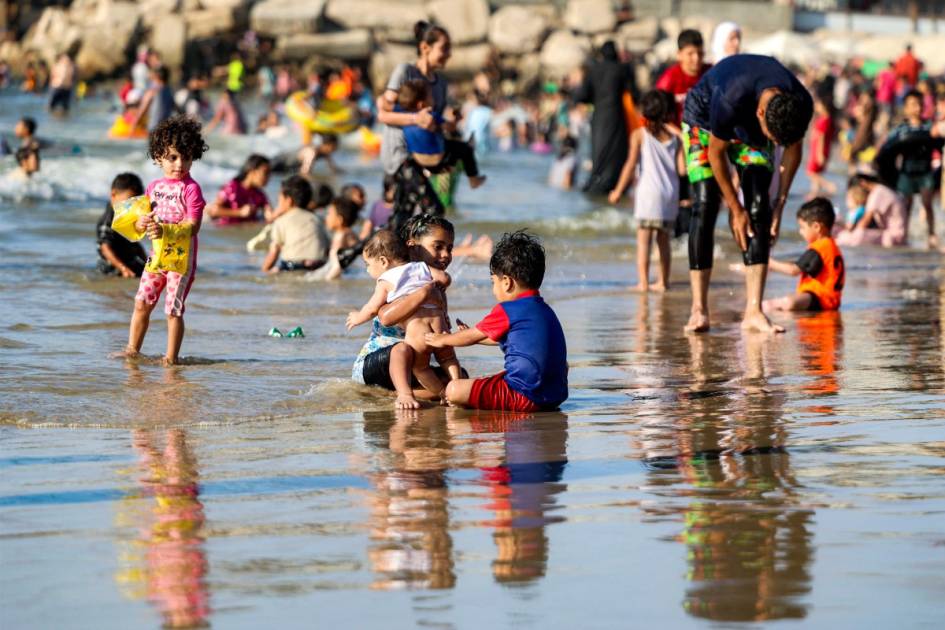
With the onset of summer and rising temperatures, displaced people are flocking to the beach, diving into the waves to cool their children and protect them from heatstroke. However, this recreation in the Mediterranean waters collides with an unprecedented environmental disaster; the sea receives hundreds of thousands of cubic meters of liquid waste and heavy sewage daily.
Under the blazing July sky on the coast of southern Gaza, Randa al-Dahdouh emerges from her tent in the Al-Mawasi area, dragging her four children behind her, their shirts soaked in heavy sweat.
Inside the tent, temperatures soared to around 45 degrees Celsius, making staying inside a direct danger to the children's safety, due to the lack of electricity and blocked air vents.
Her child Youssef could not bear this heat, instinctively fleeing to the beach stretching in front of the camp, crowded with thousands of bodies escaping the same fate.
Cold and Danger
The little one threw himself into the Mediterranean waters, letting out a long sigh as the first cold wave touched his burning skin, finally breathing after hours of suffocation.
But this temporary coolness carries an invisible biological danger; the water Youssef takes refuge in to wash away the sweat of displacement has become an open outlet for thousands of cubic meters of untreated sewage daily.
After the destruction of infrastructure networks and the shutdown of treatment plants, Gaza municipalities were forced to pump untreated sewage into the sea.
This reality puts Gazans before a harsh choice between the hell of heat exhaustion inside the tents and the trap of skin and intestinal diseases lurking in the only remaining refuge.
No Cooling Means in Tents
The sector's sea beach, stretching about 40 kilometers, is no longer the area for recreation and well-being that Gazans were accustomed to. It has turned, due to war and displacement, into a shelter where the displaced have pitched their tents. With the onset of summer and the peak of heatwaves, they face a complex geographical reality.
The displaced are besieged by tents made of worn-out fabrics and reinforced nylon that magnify the heat intensity, amid a complete lack of electricity networks, shutdown of water desalination plants, and absence of the simplest ventilation or basic cooling tools.
This reality, with the onset of summer and rising temperatures, has pushed the displaced toward the beach, diving into the waves to cool their children and protect them from heatstroke.
But this recreation in the Mediterranean collides with an unprecedented environmental disaster; the sea receives hundreds of thousands of cubic meters of liquid waste and heavy sewage daily.
Tent Inferno
With the intensifying summer, the displaced tents have turned into 'heat traps' imprisoning the heat inside, says Iyad al-Mughrabi: 'Sleeping inside the tent at noon is exactly like sitting inside a burning oven.'
Read more
This section contains related articles placed in (Related Nodes field)
He adds: 'We are not just talking about a feeling of intense heat, but actual suffocation. The fabric and nylon absorb sunlight all day and re-radiate it downwards. We don't have a single fan because there is no electricity to run it.'
Inside the tent community, there are painful stories about the summer heat. Huda Asfour, mother of two infants, recounts: 'The water we are supposed to wash the little ones' faces with to cool their bodies comes out of the gallons very hot due to the sun.'
She adds: 'Even breastfeeding has become a burden because the infants refuse to cling to their mothers' bodies due to severe sweating and heat. The tent pushes us outside, and the sea in front of us is the only place that does not ask us for the price of a breath of air.'
Summer Diseases
Due to the tent heat, medical points receive hundreds of cases suffering from heat exhaustion. Ministry of Health spokesman Khalil al-Daqran confirms that field clinics adjacent to the camps are recording a daily surge in cases of heat exhaustion and severe dehydration, especially among the most vulnerable groups.
Al-Daqran says: 'We receive dozens of infants and elderly daily suffering from heatstroke symptoms, such as continuous vomiting, severe rise in body temperature, delirium, and low blood pressure.'
He explains that high humidity, along with heat retention inside the nylon, prevents children's bodies from cooling themselves through sweating, making staying inside the tent during the day a direct danger to their lives, and forces their families toward the sea to save them from suffocation.
Gaza Beach: A Sewage Outfall
What Gaza's sea is undergoing is one of the biggest environmental disasters in the eastern Mediterranean basin. Having fallen outside strict monitoring and periodic checks due to the war, it has also become an open outlet for the most dangerous biological and chemical pollutants.
Gaza Municipality spokesman Husni Mahanna says: 'The roots of this crisis go directly to the comprehensive and systematic destruction of infrastructure. The complete power outage, prevention of fuel supplies, and destruction of main pumping lines have caused total paralysis of the five main sewage treatment plants in the sector.'
He adds: 'As a result, municipalities and local councils found themselves with only one option to prevent the drowning of displacement centers and streets with wastewater: diverting the conveyance lines to discharge directly into the sea without any proper treatment.'
According to data from the Palestinian Environmental Quality Authority, the volume of untreated sewage and chemical materials pumped daily into Gaza's sea is estimated at more than 130,000 cubic meters.
The Director General of the Coastal Municipalities Water Utility, Munther Shublaq, says: 'These huge quantities have turned large areas of the beach, especially those adjacent to displacement camps, into black contaminated spots emitting foul odors, with heavy waste floating on the surface.'
He adds: 'The current seawater in the Gaza Strip does not meet any Palestinian or international health standards for swimming. The level of microbiological pollution has exceeded the red lines by multiple times due to the daily and continuous flow of untreated sewage.'
Shublaq explains that the shutdown of central treatment plants means that parasitic bacteria, intestinal microbes, and heavy metals are discharged directly into the coastal waters where children swim.
He continues: 'Entering this water is not a recreational activity; it is direct contact with a ticking biological bomb, fed by sea currents that redistribute it along the beach, making the entire coast a danger zone.'
Children's Bodies Pay the Price
The few minutes of cooling that children enjoy in the water quickly turn into medical nightmares hours later, especially in the absence of fresh water for bathing and disinfection after swimming. Thus, the microbes clinging to bodies remain active, finding an ideal environment for reproduction.
The Director General of Hospitals in Gaza, Muhammad Zaqout, says: 'Outpatient clinics are witnessing a huge influx and increasing cases of patients, most of them children, showing symptoms directly after entering the sea.'
Original source: Independent Arabia


Comments (0)
Be the first to comment.