Gaza and Jerusalem: Two Potential Obstacles to Holding Elections
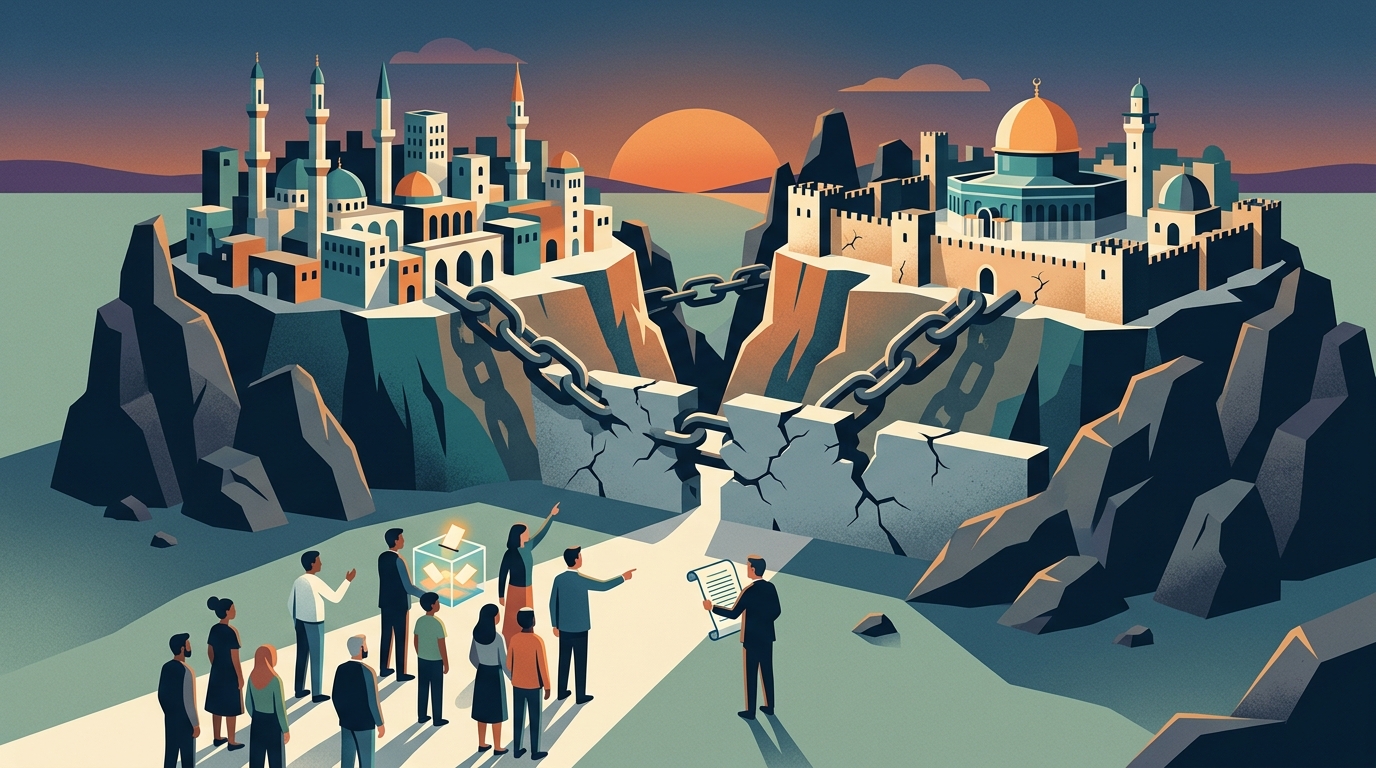
Summary: Holding these elections faces several obstacles, foremost among them Israel allowing Palestinians to vote in Jerusalem, and holding them in the Gaza Strip, which is under the mandate of the 'Peace Council' by a UN Security Council decision until the end of 2027, with the possibility of renewal.
The decree of Palestinian President Mahmoud Abbas to hold legislative elections on the 28th of next November came after 20 years since they were last held, and five years after they were postponed due to Israel's refusal to hold them in Jerusalem. If elections are held in the West Bank, including Jerusalem, and in the Gaza Strip, they will lead to the return of parliamentary life for Palestinians, which has been suspended since Hamas took control of the Gaza Strip in 2007.
Several obstacles
But holding these elections faces several obstacles, foremost among them Israel allowing Palestinians to vote in Jerusalem, and holding them in the Gaza Strip, which is under the mandate of the 'Peace Council' by a UN Security Council decision until the end of 2027, with the possibility of renewal.
Days before the presidential decree, six Palestinian factions, excluding Fatah, warned of 'the danger of any attempts to re-engineer the Palestinian political system in response to external pressures or dictates.' These factions—Hamas, Islamic Jihad, the Popular Front for the Liberation of Palestine, the Democratic Front for the Liberation of Palestine, and the Palestinian National Initiative—demanded that the elections be preceded by 'comprehensive national consensus and an inclusive dialogue.'
Election Law
These factions reject President Abbas's amendment to the election law, which requires recognition of the Palestine Liberation Organization as the sole legitimate representative of the Palestinian people, its political and national program, and relevant international legitimacy resolutions.
The amendments made by President Abbas last month amid the dissolution of the Legislative Council included increasing the number of council members to 200, lowering the candidacy age to 23, and raising the percentage of women's representation.
The increase in Legislative Council members from 120 to 200 was made considering that council members will automatically become members of the Palestinian National Council, which consists of 350 members, including 150 from Palestinians abroad.
Consensus
According to Palestinian officials who spoke to Independent Arabia, the decree to hold legislative elections on November 28 means canceling a decree issued by President Abbas earlier this year to hold National Council elections on the first of the same month.
A committee formed by the Palestinian president is working on appointing the 150 National Council members by consensus, due to the impossibility of holding elections abroad.
The presidential decree stated: 'Calling upon the Palestinian people in Jerusalem, the West Bank, and the Gaza Strip to participate in free and direct legislative elections to elect members of the Palestinian Legislative Council on Saturday, November 28 next.'
According to Ahmed Majdalani, member of the PLO Executive Committee, 'There is no need to cancel the presidential decree regarding the National Council, because members of the Legislative Council are automatic members of the National Council.'
The Legislative Council is the parliament of the State of Palestine and concerns Palestinians in the West Bank and Gaza Strip, while the Palestinian National Council is the parliament of the entire Palestinian people.
Read more
Palestinian legislative elections on November 28
'Peace Council' plans to establish a humanitarian zone in southern Gaza
Israel prevents Arab League Secretary-General from visiting West Bank
Obstacles
Regarding the possibility of Israel agreeing to hold elections in Jerusalem, Majdalani indicated that this matter 'has been largely resolved,' without revealing details, noting that there will be no obstacle to holding them, unlike in the 2021 elections, which were canceled due to Israeli refusal.
Majdalani added that 'the main obstacle this time to holding elections is in the Gaza Strip due to the position of Hamas, in addition to the position of the Peace Council.'
The Council manages the transitional phase in the Gaza Strip under a mandate from the UN Security Council, for a renewable two-year period.
Majdalani explained that the High Representative for Gaza, Nikolay Mladenov, 'might say he has a UN mandate and refuse to hold them in the Strip,' stressing that 'there is no possibility of holding elections without Gaza,' and noting that 'the matter requires work to remove this dilemma.'
Political researcher Jihad Harb opined that the possibility of holding elections 'remains undecided due to the lack of certainty now about the possibility of holding them in Jerusalem and Gaza, leaving fears of cancellation as happened in 2021.'
Election Protocol
Regarding Jerusalem, Harb noted that the current proposal is to hold the elections outside Jerusalem, in neighboring towns affiliated with the Jerusalem Governorate. He explained that the 1995 election protocol stipulates the participation of 6,200 Palestinians from Jerusalem via postal centers in the city, pointing to fears among Jerusalemites that their Jerusalem IDs might be revoked if they participate in voting or candidacy.
According to Harb, 'The issue of holding elections in the Gaza Strip requires an agreement with Hamas if it remains in control of part of the Strip, and approval from the Peace Council.' Therefore, holding them in the Strip 'requires a substantial update of the electoral register there, due to the erasure of entire cities from the map such as Rafah and Beit Hanoun, and also requires Israeli approval to grant facilities for holding them.'
Political analyst Nabhan Khuraishah predicted that 'compromise solutions will be found for the issue of holding elections in Jerusalem, and that they will be held symbolically, because the Palestinian political system has become wholly loyal to President Abbas.' He explained that 'power centers within Fatah have been significantly weakened after the movement's eighth conference, so there are no longer voices opposing President Abbas from within the movement.'
According to the official Palestinian news agency (WAFA), holding the elections aims to 'consolidate the foundations of democracy and complete the electoral process launched in the State of Palestine.' The official agency stated that 'a date will be set for the presidential elections, which are scheduled to be held in the first quarter of next year, according to the law.'
Original source: Independent Arabia



Comments (0)
Be the first to comment.