Yemeni woman gives birth to quintuplets in rare delivery
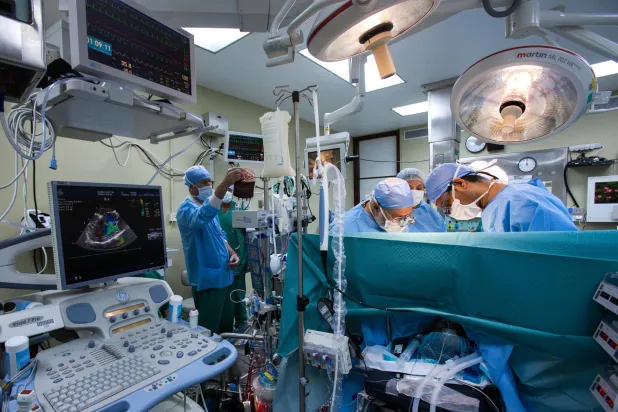
A Yemeni woman gave birth to quintuplets yesterday, Saturday, in a rare delivery in the province of Taiz in southwestern Yemen.
Korean-Swiss director Hai-Sub Sin said that his short film 'Half-Moon' (Ban Dal) came after he watched a documentary on Swiss television about a Korean girl who was adopted, and then her biological mother visited her years later. He noted that what intrigued him most was not the meeting itself, but the feelings that the mother who raised the child might experience when she finds herself face to face with the biological mother.
Sin added, in an interview with Asharq Al-Awsat via Zoom, that he did not want to retell the story he had seen, but rather drew inspiration from its basic idea, before completely rewriting the characters and events according to his own vision. He pointed out that what attracted him from the beginning was the concept of motherhood as a complex human experience that cannot be reduced to a blood bond, but rather involves intertwining feelings of care, memory, and sacrifice, which led him to write a new story that gives this question more room for reflection.
Korean-Swiss director Hai-Sub Sin (the production company)
The film 'Half-Moon' (Ban Dal) is screened as part of the program 'Future Frames: Generation NEXT of European Cinema' at the current edition of the Karlovy Vary International Film Festival in the Czech Republic. The film revolves around Annette, who travels with her adoptive son Joel to South Korea to meet his biological mother for the first time, on a journey that turns into a complex human confrontation imposed by differences in language and culture, while repressed feelings and long silence reveal questions about identity, belonging, and the meaning of motherhood.
The young director explained that most films about adoption focused on children who return to search for their roots, while he felt there was another angle worth telling: the feelings of the biological mother and the adoptive mother. He found that approaching the feelings of each mother gives him more room to talk about love, fear, and loss without claiming to know what the adopted person feels.
He stressed that 'the film does not look for a good mother and a bad one, nor does it try to blame one side for what happened, but rather presents the issue as a space for reflection.' He noted that 'international adoption inherently raises complex ethical questions; even a family that adopts a child out of love may place him in an environment completely different from his roots, culture, and language, which makes the issue bigger than just determining who was wrong and who was right.'
The Korean director said that 'the film relies heavily on silence,' explaining that he belongs to the second generation of Koreans living abroad and speaks more than one language, which made him realize how language barriers can affect human relationships. He noted that words are not always the best means of communication; so he chose to make silence a common language among the characters, because it is the only language that everyone can understand, especially when words fail to express or translation cannot convey emotions as they are.
A still from the film (the production company)
Sin revealed that the most difficult challenge he faced while making the film was shooting inside South Korea, even though it was a graduation project at the Zurich University of the Arts (ZHdK) in Switzerland. The core team that traveled with him was limited to the producer and Swiss actress of Turkish origin, Lale Yavas, who played the role of the Swiss mother, while a local team in Korea was relied upon to select the rest of the actors and form the technical crew, which required extensive coordination between two teams working in different environments.
He added that implementing a graduation project outside the country of study carries double production challenges, because the team does not benefit from the technical capabilities or equipment that the university usually provides for its students. Moreover, all local crew members were professionals, which imposed a larger budget than usual. He noted that the support the film received from the Swiss Radio and Television (SRF) helped cover these additional costs and contributed to completing the project as he had envisioned.
He pointed out that the challenge was not only production-related but also personal, because for the first time he acted, playing the son Joel himself, even though he is not a professional actor. Therefore, he found himself required to simultaneously focus on directing, follow filming details, and supervise the performance of other actors, while maintaining his presence inside the character in front of the camera. He described this experience as one of the most difficult he had gone through during the filmmaking, but it gave him a deeper understanding of the relationship between actor and director, and made him more aware of the challenges both parties face on set.
He noted that the screening of the film at the Karlovy Vary International Film Festival represents an important milestone in his career, because it allows new cinematic voices the opportunity to reach a wider audience and meet filmmakers, critics, and producers from around the world.
Original source: Asharq Al-Awsat
Comments (0)
Be the first to comment.