Algeria: Awaiting Scenarios for the New Government Formation After Sifting Through the 'Legislative' Ballot Boxes
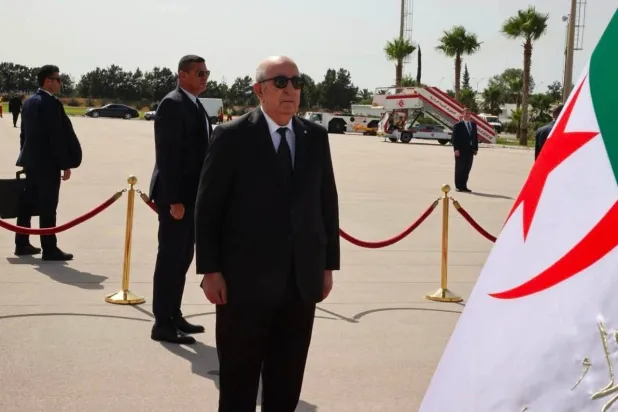
While the Algerian opposition expressed concern over the 'worsening trust crisis' following the abstention of many voters from the legislative ballot, attention is turning to the anticipated new government formation.
While the Algerian opposition expressed concern over the 'worsening trust crisis' following the large voter abstention in the legislative ballot held on the 2nd of this month, attention is turning to the Presidency building where the new government is being engineered after the election results were confirmed, with the possibility of retaining the current government team led by Prime Minister Sifi Gharib.
The Constitutional Court on Saturday confirmed the election results announced by the Independent National Election Authority, cementing the dominance of the parties known as the 'presidential majority' over most seats in the National People's Assembly, namely the National Liberation Front, the National Democratic Rally, and the Future Front; while opposition parties ranked relatively far behind, particularly the Movement of Society for Peace, the Socialist Forces Front, and the Rally for Culture and Democracy, which will allow the government to pass its projects without any disruption during the 2026-2031 legislative term.
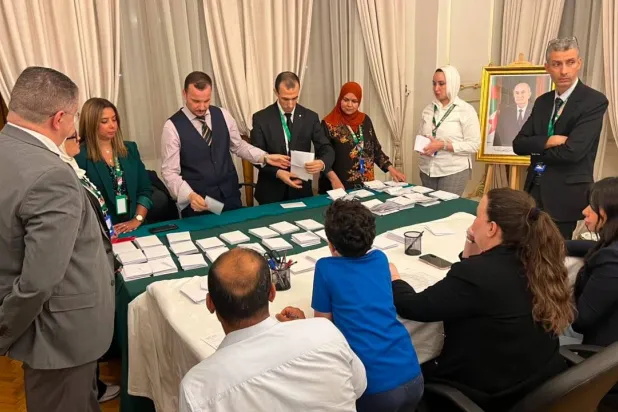
Members of the election authority during the sifting of candidacies (Election Authority)
The ballot saw a turnout rate considered the weakest in the country's electoral history, not exceeding 21 percent, prompting three opposition parties to issue a warning about 'the worsening trust crisis manifested in the abstention and widespread boycott, and violations that affected the transparency of the ballot.'
A statement issued by the Rally for Culture and Democracy at the conclusion of its leadership meeting on Sunday stated that the vast majority of Algerians 'have lost hope in the ability of the current electoral process to bring about real and tangible political change.' The party, which won three seats, said that 'the continued organization of elections in an environment lacking guarantees of equal opportunities among competitors, and lacking absolute transparency and the actual components of democratic alternation, will make popular abstention a persistent phenomenon and a dominant choice for citizens.'
Meeting of the leadership body of the Rally for Culture and Democracy party (Party media)
The party stressed that 'no ballot that confiscates the people's right to freely choose their rulers can establish the true legitimacy that forms the main pillar of state stability and the preservation of its institutions.'
In the party's view, the municipal elections scheduled before the end of this year represent 'a new station in this democratic path, given the importance of local communities as a vital space for grassroots work and citizen participation,' announcing the launch of its preparations for this date, and calling on its activists to 'strengthen field presence, and open up to youth, women, and competencies to build strong candidate lists that reflect the reality of municipalities and provinces.'
'Trust Crisis'
For its part, the Islamic party Justice and Development Front, which won three seats, stated in a statement that what the Constitutional Court announced as the final results of the appeals related to the legislative elections 'confirms the need for deep reforms of the electoral system, ensuring the protection of the popular will, and enhancing the integrity and transparency of elections at all stages.'
Leadership of the Justice and Development Front headed by Sheikh Abdallah Djaballah (Party media)
The party, led by Sheikh Abdallah Djaballah, indicated that the elections 'took place in a context characterized by continued popular abstention from participation, recording the lowest turnout levels since the adoption of political pluralism in 1989, leaving the participation rate in our country among the weakest, which reflects a worsening trust crisis between the citizen and the electoral process, as well as state institutions, which requires serious political and legal treatment that restores the electoral process as the natural gateway to renewing popular legitimacy.'
The Front demanded, through the same statement, 'precise and transparent standards in selecting and qualifying the organizers of the electoral process, to enhance their independence, neutrality, and competence, and to establish full transparency in announcing detailed results at all polling stations and centers, and enabling parties, candidates, and public opinion to access them, thereby enhancing confidence in the results and entrenching societal oversight.'
The Jil Jadid party raised doubts about the integrity of the elections (Party media)
The Jil Jadid party, a liberal party that won one seat, considered that the legislative elections 'highlighted a trust crisis between citizens and institutions,' calling for a new political phase 'based on a new democratic contract, renewed governance, and deep reforms.'
Government Formation
Attention is currently turning to the presidential palace, awaiting the legal and political path that the executive will take following the announcement of the final results of the legislative elections; although the constitutional document lacks any clause explicitly obligating the government to resign as soon as the features of the new parliamentary majority become clear under the dome of parliament, political custom has established a fixed tradition of reshuffling the government team in harmony with the newly formed parliamentary composition.
The constitution places all the strings of the game in the hands of the President of the Republic, who enjoys absolute powers in engineering the government apparatus, either by appointing a 'Prime Minister' to lead the president's program if the ballot boxes result in a loyal majority, or appointing a 'Head of Government' emerging from a majority parliamentary opposition.
Based on these constitutional determinants, all political options remain open to President Abdelmadjid Tebboune, as he can maintain stability by publicly renewing confidence in Prime Minister Sifi Gharib to continue leading the executive body, or go towards the option of fully appointing a new government face.
Prime Minister Sifi Gharib is a candidate to remain in his post (Prime Ministry)
In a related context, the concern over the so-called 'social re-entry' expected next September, i.e., the return of business and education sectors and others after the holiday season, may force resorting to the option of temporarily extending the tasks of the current team to ensure continuity of public service; a scenario that does not prevent the president from making a partial government reshuffle and limiting new ministerial portfolios to sectors that the performance evaluation process has shown need a new breath and dynamism.
Original source: Asharq Al-Awsat

Comments (0)
Be the first to comment.