"America First": Did It Strengthen or Weaken Washington's Influence?
Summary: This issue remains one of the most controversial geopolitical topics in Washington, between those who see it as a successful policy that added a necessary dose of realism to American foreign policy and focused on protecting internal interests and restoring America's prestige and status, and those who see it as having severely damaged America's global standing by undermining soft power and alliances and weakening the shared military deterrence.
Amid the euphoria of America's celebrations of its independence from Britain two and a half centuries ago, and the reminder of the first seed planted by the founding fathers of isolationism, focusing on internal interests and avoiding external conflicts, several questions arise about whether President Donald Trump's slogan "America First" and his policy strengthened or weakened American influence around the world. This issue remains one of the most controversial geopolitical topics in Washington, between those who see it as a successful policy that added a necessary dose of realism to American foreign policy and focused on protecting internal interests and restoring America's prestige and status, and those who see it as having severely damaged the United States' standing by undermining soft power and alliances and weakening the shared military deterrence that has historically been the main pillar of American global dominance.
The First Seed
While the specific modern political slogan "America First" did not exist in the late 18th century when the country was founded after long battles with British forces, the founding fathers of the nascent 13 United States planted the first seed of the basic principles underlying this slogan: isolationism, avoiding external conflicts, and prioritizing American national interests over global affairs.
The early foreign policy of the United States was deeply rooted in ideas that closely align with this principle, despite nuanced differences in intent. The founders aligned with "America First" in their rejection of foreign alliances and entanglements to protect the sovereignty of the young state, as they distrusted the policies of European powers. The first president, George Washington, in his famous farewell address of 1796, explicitly advised the country to avoid permanent alliances with any part of the foreign world, arguing that Europe had a set of primary interests that were of no concern to Americans, and that involvement in their rivalries would only harm the prosperity of the United States.
As for the third president of the country, Thomas Jefferson, in his first inaugural address in 1801, he summarized his famous vision for American foreign policy as peace, trade, and friendship with all nations, and no entangling alliances with any, prioritizing domestic needs.
The founders realized that the United States was physically separated from Europe by a vast ocean, which they considered a huge geopolitical asset, and believed that the country should focus entirely on its growth, economic infrastructure, and internal stability rather than engaging in external wars.
For this reason, they used early trade protectionism to protect the fragile newborn economy from the dominant European empires. Alexander Hamilton, as the first Secretary of the Treasury, strongly advocated for imposing tariffs to protect nascent American manufacturing industries from foreign competition, which was a precursor to the modern trade protectionism embodied in "America First".
Different Motives
But although the modern doctrine of "America First" outwardly matches the philosophies of the founders, the motives of the early leaders were different. It was built on a strategy of weakness versus strength. The founders avoided foreign entanglements out of necessity: in 1789, the United States had no real naval power, only a small regular army, and heavy war debts. Therefore, involvement in European wars could have completely destroyed the United States.
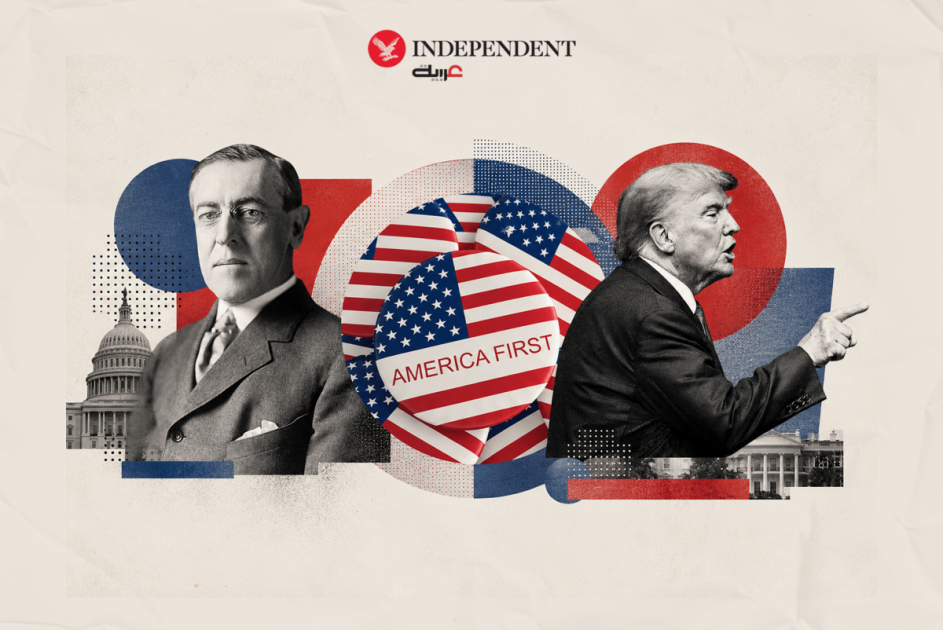
US President Woodrow Wilson (1915-1916) - (Wikipedia)
In contrast, the Trump administration implements modern "America First" policies from a position of possessing global superpower status and unparalleled economic and military influence against weaker adversaries and allies. The approach to global trade also differs: while the founders wanted to avoid political relations and military treaties, they were very keen to build strong and unrestricted trade networks with every country on earth, including global superpowers. The Trump administration, on the other hand, follows a reciprocal approach and uses tariffs as a weapon to restrict trade to work in its favor.
The First Coining
US President Woodrow Wilson (1915-1916) was the first to coin the phrase "America First" as a campaign slogan during his re-election bid in 1916, but he used it to pledge American neutrality during the early years of World War I.
Four years after World War I, Republican Senator Warren Harding successfully ran for president on an isolationist and protectionist "America First" platform, using it to successfully oppose US membership in the League of Nations.
However, the most formal and organized historical manifestation of the movement was the "America First Committee," officially established on September 4, 1940, as an influential non-interventionist pressure group dedicated to keeping the United States out of the conflict of World War II. But the committee was immediately dissolved on December 11, 1941, days after the Japanese attack on Pearl Harbor, which effectively ended the American isolationist trend that had prevailed for decades.
A Strong Return After Absence
America abandoned its isolationism since then, and the slogan "America First" disappeared after it became after World War II an economically, militarily, and culturally unique power, maintaining its strength and global dominance to this day. This slogan did not reappear in political discourse until the 1990s after the collapse of the Soviet Union and the end of the Cold War, with the rise of Pat Buchanan as one of the most prominent symbols of the paleoconservative movement during his populist presidential campaigns in 1992, 1996, and 2000.
Buchanan strongly opposed the North American Free Trade Agreement (NAFTA) and the General Agreement on Tariffs and Trade (GATT), warning that corporate globalization would destroy American industries.
He also called for building a border wall and stopping immigration to preserve local labor markets, and argued that America should return to being a republic, not an empire, strongly criticizing the expansion of the North Atlantic Treaty Organization (NATO).
Original source: Independent Arabia



Comments (0)
Be the first to comment.