Why the mystery of Egypt’s pyramids still refuses to be solved

LONDON: The announcement last month by a team of Egyptian archaeologists of excavations at an ancient burial ground on the east bank of the Nile triggered the usual wave of global media excitement, heralding a supposed new breakthrough in understanding how the great pyramids of ancient Egypt were built.
The pyramids of Giza, built around 4,500 years ago, remain one of the Seven Wonders of the Ancient World and continue to fascinate both scholars and the public alike.
The twin 5,000-year-old tombs at Jabal Al-Tayr were not pyramids — it would be several centuries before the first of those were built — but the media excitement centered on the discovery that, in one of the tombs, the subterranean stone walls were thicker at the bottom, gradually becoming thinner toward the top.
One article declared, “These tombs reveal the origins of the pyramids,” while others claimed they “rewrite” or “redefine” the origins of Egyptian pyramid architecture. Yet a small but critical qualifying word was absent from much of the enthusiastic reporting.

Early Dynastic tombs discovered at Jabal Al-Teyir in Minya governorate. (Photo: Egypt Minister of Tourism and Antiquities)
What the press release from Egypt’s Ministry of Tourism and Antiquities had actually said was that “the architectural style may represent an early stage in the development of geometric thought that later led to the appearance of the terraced pyramid, then the full pyramid.”
The enthusiasm to seize on any possible “explanation” for the enduring mystery of how the great Egyptian pyramids were built came as no surprise to Roland Enmarch, reader in Egyptology at the UK’s University of Liverpool and a former editor of The Journal of Egyptian Archaeology.
“It’s one of those questions which is permanently lodged in the mass consciousness of the modern common culture of the world,” he said. “It’s the sheer stupendousness of the pyramids that captures people’s imagination above everything else.
“The pyramids are such an astonishing achievement, and they are so early in the history of human civilization that people have always wondered how on earth did they do something that astonishingly huge, so long ago, with the relatively primitive technologies that were available to the people at the time.”

Some of the theories have been out of this world. In 1968, the Swiss author Erich von Daniken published a global best-seller — “Chariots of the Gods?” — in which he suggested that the pyramids were such complex structures that they must have been built by aliens, a theory dismissed as pseudoscience but still clung to by conspiracy theorists.
According to Enmarch, the finds at Jabal Al-Tayr “are extremely interesting in their own right; we previously had little evidence for elite tombs of the Early Dynastic period in Middle Egypt.” Yet whether “the feature which is being reported as offering insights into the pyramids” actually paved the way for the iconic structures several centuries later remains open to debate.
“It’s not the first time that stepped mud-brick interior structures have been found inside the structure of Early Dynastic tombs; there is another well-known example at Saqqara, excavated many years ago.”

Early Dynastic tombs discovered at Jabal Al-Teyir in Minya governorate. (Photo: Egypt Minister of Tourism and Antiquities)
Egyptologists, Enmarch added, “are divided on whether they represent the prehistory of the pyramid as a conceptual form. The current opinion is that, most likely, there isn’t a direct link.”
The idea of the pyramid structure, he said, “developed relatively quickly, in a few generations, between about the 27th and the 26th centuries” B.C.
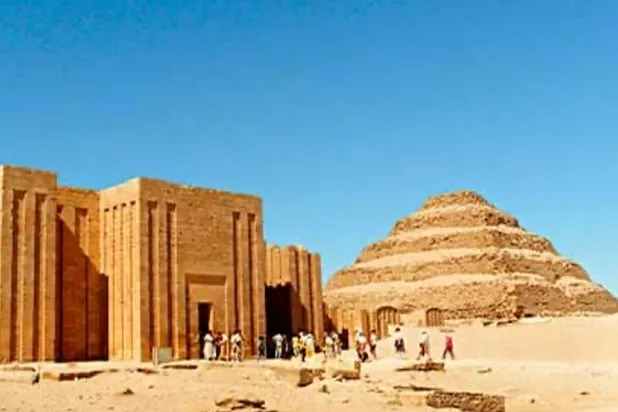
The first “true” pyramid, regarded as the direct ancestor of the famous pyramids at Giza, is the step-pyramid at Saqqara, to the south of Cairo, which was built by the pharaoh Djoser, founder of the Third Dynasty, between about 2670 and 2650 B.C.
“It was revolutionary,” said Enmarch. “In the beginning, when Egypt was first unified as a state in the 31st century B.C.E., the rulers tended to be buried in quite lavish tombs but with relatively modest superstructures.”
In Arabic, these rectangular, mudbrick tombs with flat roofs and sloping sides are known as mastaba: a bench. In hindsight, it is not difficult to see that these structures — such as the Mastaba Al-Faraun, the tomb of Shepseskaf, the last king of the Fourth Dynasty — might have evolved to become the foundation level of the early “layer-cake” style of step-pyramid.

Tourists visit the site of step pyramid of the third dynasty Ancient Egyptian king Djoser (27th century BC), at the Saqqara Necropolis south of Egypt's capital Cairo, on December 3, 2023. (AFP)
“For hundreds of years, that was the superstructure of a tomb, and then Djoser did something revolutionary,” said Enmarch.
“First, he decided to make his mastaba out of stone rather than mud brick and then he, and presumably his architect, Imhotep, kept modifying their design.”
On top of the initial mastaba, they built a second, smaller level, and then others on top of that. The result, while not a true pyramid, was the first step-pyramid.
“Although there had been a small use of stone in predominantly mudbrick architecture before this time, this was the first pyramid, and also surrounding complex, that was built entirely of stone,” Enmarch said.
“So it was a step-change, as well as being a step-pyramid. In the two or three generations after him, the Egyptians kept improving this technology, and by the time of Sneferu, the first pharaoh of the Fourth Dynasty and the father of Khufu, they had got to the point of building true pyramids, with flat, smooth sides rather than steps.”
In fact, the Meidum Pyramid, built by Sneferu in about 2610 B.C., began life as a step-pyramid, similar to Djoser’s. Later, limestone casing was added, which filled in the steps to create smooth sides — and starting a trend.

This picture taken on February 6, 2023 shows a view of the Red Pyramid (L) of the ancient Egyptian Old Kingdom king Sneferu (built between 2575–2551 BC) in the Dahshur Necropolis south of Egypt's capital, the step pyramid of his predecessor Netjerikhet-Djoser (built between 2670-2650 BC) in Saqqara, about eight km away. (AFP)
Meidum was followed by the “Bent Pyramid,” so called because the angle of the walls changes part of the way up, possibly because the builders experienced some kind of structural problem.
But it is Sneferu’s later attempt, the Red Pyramid at Dahshur, built in about 2595 B.C., that is regarded as the first successful, true pyramid, with completely smooth sides.
Standing about 105 meters tall, it is the third-largest pyramid in Egypt, dwarfed only by two of the three structures at Giza.
It was Sneferu’s son, Khufu, building on the techniques developed during his father’s reign, who created the ultimate expression of the pyramid-builder’s art: the Great Pyramid at Giza, which was constructed between 2580 and 2560 B.C. and served as his tomb.

Tourists ride camels near the Great Pyramid of Khufu (Cheops) at the Giza Pyramids Necropolis on the outskirts of Giza on May 3, 2024. (AFP)
At more than 146 meters high, it remained the world’s tallest structure for more than 3,700 years, until it was eventually overtaken by some of the spires of medieval cathedrals in Europe.
Despite the many and regular stories proclaiming “eureka” moments in our understanding of how the pyramids were made, the reality is that while there have been many theories, we still do not really know.
“There are different levels to that question,” said Enmarch.
“First of all, there’s the strength and organizational capacity of the Egyptian state at that time, which was sufficiently powerful to logistically organize such a massive project, and to compel people to take part.”
Egyptologists continue to debate whether the workforce consisted of slaves, “but many of them would probably have been Egyptian peasants who were basically paying their tax in labor as part of their duties to the state,” Enmarch added.

Monumental buildings were made of post and lintel. The peak of pyramid building began with the late third dynasty and continued until roughly the sixth (c2325 BC). From "Cassell's Illustrated Universal History, Vol. I - Early and Greek History", by Edmund Ollier. [Cassell and Company, Limited, London, Paris and Melbourne, 1890]. Artist Unknown. (Photo by The Print Collector/Heritage Images via Getty Images)
“People have thrown out all sorts of guesstimates about what percentage of the national workforce must have been involved in the construction of the Great Pyramid at any one time, but certainly it would have been a significant percentage of the total national workforce.
“There’s also the happenstance that in Egypt, building stone was readily available, unlike, for example, in Mesopotamia.
“But the real question is how were they physically able to raise up all of those stones into a giant artificial mountain?”
Of course, there are plenty of theories.
The average limestone block used to build the Great Pyramid at Giza weighed between 1.5 and 5 tonnes, up to twice as much as the average car but nevertheless fairly easily moved along the ground by a relatively small group of people.

Illustration of Jewish slaves building pyramids in Egypt. (Getty Images)
But some of the stones are much heavier; each of the granite beams over the Great Pyramid’s burial chamber, for example, weighs as much as 80 tonnes.
There was much coverage in 2024 of the discovery by archaeologists using radar satellite imagery that more than 30 pyramids, including those at Giza, lay along the course of a lost branch of the River Nile.
The authors of a paper published in May 2024 speculated that this branch was “used as a transportation waterway (bringing) workmen and materials to the pyramids’ sites.”
Although this is entirely possible — ancient Egypt was crisscrossed with canals “and probably some of these were used for transporting stone,” Enmarch said — it does not address the basic question of how more than 2 million limestone blocks were heaved up to create the Great Pyramid at Giza.

Egypt: Building the pyramids. Slaves putting a stone into position with a wooden lever. (Getty Images)
One recent theory, proposed in 2024 by a team of French archaeologists, was that the builders of the Djoser step pyramid at Saqqara might have used hydraulic force, utilizing a “possible ephemeral lake west of the Djoser complex” for pressure.
“Now, I am not an engineer,” Enmarch said, “but I did read this paper about hydraulic force, and I just don’t understand how it can possibly have worked. I struggle to understand the physics behind it, because the heights we’re talking about are not as different as they would need to be.”
The best guess to date is that the Egyptians used ramps of some kind.
“People have tried making arguments that other kinds of elevation were possible, such as winching things up, but none of these have really come with any really convincing reconstructions. Cranes, for example, were not used in this time period.
“So once you discount those kinds of things, you are really talking about some kind of ramp, and so the real question is how was that ramp configured?”

A view of the pyramids of Giza in Egypt, before they were rehabilitated. (Getty Images)
Calculations that attempt to estimate the maximum steepness of a ramp, made of rubble or mudbrick, up which huge stone blocks could be maneuvered, have found that “the length of the ramp would be so long and the volume of the material to make it so large, building it would actually dwarf the effort to make the pyramid itself.”
Other theories propose ramps that wrapped around the pyramid as it went up, using the pyramid itself for support, “and I must admit, I personally suspect that something along those lines must be right,” Enmarch said.
A highly complex refinement of this idea was put forward by a paper published in the journal Heritage Science in March. Drawing on computer models, this proposed that the Khufu Pyramid was built using an “integrated edge-ramp,” a built-in ramp that followed a helical path around the four sides of the structure and was filled in afterwards. This would also explain why no traces of external ramps have ever been found.
“It’s entirely possible,” Enmarch said. “I looked at the assumptions they make, about how much work could be done, how much time the project probably had, given the duration of the king’s reign, and the calculation looks plausible to me.
“But I can’t be more definite about it than that. With any kind of complex calculation, it only takes a few of the variables to be a bit different for the result to look massively different.”

Caption
Some of the “mysteries” surrounding the construction of the pyramids boil down to little more than a tendency to minimize the abilities of ancient peoples.
“You can do more than people imagine with basic technology,” Enmarch said. “It used to be held, for example, that the Egyptians must have known the number of pi because of the pyramids, but it’s become relatively clear that that’s not necessary. You just need a cylinder that you can run as a pedometer.
“Even so, the level of accuracy they achieved was astonishing. The degree to which the base of the Great Pyramid deviates from being a true square is tiny.”
The ultimate proof that the ancient Egyptians were master engineers and builders is the fact that, although almost none of the true pyramids retain the original smooth, limestone outer skin, which was stripped off to be used on buildings in medieval Cairo, of the 130 or more pyramids that were built, the majority still stand.

Dr. Nasri Iskander restoring the mummy of the great Ahmose I (1580-1558 BC), founder of the 18th dynasty and therefore of the New Empire, who drove the invader Hyksos from Egypt's frontiers, April 2006, at Cairo Museum, Egypt. (Patrick Landmann/Getty Images)
The Egyptians more or less stopped building pyramids about a thousand years after they started. The last royal example is considered to be the tomb of Ahmose at Abydos in Upper Egypt, which was built between 1550 and 1525 B.C. After that, rulers were buried in the Valley of the Kings, in elaborate tombs carved out of the rock face.
Why they stopped building the incredible structures that continue to fascinate the modern world some 3,500 years later, is another mystery that remains open to debate and, of course, multiple theories.

The enduring mystery of pyramid construction highlights the gap between modern technology and ancient ingenuity. While each excavation adds pieces to the puzzle, the full picture remains elusive. The debate over the significance of the Jabal Al-Tayr tombs underscores how even incremental discoveries can fuel broader questions about early Egyptian engineering.
Original source: Arab News



Comments (0)
Be the first to comment.