Sale of South Dakota T. Rex Skeleton Could Deprive Science
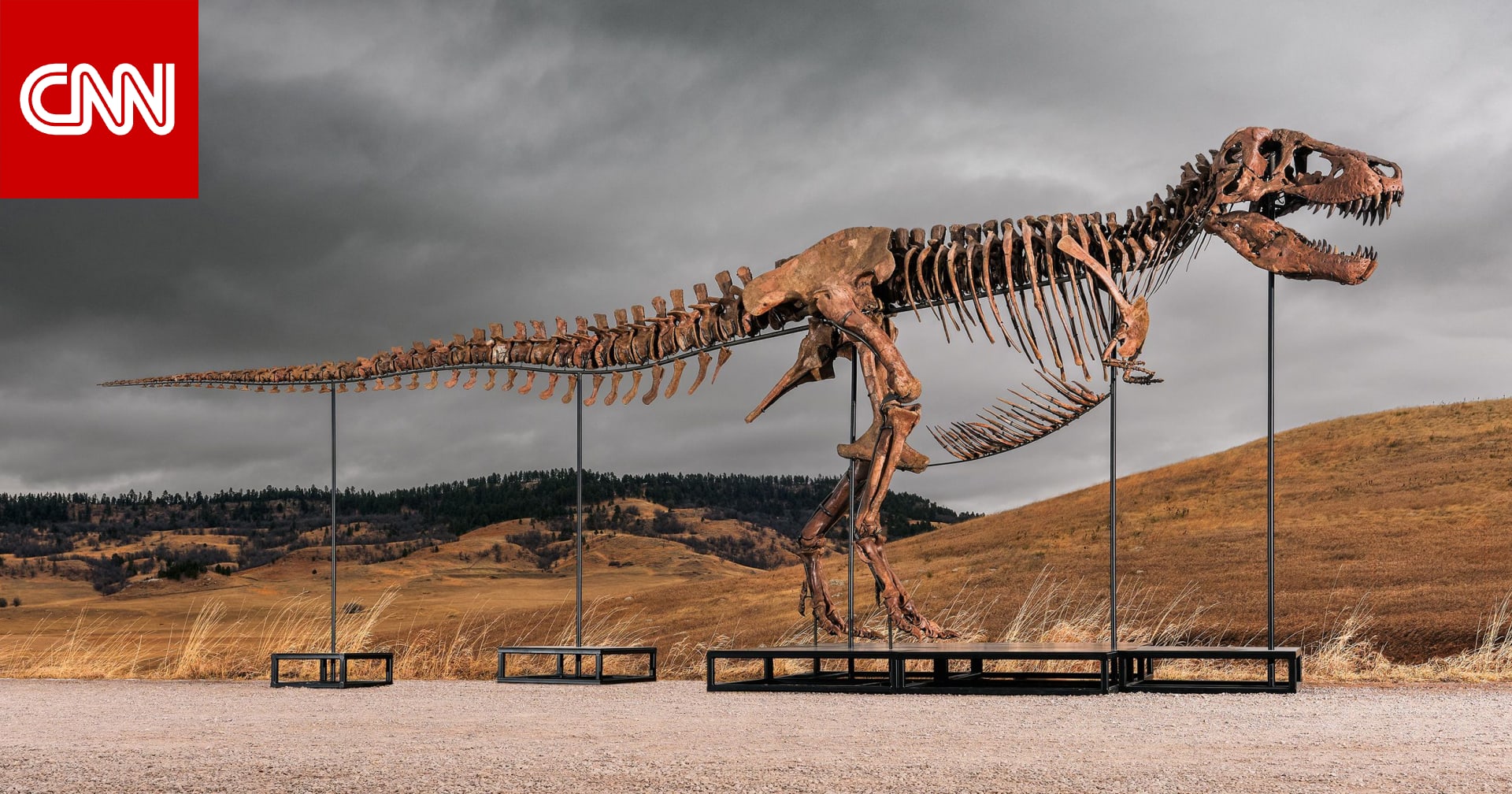
A Tyrannosaurus rex skeleton nicknamed "Gus" is being put up for auction by Sotheby's on Tuesday. Credit: Matthew Sherman/Courtesy Sotheby's
(CNN) -- Before his name was immortalized by being given to one of the largest predators to ever live on Earth, Gary "Gus" Licking, a rancher from South Dakota, believed his land held something extraordinary.
His ranch lies within the Hell Creek Formation, one of the world's most famous geological sites for discovering Tyrannosaurus rex fossils, where one of the earliest skeletons of this species was found in 1902.
In 2020, the skeleton of "Stan," a nearly complete Tyrannosaurus rex found near Licking's ranch, sold for $31.8 million, setting a record at the time.
Today, the Licking ranch name returns to the spotlight after the discovery of a new skeleton named "Gus" in his honor, scheduled to be auctioned by Sotheby's in New York City, where it could become the most expensive fossil ever sold.
But the sale of "Gus" could reignite the debate over private fossil ownership, as experts believe that these discoveries falling into private hands could deprive science and the public of studying them in the future.
The story of "Gus" began when Licking met commercial paleontologist Thomas Hitecamp, founder of Theropoda Expeditions, who was interested in the ranch's location within the Hell Creek Formation.
Hitecamp told CNN: 'The Licking ranch was of interest to me because of its location within the Hell Creek Formation. Gary was always interested in fossils and artifacts, and I think he knew how rich his land was in fossils, and he believed that one day an exceptional skeleton would be found.'
Hitecamp and his team discovered the "Gus" skeleton in 2021, after Licking identified its approximate location, but he died before the excavation was completed and never saw the discovery in its final form.
According to Sotheby's, "Gus" measures 11.6 meters in length and 3.8 meters in height, with a skull about 1.37 meters long. It contains 183 fossilized bones, making it 61% complete by bone count, or between 75% and 80% by mass, positioning it as one of the largest and most complete Tyrannosaurus rex skeletons ever discovered.
According to Sotheby's, "Gus" is one of the largest and most complete Tyrannosaurus rex fossils ever discovered. Credit: Matthew Sherman/Courtesy Sotheby's
Sotheby's said "Gus" is one of the most complete Tyrannosaurus rex skeletons, but less so than "Stan," which is about 70% complete by bone count, and "Sue," the first dinosaur fossil sold at auction in 1997, which is about 90% complete.
It added that "Gus" bears marks of bites and fractures that healed during the dinosaur's life, which may increase its scientific value.
Nevertheless, no scientific study has been published on "Gus," especially as most researchers refuse to study privately owned fossils. Hitecamp said that several researchers have informally examined the skeleton, but its sale — which is legal especially since it was discovered on private land — reignites the debate over fossil auctions and the potential disappearance of Tyrannosaurus rex skeletons from the public domain.
Stuart Sumida, a biology professor at California State University and president of the Society of Vertebrate Paleontology, said: 'If this fossil passes into private hands, the public may never see it again.'
He added that some private fossils are loaned to museums, while others disappear into private collections, explaining that they 'also will not undergo proper scientific study, as no reputable scientific journal will publish research based on a fossil that is not housed in publicly accessible collections.'
The society requires its members to study fossils that are in collections accessible to researchers, to ensure the same specimens can be examined in the future.
Record Sale Looms
Hitecamp said his team spent a year searching the Licking ranch before finding "Gus" in 2021 in a small valley where no bedrock was visible, which delayed its discovery.
He added: 'It was clear from the first moment that the fossil remains belonged to a Tyrannosaurus rex, and that is always an exciting discovery.'
The discovery, extraction, and preparation of this skeleton took about five years of field and laboratory work. Credit: Matthew Sherman/Courtesy Sotheby's
Hitecamp began his career documenting fossils at Bonhams auction house in Los Angeles, before founding Theropoda Expeditions in 2012. His team excavated "Gus" over three seasons between 2021 and 2023, able to work only five months a year due to frozen ground.
He said: 'We manually excavated an area of about 650 square meters to collect the remains, and natural cracks and the abundance of bones were among the biggest technical challenges.'
After excavation, the skeleton underwent laboratory work to clean the bones and complete missing parts, before being mounted in a predatory pose on a custom steel support.
"Gus" retains about 82% of its original skull bones and includes rare parts such as a complete pelvis and both feet. Sotheby's estimates its value at around $30 million, but that figure could rise after the sale of "Apex," a Stegosaurus skeleton, in 2024 for $44.6 million.
"Gus" comes with "full ownership rights," as it contains no parts from other skeletons. Cassandra Hatton, vice president of Sotheby's, said most Tyrannosaurus rex skeletons on display in museums are based on casts of "Stan," while "Gus" contains no elements from it, which may allow its owner to produce replicas in the future.
Hatton acknowledged that a formal scientific study of "Gus" is not possible, but said commercial excavation helps discover fossils that might otherwise be lost without such funding. She added: 'If these fossils are not excavated, they will be lost.'
In contrast, paleontologist David Hone argued that public institutions could do this job if landowners cooperate with them, noting that millions of dollars could be enough to discover similar skeletons at a lower cost.
Experts criticize the sale of important skeletons to private buyers, asserting that fossils only become true scientific specimens when preserved in museums and accessible to researchers.
The Society of Vertebrate Paleontology (SVP) said that loaning the "Apex" skeleton does not guarantee permanent access to researchers, and 3D digital models do not substitute for studying the original fossil.
Steve Brusatte, a paleontology professor at the University of Edinburgh, explained: 'Open science cannot rely on wealthy individuals deciding who can study a fossil and who cannot.'
He noted that museums cannot compete with auctions reaching $30 million or more, pointing out that some private sales of Tyrannosaurus rex skeletons have exceeded $50 million.
Kristi Curry Rogers, vice president of the society, explained that the debate over fossil auctions is not just about ownership, but about preserving unique records of Earth's history, stressing that losing access to these specimens means losing irretrievable information.
She added: 'Fossils of scientific importance are non-renewable records. Every specimen represents information that cannot be recovered if lost or if access becomes impossible.'
Original source: CNN Arabic



Comments (0)
Be the first to comment.