Convicted of Attempting to Kill Salman Rushdie Faces New Trial
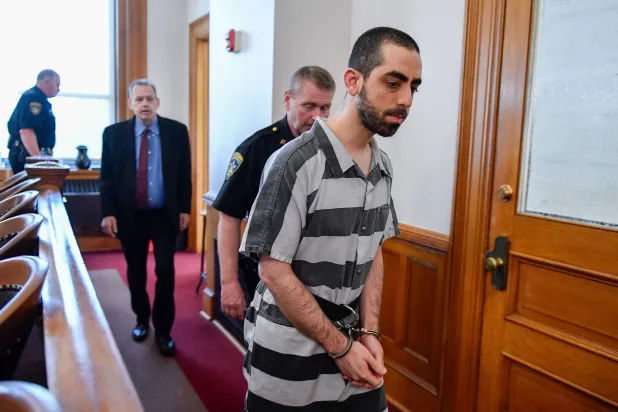
Hadi Matar, the American-Lebanese young man convicted of attempting to kill author Salman Rushdie, faces new charges in a federal terrorism case that deepens the investigation into the motives of the attack that targeted the globally renowned writer with a knife during a lecture in 2022.
Arguments in the new case began Wednesday before the federal court in Buffalo, New York, about 115 kilometers from the artistic and intellectual retreat where Rushdie was attacked.
Rushdie (79) was expected to testify about the details of the stabbing incident that nearly killed him and led to the loss of sight in one of his eyes, noting that he has recounted that moment and his long recovery period in his previous court testimonies, as well as in his memoir and numerous interviews.
During one of his interviews in 2024, Rushdie said: 'When you look at death closely—as close as you can get without going over to the other side— that feeling stays with you. It's like a shadow that hangs over the place.'
Salman Rushdie attends the opening of the documentary 'Knife: Attempted Assassination of Salman Rushdie' at the Sundance Film Festival in Utah on January 25, 2026 (AP)
Matar (28) is currently serving a 25-year prison sentence in New York for attempted murder and assault at the state level. That case largely focused on the details of the attack itself, while the federal case delves deeper into the motives of the crime.
Matar has pleaded not guilty to the federal charges against him, which include involvement in a cross-border terrorist act. If convicted, he faces life imprisonment.
Prosecutors believe Matar was acting out of loyalty to the Iranian government and Hezbollah.
The founder of the Islamic Republic of Iran, Ayatollah Ruhollah Khomeini, had issued a fatwa authorizing the killing of Rushdie for his novel 'The Satanic Verses,' published in 1988.
Matar's electronic devices contained information about that fatwa. Prosecutors stated in a court filing in 2025 that Matar kept sticky notes recording his research on Rushdie and the possible routes and locations to kill him. Federal agents also found in his bedroom in New Jersey pictures of Khomeini and his successor, the late Supreme Leader Ali Khamenei.
U.S. Deputy Assistant Attorneys General Timothy Lynch and Charles Crowley wrote in the filing that 'when he attempted to carry out the fatwa, he believed he was doing so on behalf of Hezbollah, which the U.S. government designates as a terrorist organization.'
Commenting on the case, Matar's defense attorney, Nathaniel Barone, said he intends to make a statement during the new trial.
In the years leading up to the trial, Matar's lawyers unsuccessfully tried to exclude some evidence from his social media accounts and other digital activity, arguing that the government's electronic searches were too broad.
Matar refused to testify at the state court, and it remains unclear whether he will testify at the federal court.
During the sentencing hearing in state court, Matar affirmed that he believes in freedom of expression, but he considered Rushdie a 'hypocrite' who 'wants to bully others.'
Matar was born in the United States to parents who emigrated from Lebanon, and he holds citizenship of both countries. His mother said he became moody and withdrawn after a trip to Lebanon in 2018.
Rushdie was born in India, raised in Britain, and is now a U.S. citizen. He won the Booker Prize in 1981 for his novel 'Midnight's Children.' But his fame peaked with his novel 'The Satanic Verses.'
Khomeini's 1989 fatwa forced Rushdie into hiding for years. Although Iran has not focused on the fatwa in recent years, it has never revoked it.
The Iranian government has denied involvement in the 2022 stabbing incident.
After his novel 'Knife,' which includes his memoir of the stabbing, Rushdie returned to writing, including a collection of stories titled 'Eleventh Hour' in 2025.
Original source: Asharq Al-Awsat


Comments (0)
Be the first to comment.