European Financial Support for Egypt Eases Repercussions of 'Iran War'
New European financial support for Cairo as the European Commission approves the transfer of the second instalment of the second tranche of the Egyptian budget support package worth €1.5 billion, about six months after disbursing the first instalment worth €1 billion, and two years after disbursing the first tranche.
This support, which comes within the macro-financial assistance package for Egypt worth €5 billion, is seen by an Egyptian banking expert who spoke to Asharq Al-Awsat as confirming the depth of relations between the two sides, and helping to ease the repercussions of the 'Iran war' that has led to a rise in the pound against the dollar again.
The European Commission approved on Friday the transfer of the second instalment of the second tranche of the package worth €1.5 billion, as part of the macro-financial assistance package for Egypt worth €5 billion, according to a statement by the Egyptian Foreign Ministry without specifying the date of receipt.
The first instalment of the second tranche worth €1 billion was previously disbursed in January 2026, along with the first tranche disbursed in 2024 worth €1 billion, within the framework of the strategic and comprehensive partnership between Egypt and the European Union approved in March 2024, according to the Egyptian statement.
Banking expert Mohamed Abdel Aal believes that the European Commission's decision to approve the transfer of the second instalment of the second tranche confirms the depth of cooperation between Europe and Egypt regarding economic support, noting that the flow of payments reflects confidence in the Egyptian economy and government policies.
The Egyptian Foreign Ministry stated in the same statement that the Commission's decision 'affirms the importance of this partnership in supporting the Egyptian state's efforts to achieve economic stability and advance sustainable development efforts, and also reflects the confidence the European Union places in Egypt's efforts to enhance regional security and stability.'
It explained that 'the past period witnessed intensive Egyptian contacts with various institutions of the European Union at all levels, aimed at securing the necessary support for implementing the various axes of the strategic and comprehensive partnership.'
The return of war between Washington and Tehran led to rises in the Egyptian pound against the dollar, surpassing 51 pounds after its decline during the period of war cessation.
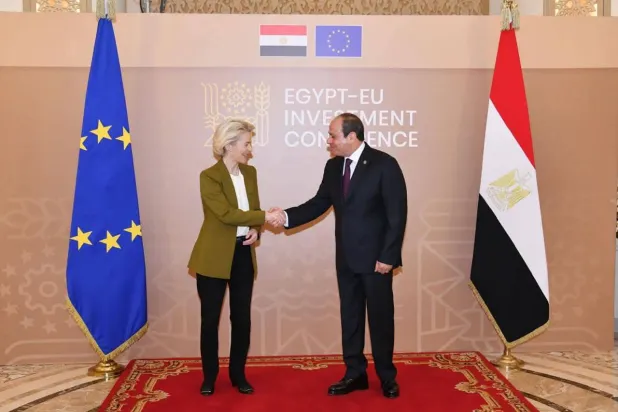
President Abdel Fattah El-Sisi during his meeting with the President of the European Commission on the sidelines of the 'G7 summit' in mid-last month (Egyptian Presidency)
The Egyptian currency had been enjoying relative stability in the previous few months and even before the Iran war, recording on February 16 its best level against the dollar in about two years at 46.64 pounds.
The banking expert believes that the arrival and receipt of this amount from the European Commission to Egypt would enhance the availability and diversity of foreign currency sources, which is vital under current circumstances that see some pressure on the Egyptian pound due to the uncertainty and surrounding geopolitical tensions with the return of war between Washington and Tehran.
He points out that the entry of one billion dollars at this time contributes to achieving a kind of balance in the face of the severity of pressures resulting from the exit of hot money due to geopolitical tensions and escalating uncertainty, and stresses that this is a very positive matter.
As for the sectors and priorities that will benefit from these funds, Mohamed Abdel Aal explained that 'the focus is currently on development operations in sectors related to exports, the energy sector, petrochemicals, and technology,' likely directing these funds towards all value-added productive sectors in the Egyptian economy.
Original source: Asharq Al-Awsat
Comments (0)
Be the first to comment.