Ethiopian accusations against Egypt over the 'Grand Ethiopian Renaissance Dam' deepen the crisis
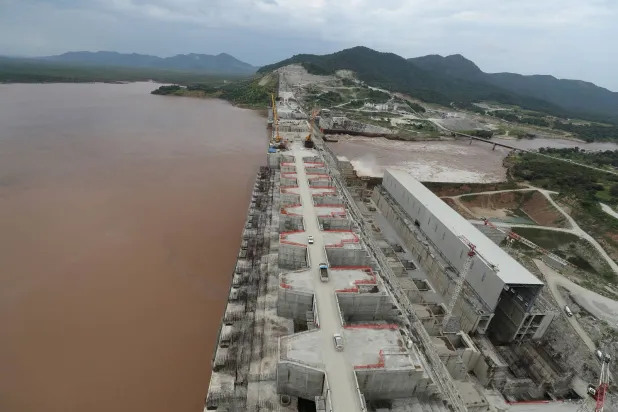
New Ethiopian accusations directed at Egypt regarding Cairo's persistent talk of 'unilateral actions' taken by Addis Ababa concerning the operation and filling of the 'Grand Ethiopian Renaissance Dam'.
Ethiopia has directed new accusations at Egypt regarding Cairo's persistent talk of 'unilateral actions' taken by Addis Ababa concerning the operation and filling of the 'Grand Ethiopian Renaissance Dam', amid Egyptian fears of damage to its water share, estimated at approximately 55.5 billion cubic meters.
These Ethiopian accusations, which come amidst American efforts to revive the negotiations on the 'Grand Ethiopian Renaissance Dam' that have been frozen between Cairo and Addis Ababa since 2024, are seen by experts who spoke to Asharq Al-Awsat as part of 'Ethiopian attempts to improve its image internationally and distract its domestic audience with the existence of an external threat.' They predicted that 'the crisis between the two countries will increase without hindering Washington's pressures to revive technical negotiations.'
The official 'Ethiopian News Agency' has intensified the publication of criticisms of Egypt regarding its position, which rejects the continued operation of the 'Grand Ethiopian Renaissance Dam', built on the Nile River—the existential lifeline for the Egyptian people—without prior coordination.
The agency quoted a member of the Ethiopian House of Peoples' Representatives, Mohamed Al-Arusi, on Thursday, as saying that 'repeated Egyptian accusations of Ethiopia acting unilaterally in the construction and operation of the Grand Ethiopian Renaissance Dam ignore historical facts, the established principles of international law, and the developmental rights of upstream countries in the Nile Basin, and express a persistent nostalgia for a phase that was based on exclusive hegemony over the Nile River.'
The agency also quoted, on Wednesday, an opinion piece by a lawyer named Al-Mariam, in which he considered that 'Egypt has used the term unilateralism along with other descriptions to tarnish Ethiopia's image, not only in global media, but also before the United Nations Security Council on numerous occasions,' asserting that 'the repetition of this narrative does not reflect a legal reality.'
Asharq Al-Awsat attempted on Thursday to obtain an official statement from Egyptian authorities regarding the Ethiopian accusations, but was unable to do so.
Cairo had announced the cessation of the negotiation path with Addis Ababa regarding the 'Dam' in 2024 after rounds that lasted for years, attributing this to 'the absence of political will on the Ethiopian side,' according to previous statements by the Ministry of Water Resources and Irrigation.
President Sisi meets his American counterpart on the sidelines of the G7 summit last month (Egyptian Presidency).
Following the Ethiopian government's inauguration of the 'Dam' project last September, Cairo condemned the move and sent a letter to the UN Security Council confirming that it 'will not turn a blind eye to its existential interests in the Nile River.'
Ambassador Salah Halima, Vice President of the 'Egyptian Council for African Affairs' and former Assistant Foreign Minister, believes that 'Ethiopia has been carrying out unilateral actions and imposing a fait accompli since the construction, filling, and operation processes, in violation of international law, which confirms that sovereignty over the Blue Nile is joint sovereignty for the three countries: Egypt and Sudan (downstream) and Ethiopia (upstream), and is not unilateral sovereignty.'
He emphasized that 'there must be close cooperation, joint management, and joint actions, not unilateral ones.'
Hussein El-Beheiri, an expert on African affairs at the 'National Center for Middle East Studies', indicates that 'the Ethiopian accusations are not the first of their kind within the framework of the political propaganda campaigns pursued by the Ethiopian government to achieve a set of goals.'
According to El-Beheiri, among the most prominent of these goals is 'an attempt to justify the policies and unilateral measures it adopts and carries out, in addition to using these statements for domestic consumption within Ethiopia and attempting to show the existence of an external threat to divert attention from internal crises, particularly in light of the ongoing ethnic violence in the northern regions of Tigray and Amhara.'
The Ethiopian accusations against Cairo come about a month after Egyptian-American presidential discussions regarding the Ethiopian dam.
President Abdel Fattah El-Sisi reiterated during his meeting with his American counterpart, Donald Trump, last June, 'the utmost importance of the Nile River issue as a national security issue for Egypt.' At the time, Trump indicated his 'understanding of all Egyptian concerns in this regard,' and emphasized that 'he will give this file the highest priority to resolve it fairly,' according to a statement by the Egyptian presidency at the time.
Cairo announced the cessation of the negotiation path with Addis Ababa regarding the 'Grand Ethiopian Renaissance Dam' in 2024 (Asharq Al-Awsat).
Recent times have witnessed American movement after about two years of suspended negotiations between Egypt and Ethiopia regarding the 'Grand Ethiopian Renaissance Dam'... In May, a phone call took place between Egyptian Foreign Minister Badr Abdelatty and the Senior Advisor to the US President for Arab and African Affairs, Massad Boulos, regarding the Ethiopian dam dispute and Egyptian water security.
During the same month, Boulos said via his account on the 'X' platform that 'productive and comprehensive meetings' had been held with an Ethiopian delegation led by Foreign Minister Gedion Timothewos, concerning the Nile River and the Grand Ethiopian Renaissance Dam.
In January, Trump sent an official letter to Sisi expressing Washington's readiness to resume the 'Grand Ethiopian Renaissance Dam' negotiations and reach a final and fair solution to the issue; this followed three discussions on the same matter in June and July 2025, in which he asserted that 'Washington financed the dam, and there must be a quick solution to that crisis.'
Halima attributes the Ethiopian campaign against Egypt to 'confronting American moves to revive the negotiations,' and confirms that it 'increases tension and deepens the crisis between the two countries.'
Meanwhile, El-Beheiri believes that 'these accusations lead to escalation between Egypt and Ethiopia and more political tension, rather than resolving these crises or settling existing disputes.'
Original source: Asharq Al-Awsat




Comments (0)
Be the first to comment.