Israelis Infiltrate Palestinian Village, Army Occupies It for Fear of 'Kidnapping'
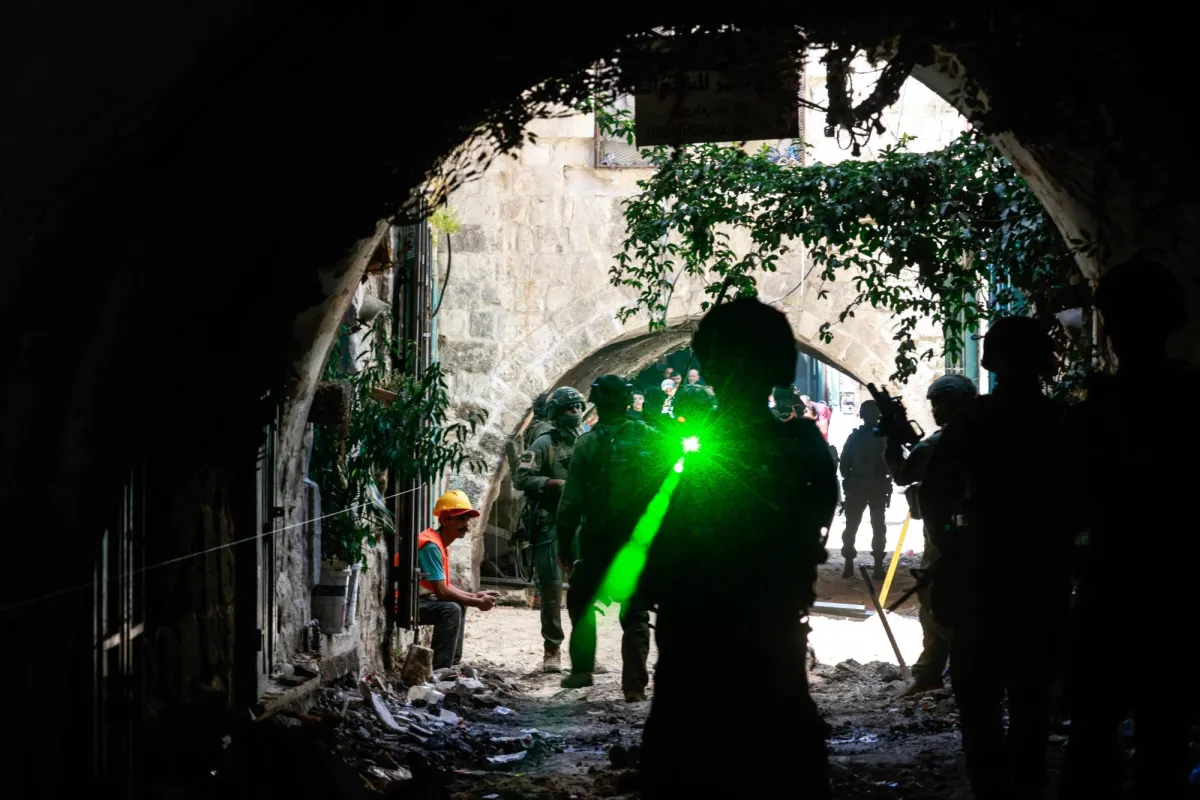
A Palestinian village was subjected to a 6-hour occupation during which Israeli army and intelligence forces searched for 10 religious Jews who had entered it.
The Palestinian village of Mukhmas was subjected to a 6-hour occupation early Thursday morning, during which Israeli army and intelligence forces searched for 10 religious Jews who had entered it.
The occupation operation was led by senior generals who considered it a serious security incident, but at the conclusion of the operation, it turned out to be an attempt by Jews who entered to pray at the Tomb of Joseph in Nablus in violation of instructions. They sparked panic in the corridors of military and political leadership.
According to a report by the Hebrew newspaper Ma'ariv, the incident occurred in the early hours after midnight, and at the conclusion of the operation, it became clear that 10 Haredi Israelis arrived from Israel to Nablus to pray at the Tomb of Joseph, a shrine that Jews believe is the tomb of the prophet Joseph, while Palestinians believe it is the tomb of a local saint.
Israeli soldiers stand on guard duty during a weekly settlers' tour in Hebron in the occupied West Bank on May 16, 2026 (Reuters)
The Israeli army withdrew from this shrine under the Oslo Accords, which stipulated the transfer of 40 percent of the West Bank area to the Palestinian Authority in the mid-1990s.
Jews consider the site a holy shrine, and they are allowed to enter and pray there, but under strict security arrangements, with the army escorting worshippers from the moment they enter until they return.
Infiltrated at night and claimed they were besieged
It seems the aforementioned ten Jews decided to violate instructions and not wait for an organized delegation; they infiltrated Nablus at 1 a.m. the previous night, performed prayers, and returned safely.
However, at that time, information reached the Israeli General Security Service (Shin Bet) that an Israeli transit van had entered the forbidden zone in Nablus, so an Israeli police car was sent to the location. When the Jewish citizens saw the police car, they fled from it at a crazy speed, and after traveling 60 kilometers, they entered the Palestinian village of Mukhmas, located southeast of Ramallah, driving at high speed and in a reckless manner, hitting Palestinian cars on the street, and disappeared into the village alleys.
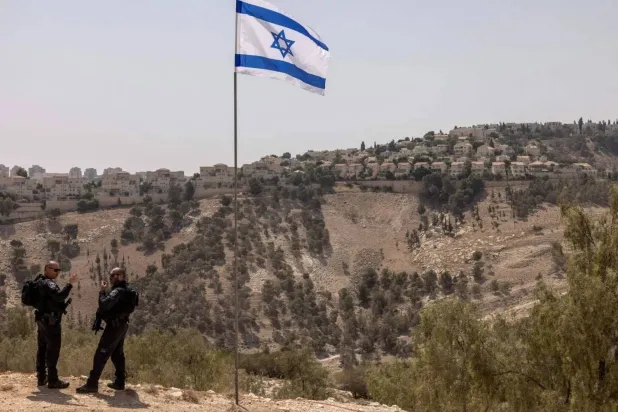
Two Israeli soldiers participate in escorting a weekly tour of Israeli settlers in Hebron in the occupied West Bank on February 14, 2026 (Reuters)
After a period of intelligence tracking, the vehicle was spotted and its owner identified. After checking the police computer, they contacted the owner, who tried to justify his action by saying he entered the Palestinian village by mistake, and claimed that he and his companions were being besieged by a group of Palestinians throwing stones at their vehicle.
Immediately, a major and serious security incident was declared, with fears it could turn into a kidnapping. A huge number of army, commando, and intelligence forces were mobilized, surrounding the Palestinian village of Mukhmas and setting up checkpoints at all its entrances and inside. They stopped cars and began abusing Palestinians to 'confess to the charge,' according to local testimonies. A combat helicopter and drones hovered over the village.
But the Israelis' vehicle had already left the village on its way to central Israel. In the morning hours, the army announced the end of the incident, and the religious Jews were detained for questioning, and the siege on the Palestinian village was lifted.
Palestinian Saoud al-Atrash hugs his mother as Israeli forces demolish the family home on Tuesday in southern Hebron in the West Bank on the pretext of lacking a building permit (AFP)
It is worth noting that the village of Mukhmas has, over the 60 years of occupation, been subjected to many incursions and attacks by Israeli soldiers, as well as by settler militias established with government encouragement.
During the past 30 years of Oslo, hundreds of Israelis have mistakenly entered Palestinian towns, and they were usually handed over to the Israeli army peacefully, except for some rare cases.
However, the Israeli army and intelligence believe that in the wake of the 'genocide war' in Gaza and the daily assaults in the West Bank, there are Palestinians planning revenge operations, such as kidnapping Israelis or carrying out bombings.
Israeli security forces are constantly on alert to confront such attempts. West Bank cities are closed with more than a thousand yellow iron gates that restrict citizens' lives, education, work, and medical services, and shackle movement from one town to another, making people's lives harsh, sometimes lacking basic sustenance, the simplest medical treatments, and minimal security.
The occupation authorities manage their policy in this regard amid constant panic and fear, and they crack down ruthlessly. Last week, there was a similar case when it was reported that police in the West Bank rescued an Israeli soldier from Palestinians in the town of Tarqumiya near Ramallah; it later turned out that a soldier had entered the town and quarreled with a Palestinian resident over a criminal matter. This also caused a massive military mobilization.
Israeli settlers and soldiers stand in a field while Palestinian farmers are prevented from picking olives in the village of Sa'ir near Hebron in the West Bank (Archive - AFP)
It is known that the Oslo Accords divided the West Bank into three main administrative and security areas. Area A includes the major Palestinian cities, such as Ramallah, Nablus, Hebron, and Jenin, and is under full Palestinian civil and security control. Area B is under Palestinian civil control and joint security control. Area C is under full Israeli control and includes settlements and military areas. Israeli Jews are prohibited from entering them under military orders, with warning signs placed at their entrances. If any Israeli enters, they receive a notification from the Waze app saying: 'Caution. You are entering an area prohibited for Israelis.'
); googletag.cmd.push(function() { onDvtagReady(function () { googletag.display('div-gpt-ad-3341368-4'); }); }); }
Original source: Asharq Al-Awsat



Comments (0)
Be the first to comment.