Japanese Prime Minister Sparks Controversy After Announcing Her Sleep Hours
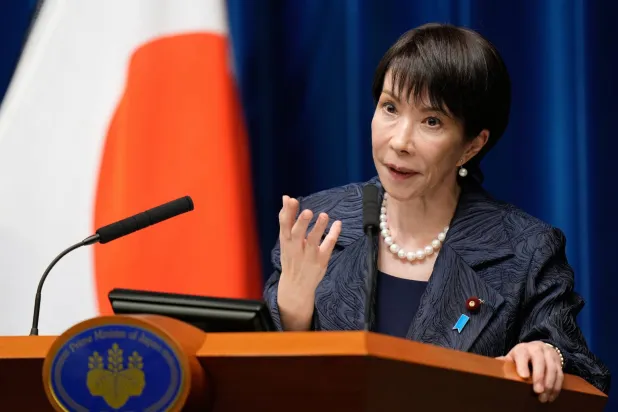
Japanese Prime Minister Sanae Takaichi has sparked controversy after stating that she sleeps only "zero to three hours" a night.
Japanese Prime Minister Sanae Takaichi sparked controversy following statements that she sleeps only "zero to three hours" a night, triggering widespread debate in the country regarding work-life balance.
Takaichi spent the weekend rereading policy documents and handling a backlog of thousands of emails, according to a social media post yesterday (Tuesday). She wrote that she got "a full five hours of sleep for the first time in a long time"—which is better than the "zero to three hours" she had grown accustomed to.
Takaichi said she spent her limited free time ironing underwear, sewing frayed skirts, and fixing loose jacket buttons, according to the New York Times.
The Japanese Prime Minister's post, which appeared to highlight her struggle with lack of sleep, elicited mixed reactions between supporters and opponents. Hiroyuki Konishi, a critic of Takaichi in parliament, called for her resignation, saying: "The prime minister's real job is to set policy directions and issue instructions, not to scrutinize every detail of documents."
Yuichiro Tamaki, leader of the Democratic Party for People, said at a press conference held yesterday: "Isn't it the duties of the supreme leader, in a sense, to distribute work so that one can focus on tasks that can only be done by the supreme leader?" He pointed to the option of outsourcing housework, adding: "I think she needs more rest. Why doesn't her team provide her with more support to create an environment that allows her to make important decisions with a clear mind?"
Controversy over Women's Work
The Japanese Prime Minister's post garnered more than 31 million views, bringing back to the forefront the debate on work-life balance and the impact of sleep deprivation on the performance of officials and decision-makers, according to the New York Times.
Some commentators argued that more support should be provided to Takaichi, Japan's first female prime minister. While former leaders often relied on their wives to help with household chores, Takaichi appeared to take on more domestic tasks, according to Yoko Iwama, a professor at the National Graduate Institute for Policy Studies in Tokyo.
Iwama wrote in Nikkei, a prominent business newspaper: "Establishing a support system that allows the Japanese Prime Minister to focus entirely on her duties—without having to handle housework personally—would contribute to the advancement of women in society."
In her post, Takaichi wrote at length about the volume of work she has accomplished recently. She said that since early July, "from early morning until late at night," she has spent her weekends at home "immersed in reviewing piles of documents." She also shared personal details, saying that she is "bad at ironing clothes and it takes a long time." However, she said that after an ironing session during the holiday: "I got enough handkerchiefs and underwear to last until the end of the parliamentary session." She wrote: "I will return to work in earnest starting tomorrow!"
In a related context, Takaichi's allies defended her, praising her frankness in presenting the pressures of balancing work and personal commitments. Ayano Kunimitsu, Vice Minister for Foreign Affairs, said that Ms. Takaichi, like other politicians, faces pressure to manage her affairs on her own. Kunimitsu wrote on the "X" platform: "Everyone has their own circumstances and hidden stories. I would appreciate your understanding."
Previous Criticisms of Takaichi
This is not the first time Takaichi has faced criticism over her work style; in November, she faced criticism after summoning aides to work at 3:00 AM, before clarifying that a malfunction in her home fax machine forced her to do so in preparation for an official meeting.
Takaichi has made strenuous efforts recently to pass her legislative priorities before the parliamentary summer break on Saturday. She also faces ongoing economic challenges, with the yen hitting a 39-year low, and a slight decline in her popularity, although her approval ratings remain relatively high.
Long Working Hours in Japan
Japan is famous for its long working hours, where the workday in some companies exceeds 12 hours. In both the private and public sectors, employees face pressure to stay in the office until their bosses leave and to log excessive overtime, which is seen as evidence of loyalty and diligence.
In recent years, Japan has witnessed prominent cases of "karoshi," or "death from overwork." The issue came to the fore in 2016 when Matsuri Takahashi, an employee at the advertising giant Dentsu, committed suicide after her overtime hours exceeded 100 hours a month. Her death prompted the government to impose a cap on overtime of 45 hours per month, which some experts believe has contributed to easing the pressure on work culture, particularly among young people.
Original source: Asharq Al-Awsat




Comments (0)
Be the first to comment.