"Keys Without Houses" Tells the Destruction in South Lebanon
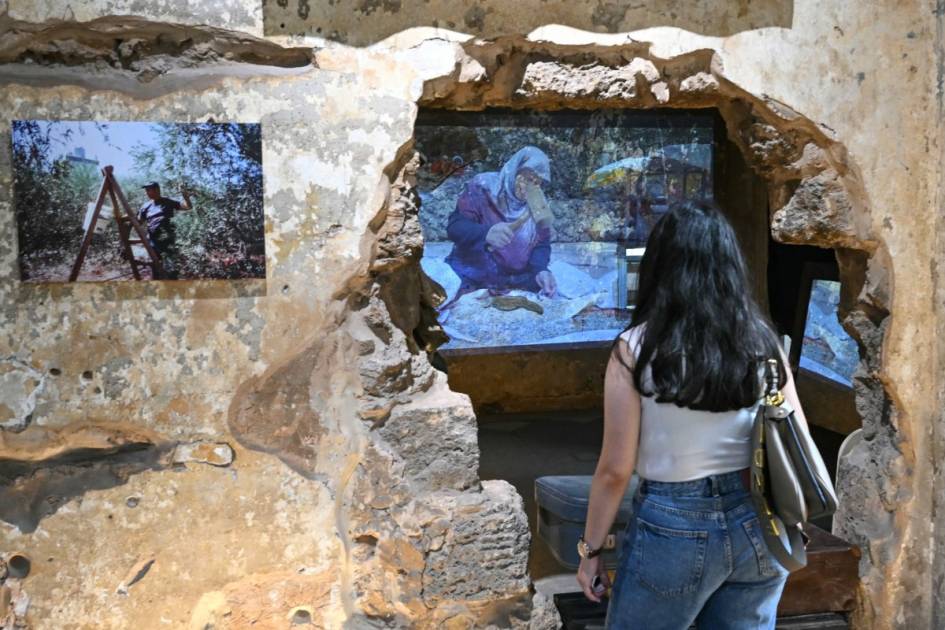
The exhibition includes works such as "What Remains", where designer and visual narrative researcher Sama Baydoun (29 years old) displays photos of her grandfather's house in the border town of Bint Jbeil.
Fatima Hajj Ali was overcome with tears as she stared at the ceiling during a visit to an art exhibition in Beirut, after finding in the keys dangling from it—all that remains of homes destroyed by Israeli strikes in southern Lebanon—a reminder of a wound that has not healed.
Hajj Ali (23 years old) told AFP, wiping away her tears, 'We should have returned and opened the door of our house with it, but there is no longer a door.'
Like tens of thousands of Lebanese, the home of Hajj Ali, who hails from the town of Nabatieh al-Fawqa in southern Lebanon, was destroyed in the two rounds of war that Israel fought with Hezbollah between 2023 and 2026.
The war destroyed dozens of towns and villages almost completely. Despite the decrease in the pace of fighting after the understanding signed by Iran and the United States in mid-June, Israel continues to launch raids from time to time and carries out demolition operations of buildings and facilities in the areas it occupies.
"We are the new Palestinians"
The Israeli state prevents residents of areas under its control from returning, and many rely on photos to find out the fate of their homes. In contrast, many residents of areas that Israeli forces did not enter are briefly inspecting them, without returning to live there for now.
Hajj Ali, currently residing in Beirut, visited her hometown for the last time in April. She said, 'Half the house collapsed and half remained,' but 'my room is still there with some belongings left in it.' She added, 'The idea that we cannot enter the village or the house is very painful.'
The young psychotherapist does not hide her longing for her former daily life as she walks through the exhibition 'Tell Me, O South,' which revives the memory of southern Lebanon through an archive of photos and video clips. The exhibition is held at 'Beit Beirut,' a heritage building turned into a museum of memory, bearing the scars of the civil war between 1975 and 1990.
Read more
Washington in South Lebanon... Guarantor, Coordinator, or Partner in Implementation?
Netanyahu from South Lebanon: We Will Not Leave Until the Threat is Gone
Israel Orders Its Army to Prepare for a 'Long Stay' in South Lebanon
A Shepherd Found Them... Tragic Fate Closes File of 4 Missing in South Lebanon
Hajj Ali was contemplating a work at the exhibition called 'Keys Without Houses,' which includes, through audio and video clips, testimonies of three people from southern Lebanon who kept keys to their homes that no longer exist.
The creator of this work, Adeeb Farhat (36 years old), also from southern Lebanon, says the idea came to him during the war in 2024, when he feared losing his home. He told AFP that the work explores people's relationship with keys as a symbol of home and memory.
He explains, 'I was haunted throughout by the question: What will become of my house? Will it be bombed? And how will my relationship with my house key change? Will we become the new Palestinians?' referring to the keys carried by hundreds of thousands of Palestinians after their displacement into exile following the establishment of Israel in 1948, which became their only link and memento to their vanished homes.
"Very simple, very beautiful"
The exhibition redraws the features of rural homes in southern Lebanon and the lives of their inhabitants, from bedrooms and living rooms to kitchens with glass jugs, coffee pots, and spice bottles. It includes an old photo of the coastal city of Tyre, a black-and-white video of the city of Nabatieh, in addition to notebooks in which visitors wrote their memories of the south.
A girl wrote on one of them, 'I miss the south.'
The exhibition includes works such as 'What Remains', where designer and visual narrative researcher Sama Baydoun (29 years old) displays photos of her grandfather's house in the border town of Bint Jbeil.
While a technical glitch caused most of the photos to appear blurry, it made them look like a 'dream,' according to Baydoun, who lives in Paris. She explains, 'I was trying to tell the story of a person going to visit his grandparents in a threatened place.'
The young woman, who last saw her grandfather's house in 2025 before it was destroyed, adds, 'I remember how many people this house gathered, how my family grew up in it, how many generations it witnessed and saw life change, while some things remained constant. Every Sunday we would gather and have the same lunch meal.' She continues, 'Life was very simple, but it was very beautiful.'
In a photographic work titled 'Lines of Alienation,' photographer Rawan Mazzeh (29 years old) presents the story of a couple who were prisoners in a detention camp set up by Israel in the town of Khiam in southern Lebanon during its occupation of these areas between 1978 and 2000.
The 'South Lebanon Army,' a local force created by the Israeli state, administered this camp, where non-governmental organizations denounced torture and severe violations.
Mazzeh believes the exhibition provides 'a comfortable place where people can come and feel close to their land,' given their inability to return to the south.
Original source: Independent Arabia



Comments (0)
Be the first to comment.