Khamenei's Funeral: How It Revealed 'Cracks in the System' in Iran?

The funeral of Iran's Supreme Leader Ali Khamenei displayed temporary unity among elites but highlighted deep divisions, especially the absence of his successor Mojtaba Khamenei. The event underscored a power struggle between pragmatic and hardline factions over negotiations with the US, amid severe economic pressures and a shift toward collective leadership.
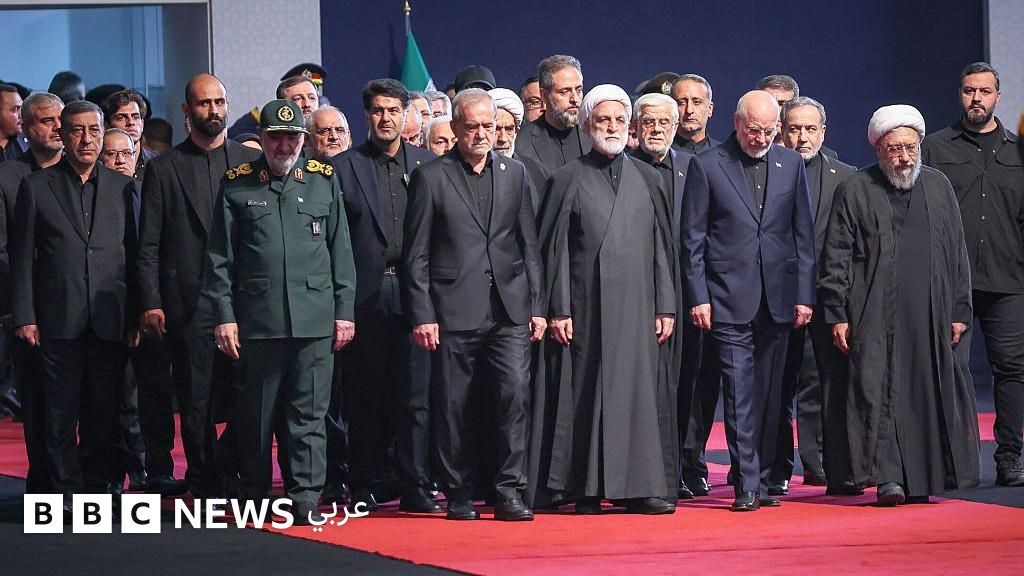
The funeral procession for Iran's Supreme Leader Ali Khamenei displayed a temporary gathering of a political and military elite suffering from deep divisions, amid growing questions about the absence of his successor, the new Supreme Leader Mojtaba Khamenei, from the public scene since his rise to power last March.
Senior officials and military leaders, who had not appeared together publicly for weeks, walked side by side during the ceremony. The scene was led by President Masoud Pezeshkian, Parliament Speaker and chief negotiator Mohammad Baqer Qalibaf, the head of the judiciary, and top generals of the Revolutionary Guard, in a move by funeral organizers to project the 'unity and continuity' of the regime.
However, the absence of Mojtaba Khamenei highlighted the fierce behind-the-scenes struggle over the management of the country and decision-making, especially regarding diplomatic negotiations with Washington.
According to sources from the American 'New York Times', the absence of the former Supreme Leader, who monopolized the final decision, led to an explosion of differences within the Iranian conservative camp, branching into two main wings: the pragmatic current comprising Pezeshkian, Qalibaf, and Secretary of the Supreme National Security Council General Mohammad Baqer Zolqadr, supported by some Revolutionary Guard leaders.
This wing pushes for a 'grand deal' with Washington, including a ceasefire and the complete lifting of the naval blockade to rescue the deteriorating economy.
The other wing is the hardline minority that rejects any political or nuclear concessions to the US administration, demands military retaliation and prolonging the confrontation, accusing the negotiating team of 'collusion and treason'.
unmute
Iran's Frozen Assets: How Is the Mechanism for Releasing Any Part of Them?
Behind the Scenes of the Agreement
Four responsible sources in Tehran told the 'New York Times' that Mojtaba Khamenei's decision to agree 'in principle' to proceed with understandings with Washington came under severe economic pressures.
The sources reported that Pezeshkian informed the new Supreme Leader in a closed meeting that the US naval blockade 'paralyzes the country' and that he intends to resign if the agreement is rejected.
Central Bank Governor Abdolnaser Hemmati reinforced this stance with a warning letter stating that stocks of basic food and medical supplies face the risk of depletion by the end of next August, due to the inability to export oil and the difficulty of finding alternative trade channels.
These pressures led the Supreme National Security Council to vote with a majority of 12 votes against one in favor of accepting the agreement and starting direct talks with US officials, including Vice President JD Vance.
Related News
Collective Leadership and Media Fracture
Recently, there has been a noticeable shift in Iran's governance structure toward 'collective leadership' compared to the absolute rule exercised by Khamenei the father.
In a statement reflecting this shift, Vice President for Executive Affairs Mohammad Jafar Ghaem Panah told government officials that the new Supreme Leader's opinion 'is subject to discussion and study like other officials,' asking: 'If we are only required to implement the Supreme Leader's views, why do we have a parliament and a National Security Council?'
This coincided with a struggle over official platforms, as live television broadcast was suddenly cut off from Qalibaf while he was presenting details of the ceasefire agreement, amid repeated attacks by state television on the negotiating team.
Video clips also recorded Foreign Minister Abbas Araghchi being subjected to harassment and hostile chants from Iranian visitors while he was in Iraq to organize the external part of the mourning ceremonies.
In a related context, Iranian military sources attributed the continued absence of Mojtaba Khamenei from view to 'extreme security concerns'.
Officials said that security agencies rejected a request from the Supreme Leader to lead the funeral prayer in the city of Mashhad, scheduled for July 9, for fear of Israeli assassination attempts or tracking his secret residence.
Observers and political figures in Tehran believe that the main test of the sustainability of 'absentee rule' will be in the expected package of appointments after the funeral, which includes the heads of the judiciary, the broadcasting authority, the Basij forces, and the office of the Supreme Leader, where the identity of the appointees will determine which wing the new Supreme Leader leans towards.
Original source: Sky News Arabia


Comments (0)
Be the first to comment.