Kidney patients in Gaza cry out to save them from "slow death"
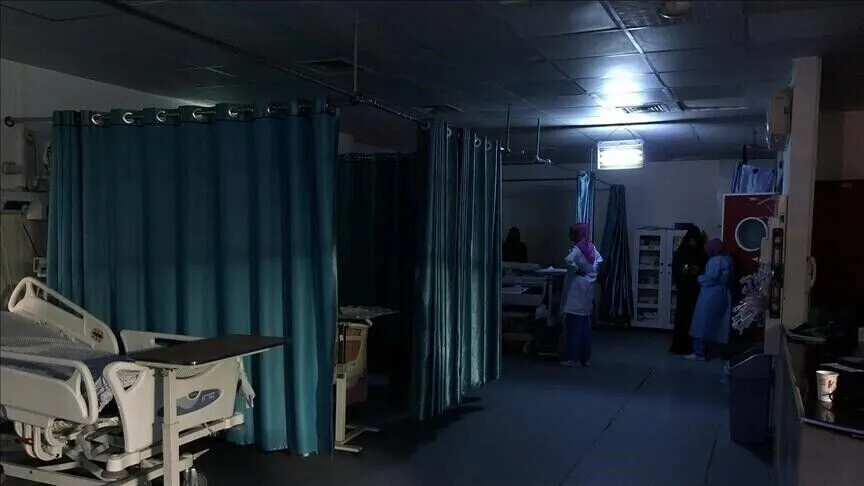
Gaza/ Husni Nedim/ Anadolu
During a vigil at Al-Aqsa Martyrs Hospital in Deir al-Balah city in central Gaza Strip, they demanded the opening of crossings, the entry of medicines, and allowing patients to travel for treatment.
A medical official told Anadolu: 43% of kidney failure patients in Gaza have lost their lives since the start of the Israeli genocidal war on Gaza.
Kidney failure patients in the Gaza Strip cried out on Thursday to save them from "slow death," amid the ongoing Israeli genocidal war on Gaza and the blockade imposed on the Strip.
That came during a vigil organized by the Follow-up Committee of the Palestinian National and Islamic Forces at Al-Aqsa Martyrs Hospital in Deir al-Balah city in central Gaza Strip, where participants demanded the entry of medicines and medical supplies, and allowing patients to travel for treatment.
Participants raised banners calling for saving kidney patients and lifting the blockade on the Gaza Strip, warning of the deterioration of their health conditions due to the shortage of medicines and the disruption of part of kidney dialysis services.
Nabil Ziad, representative of the Follow-up Committee of the National and Islamic Forces, said in a speech during the vigil that the patients "are paying the price of the continued blockade."
Ziad called on the international community and the sponsors of humanitarian agreements to "pressure Israel to abide by international law, allow patients to travel for treatment, and bring in necessary medical supplies."
He added that protecting patients is "a duty imposed by international humanitarian law," calling for intensified popular and international efforts to save them.
For his part, Palestinian Omar al-Banna, one of the kidney failure patients, said that they face extremely difficult health conditions due to the shortage of essential medicines, especially the medications and hormones needed to treat anemia associated with kidney failure.
Al-Banna told Anadolu correspondent that he has been waiting for more than a year and a half to travel to complete his treatment outside the Gaza Strip, despite having obtained a medical referral.
He pointed out that "many patients need weekly blood transfusions due to declining hemoglobin levels."
He appealed to the international community and Arab countries for "urgent intervention," saying that the continuation of the current situation "means losing more patients."
For his part, Khalil al-Daqran, spokesman for Al-Aqsa Martyrs Hospital, told Anadolu that "43% of kidney failure patients in the Gaza Strip have lost their lives since the start of the war, due to the shortage of medicines and medical supplies."
He pointed out that "about 50% of the devices and equipment needed to operate kidney dialysis units have stopped working, which directly affected the services provided to patients."
Al-Daqran stressed that "the continued shortage of medical supplies threatens patients' lives," calling for "urgent international intervention to ensure the entry of urgent medical needs and the continued operation of kidney dialysis units in the Strip."
This comes at a time when medical institutions in the Gaza Strip face a severe shortage of equipment, devices, medicines, and medical supplies, due to the Israeli genocidal war on Gaza since October 8, 2023, during which it targeted Ministry of Health facilities and its vehicles, according to human rights and official reports.
The war, with American support, has resulted in the killing of more than 73,000 Palestinians and the injury of more than 173,000, in addition to widespread destruction that affected about 90% of civilian infrastructure, while the United Nations estimated the reconstruction cost at about $70 billion.
Original source: Anadolu Agency

Comments (0)
Be the first to comment.