Palestinian Presidential Committee Warns of Rising Settlement Activity and Threat to Christian Presence
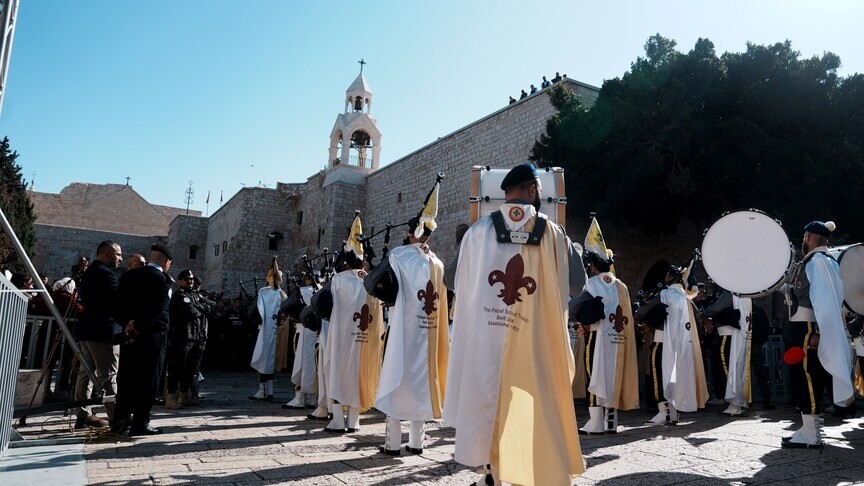
In a message addressed to heads of churches worldwide, in light of a decision to approve the establishment of 34 new settlements in the West Bank, including 6 in Bethlehem...
Husni Nadim / Anadolu
The Supreme Presidential Committee for Church Affairs in Palestine warned on Sunday of the escalating pace of Israeli settlement in the occupied Palestinian territories and its threat to the historic Palestinian Christian presence in the Holy Land.
The committee said in a message addressed to heads of churches worldwide that settlement policies, land seizure, and development restrictions weaken the resilience of Palestinians, including Christians, and threaten the preservation of the continuous Christian presence in the Holy Land for two thousand years.
It added that these warnings come in light of the disclosure of a declassified decision by the Israeli Security Cabinet approving the establishment of 34 new settlements in the occupied West Bank.
It pointed out that among those settlements are six in the Bethlehem Governorate, along with allocating more than 2.3 billion shekels ($760 million) to accelerate the implementation of the settlement project, relocate settlers, and build the necessary infrastructure.
The committee stressed that the decision represents 'an advanced stage of a systematic policy aimed at imposing permanent facts on the occupied Palestinian land.'
It warned that settlement plans in the Bethlehem Governorate aim to expand and connect settlement blocs, isolate the cities of Bethlehem, Beit Jala, and Beit Sahour from their Palestinian surroundings, and seize agricultural lands, including lands owned by Palestinian Christian families.
It added that the settlement project is not limited to urban expansion but aims to reshape the geographic and demographic reality in the occupied Palestinian territories by linking settlements to road networks and services, in violation of international law and the Fourth Geneva Convention, and in contradiction with the advisory opinion issued by the International Court of Justice in 2024.
In July 2024, the International Court of Justice issued an advisory opinion concluding that 'Israel's presence in the occupied Palestinian territories, including the West Bank, East Jerusalem, and the Gaza Strip, is illegal,' calling on Israel to 'end its occupation as quickly as possible and stop settlement activities.'
It also called on all states and international organizations 'not to recognize the situation arising from the occupation or to provide any support that contributes to its continuation.'
The Palestinian Presidential Committee called on heads of churches worldwide to assume their spiritual, historical, and moral responsibilities, take a clear stance rejecting settlement expansion, annexation policies, and the imposition of facts on the ground, and work to protect the Palestinian Christian presence and defend international law, to achieve a just peace that preserves the rights of the Palestinian people.
The United Nations and most countries of the world consider Israeli settlements built on occupied Palestinian territories illegal under international law and see them as undermining the chances of a two-state solution.
The Israeli movement Peace Now estimates that there are about half a million settlers in the occupied West Bank, in addition to about 250,000 in settlements built in East Jerusalem.
Palestinians see such steps as part of an accelerated Israeli policy to impose facts on the ground through expanding settlements and confiscating land, hindering the establishment of an independent Palestinian state.
Original source: Anadolu Agency


Comments (0)
Be the first to comment.