Battle of Hastings: The Day That Changed England's History Forever
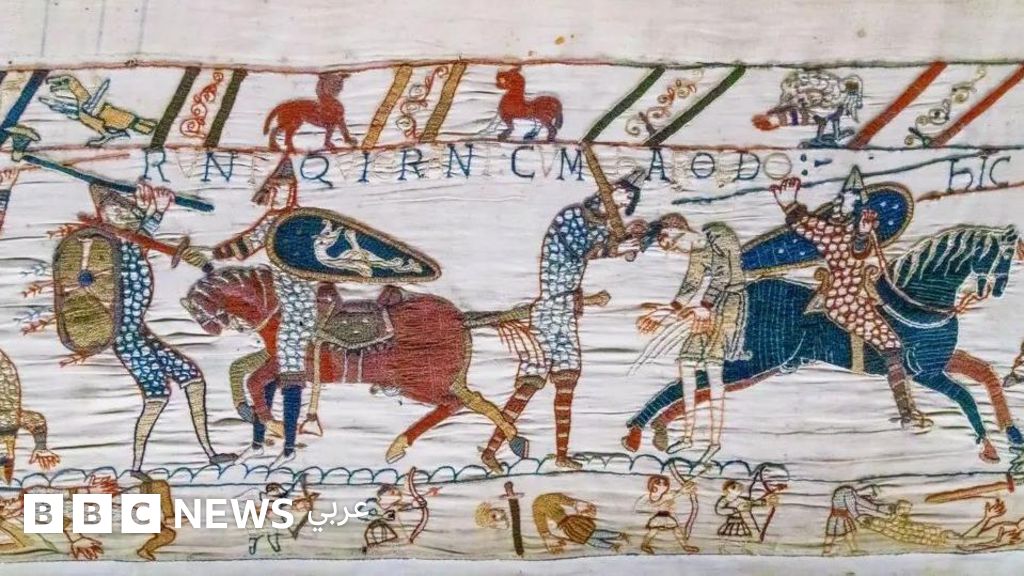
With the Bayeux Tapestry returning to Britain for the first time in nearly a thousand years, we tell the story of one of the most famous battles in history, and how it changed the English language, politics, and society to this day.
Battle of Hastings: The Day That Changed England's History Forever
Image caption, The 'Bayeux Tapestry' will be displayed in London next September
Article Information
Author, Walid BadranRole, BBC
Published 3 minutes ago
Reading time: 11 minutes
The Bayeux Tapestry has returned to the United Kingdom for the first time in nearly a thousand years, a historic event seen as the symbolic return of the piece to the place where it is believed to have been originally made in England during the 11th century.
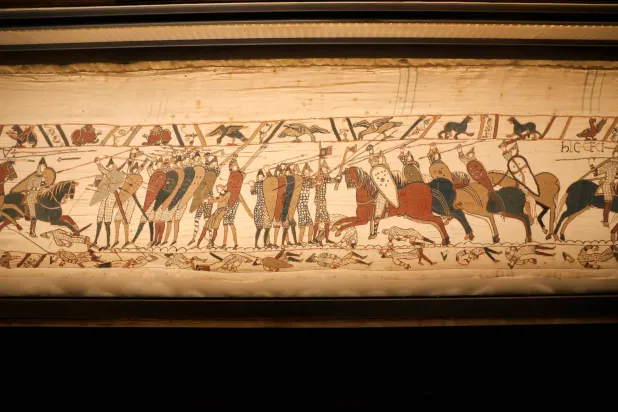
The Bayeux Tapestry is one of the most important artistic and historical works to have survived from the Middle Ages. Despite its name, it is not a tapestry in the traditional sense, but a long piece of linen embroidered with colored wool threads, about 70 meters long, dating back to the 11th century.
The tapestry contains 58 scenes, 626 characters, and 202 horses, in addition to ships, swords, spears, and arrows, telling in detail the story of the Battle of Hastings and the Norman conquest of England in 1066, an event that radically changed the course of the country.
The tapestry arrived at the British Museum after being transported from a secret location in northern France under police guard. It was placed inside a huge box surrounded by an aluminum frame specially designed to protect it during the journey, and was unloaded from the truck in front of a limited number of attendees, including the French ambassador to the United Kingdom and the director of the British Museum.
In a symbolic gesture of gratitude, the British Museum displayed the word 'Merci' (meaning 'thank you' in French) on the famous White Cliffs of Dover, in appreciation of France for lending this historic piece.
Who was the 'Virgin Queen' Elizabeth I and why was her reign a golden age for England?
What is the Magna Carta, and how did it establish the principles of human rights and democracy?
French President Emmanuel Macron described the loan of the tapestry as 'a gesture of trust and a tangible embodiment of the historic friendship between France and the United Kingdom, and a shared desire to build the future of both countries together.'
For his part, British Museum director Nick Cullinan said that the arrival of the tapestry represents 'an exceptional event,' adding that its return to England for the first time in nearly a thousand years is a historic occasion that the museum is happy to share with the public.
The Road to Hastings
Image caption, The British Museum displayed the word 'Merci' (thank you) on the White Cliffs of Dover
The Battle of Hastings, which took place on October 14, 1066, is one of the most influential battles in the history of England and Europe during the Middle Ages.
Skip most read and continue reading
Iran targets vital sites in Kuwait and the Revolutionary Guard warns countries hosting US forces on their territory
With orange lips and a roar-like call... a new monkey discovered in the Congo forests
Egypt's Future Authority: State withdrawal from the economy or a reshaping of its role?
This is our last chance to defeat the rising right in Britain – The Guardian
Skip podcast and continue reading
Worth attention
An in-depth explanation of the most prominent events and topics, to help you understand the most important changes around you and their impact on your life
Episodes
Podcast end
On that day, the army of the English King Harold Godwinson met the army of the Norman Duke William, Duke of Normandy (a region in northwestern France), in a decisive military confrontation that ended with a Norman victory and the death of the English king, beginning a new phase that changed the political, social, and cultural shape of England.
Information about Britain
The battle was not merely a struggle for the throne, but a turning point that ended six centuries of Anglo-Saxon rule after the Romans, and opened the door to the Norman era, which left a deep impact still present in the language, political system, and British culture to this day.
The story began with the death of King Edward the Confessor on January 5, 1066, who had no children. During his reign, he exploited the absence of a clear heir to the throne as a means of political bargaining.
In 1051, after his conflict with Godwin, Earl of Wessex and the most powerful man in England at the time, it is likely that Edward appointed William, a distant relative, as a possible heir to the throne, according to the Encyclopaedia Britannica.
After Godwin's death in 1053, his son Harold Godwinson became Earl of Wessex, spending the following years strengthening his political influence and gaining the support of nobles and clergy.
According to Norman accounts, including the Bayeux Tapestry, Harold, the brother-in-law of Edward, later swore an oath of allegiance to William and pledged to support his claim to the English throne. But upon Edward's death, the throne passed to Harold, who was crowned king the next day with the support of English nobles. Harold claimed that Edward the Confessor had bequeathed the throne to him on his deathbed.
Image caption, Part of the Bayeux Tapestry showing King Edward the Confessor giving instructions to Harold
For his part, William saw Harold's coronation as a betrayal of a previous promise, and began preparing a military campaign to assert his claim to the throne.
By that time, William controlled, either directly or through alliances, most of the ports from the Scheldt River to Brest. His father-in-law, Baldwin V, Count of Flanders, was regent of the throne of France, while Geoffrey III, Count of Anjou, his most dangerous neighbor, was preoccupied with an internal rebellion.
After obtaining the blessing of Pope Alexander II and broad political support, William began equipping his army. He managed to convince the Norman barons to support him, and also gathered thousands of volunteers from Brittany, Maine, France, Flanders, Spain, and Italy.
Organizing the supplies and means of transport for this diverse army, as well as imposing discipline and military unity, were among William's greatest military achievements.
As for Harold, he began his preparations to defend the kingdom, mobilizing his fleet and army in May, and managed to repel the raids of his exiled brother Tostig on the southern and eastern coasts.
But his plans were complicated by William's delay in crossing due to adverse northerly winds, so the Norman ships remained in the ports for about eight weeks.
In the meantime, Harold's forces lost morale due to the long wait and lack of supplies, so he disbanded his troops on September 8, and the English ships returned to the River Thames, thus leaving the English Channel open for William.
The Norwegian Invasion
Image caption, Part of the Bayeux Tapestry showing the coronation of King Harold by Archbishop Stigand
At the same time that William was preparing to cross the English Channel, another threat to the English throne emerged from the north.
Harald Hardrada III Sigurdsson, King of Norway and one of the claimants to the English throne, allied with Tostig Godwinson, brother of King Harold who had entered into a political conflict with his family, and entered the Humber River at the head of a large fleet of about 300 ships.
There, the Norwegian forces faced the army of Edwin, Earl of Mercia, and his brother Morcar, Earl of Northumbria, at the Battle of Gate Fulford near the city of York on September 20, 1066. The battle ended with a Norwegian victory, but it weakened their forces later.
When King Harold learned of this invasion, he immediately left London with his royal guard known as the Housecarls, and what he could gather of local nobles and county troops.
Original source: BBC Arabic





Comments (0)
Be the first to comment.