Mauritania: Opposition Mobilizes Supporters Against Inflation and Corruption
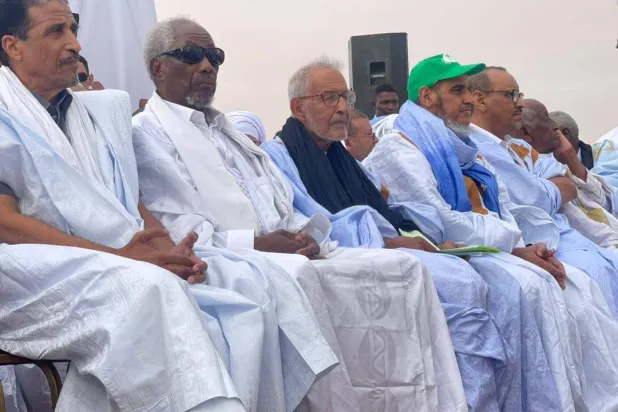
Mauritanian opposition called on its supporters to protest on Sunday against what it says is 'the high cost of living and rising prices' and 'the spread of corruption.'
Cairo and Ramallah discussed on Saturday ongoing preparations for mobilizing international support for the Palestinian Authority during the international donor conference scheduled for next week.
These consultations coincided with Egyptian-European talks aimed at 'creating international support for the Palestinian Authority not only on the funding level, but also in cementing the existence of Palestine as a future independent state, despite ongoing Israeli escalation,' according to member of the Egyptian Council for Foreign Affairs, former assistant foreign minister, Ambassador Mohamed Hegazy, in an interview with Asharq Al-Awsat.
The Egyptian Foreign Ministry reported on Saturday that a phone call took place between Foreign Minister Badr Abdelatty and Palestinian Prime Minister Mohammed Mustafa, where the two sides exchanged views on developments in the Gaza Strip. The call also covered ongoing preparations for the donor conference scheduled to be held in Brussels during this July.
Abdelatty affirmed 'Egypt's full support for the Palestinian government and the importance of mobilizing international financial support for the Palestinian National Authority to enable it to fulfill its responsibilities, provide basic services to the Palestinian people, contribute to strengthening their resilience, and support stability in the Palestinian territories.'
Hegazy believes that 'the preparations for the Brussels meeting to mobilize international support for the Palestinian Authority come at a pivotal moment in Middle East developments, where the tracks of a ceasefire in Gaza, American efforts to launch new security and regional arrangements, and Arab endeavors to restore the Palestinian cause as the real gateway to regional stability intersect.'
He stresses that reducing the donor conference to an occasion for providing financial aid to the Palestinian Authority strips it of much of its strategic significance, noting that the importance of the Brussels conference goes beyond funding, as it becomes a clear political message that the international community still sees the Palestinian Authority as the legitimate institution capable of managing the Palestinian territories, along with a parallel message to Israel that weakening the Palestinian Authority is no longer an acceptable option.
About a week ago, the European Union spokesperson in Jerusalem, Shadi Othman, told Voice of Palestine Radio about the start of preparations for the international donor conference on July 12, with the aim of mobilizing support for the two-state solution and financial backing for the National Authority.
These statements came the day after a visit by the European Commissioner for Mediterranean Affairs, Dubravka Suica, to Ramallah, as part of a regional tour to discuss the European-Palestinian partnership and the current situation in the Gaza Strip and the West Bank.
A girl rests on a rope securing a tent in a temporary camp for displaced Palestinians in the Nahr al-Bared area of Khan Younis (AFP).
The Palestinian Prime Minister at the time emphasized to Suica that 'the financial and economic siege poses a serious threat to the ability of Palestinian institutions to continue, as Israel continues to illegally withhold Palestinian tax revenues, amounting to about $6 billion, in addition to freezing about $5 billion more in Palestinian bank funds that the Israeli central bank refuses to accept, costing the Palestinian economy a loss of up to $11 billion annually.'
The Palestinian cause was present at the table of political consultations between the Egyptian Foreign Minister and the European Commissioner for the Mediterranean, Dubravka Suica, according to a statement by the Egyptian Foreign Ministry on Saturday.
Abdelatty affirmed 'the importance of refocusing international efforts on the Palestinian cause, to prepare the conditions for completing the full implementation of the obligations of the first phase of US President Donald Trump's peace plan – which began in October 2023 – and moving to the second phase.'
Meanwhile, Hegazy believes that Egyptian and European moves confirm that supporting the Palestinian Authority has become part of the equation for rebuilding the region, not just a response to a financial crisis, as one cannot talk about a more stable Middle East while Palestinian institutions collapse, and long-term economic and security alliances cannot be built while Gaza remains devastated.
The Egyptian role stands out as the most consistent with the requirements of the stage. Since the outbreak of the war, Cairo has refused to separate the humanitarian track from the political track. It has stressed that a ceasefire must be coupled with a reconstruction plan, empowerment of the Palestinian Authority, preservation of the unity of the West Bank and Gaza Strip, rejection of displacement, and launching a serious political process ending in the establishment of an independent Palestinian state. Today, Egypt is moving in the same direction by supporting the Brussels conference as a foundational step paving the way for a larger international conference for the reconstruction of Gaza once the ceasefire is solidified, according to Hegazy.
The member of the Egyptian Council for Foreign Affairs stressed that the real challenge is not in raising billions of dollars, but in building an international will that turns these resources into a historic opportunity to relaunch the Palestinian national project, revive the two-state solution, and reintegrate the Palestinian cause into the core of new regional security arrangements.
He explained that the upcoming conference will either be the beginning of a transition from 'conflict management' to 'peacebuilding,' from 'temporary relief' to 'sustainable development,' and from reactions to an integrated strategic vision, or it will remain just a fleeting financial station in a series of recurring crises.
Original source: Asharq Al-Awsat


Comments (0)
Be the first to comment.