Merz Carries Out Government Reshuffle Before Tough Electoral Test
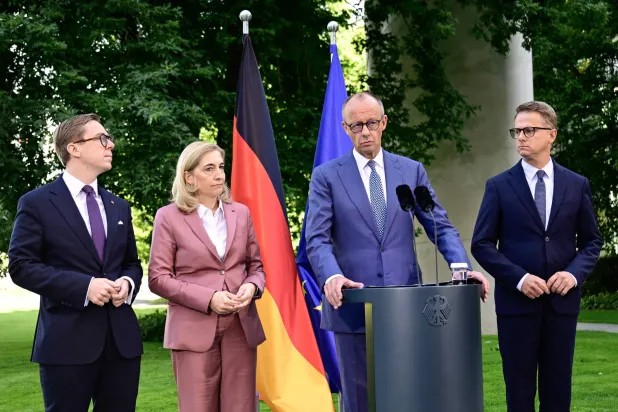
German Chancellor Friedrich Merz announced a government reshuffle, in an attempt to halt his party's dramatic decline ahead of local elections in which the far-right is making unprecedented gains.
In an attempt to halt his party's dramatic decline, on the eve of local elections in which the far-right is making unprecedented gains, German Chancellor Friedrich Merz announced a government reshuffle he hopes will restore some credibility to the coalition he has led for nearly 18 months. Germany's governing coalition, which includes Merz's Christian Democratic Union and the Social Democratic Party, has seen a sharp drop in popularity since the elections held in February last year.
Although Merz won by promising to rescue the country from economic decline, he has not achieved much since entering the chancellery. The repercussions of the Iran war and the closure of the Strait of Hormuz have exacerbated the crisis of rising oil and gas prices and inflation in Germany, with the German government failing to address the increasing cost-of-living pressures on the population. Amendments introduced by the government to the health insurance and old-age pension systems have further fueled public anger against it.
Crisis of confidence
In recent days, the government has also been suffering a crisis of confidence with voters, after Jens Spahn, the leader of Merz's parliamentary group, was forced to resign following a personal scandal that affected his credibility. Earlier, Berlin's mayor, Kai Wegner, also a member of Merz's party, was forced to withdraw from the race ahead of the local elections scheduled for September 20, after his credibility declined due to his handling of a power outage that left tens of thousands in western Berlin without electricity for days during a severe snowstorm last February.
German Chancellor Friedrich Merz is suffering a sharp decline in his popularity (dpa)
Merz tried to distance himself from Wegner and also exploited his ally Spahn's resignation to introduce a government reshuffle, hoping today to give his party a boost on the eve of local elections in three states, including Berlin, especially since the Alternative for Germany party is making unprecedented gains in all states. The far-right party hopes to win a majority that would allow it to govern alone in the eastern state of Saxony-Anhalt, one of its strongholds, where polls show it receiving 41 percent of the vote so far in the elections.
After Spahn's resignation, Merz appointed the head of the Chancellery, Thorsten Frei, as leader of the parliamentary group, and replaced him with Health Minister Nina Warken, making her the first woman to hold the position.
Merz also appointed another ally, Carsten Linnemann, as Health Minister, announcing further changes in the coming days.
German newspapers, including the widely circulated Bild, had reported that Merz would also replace Transport Minister Patrick Schnieder due to dissatisfaction with his performance. However, Merz did not announce that in the press conference he held in the morning to announce the changes.
Bild reported that Schnieder himself informed ministry employees that he had received a message from the chancellor telling him that he would be dismissed, but it appears that Merz has not yet found a replacement, after the person he wanted to appoint backed out at the last minute.
Merz's government had announced a massive budget for modernizing infrastructure, including roads, dilapidated bridges, and railway tracks.
Bild reported that Schnieder caused surprise with earlier statements in which he spoke about a lack of funds for necessary reforms, which increased Merz's dissatisfaction with his performance.
The government allocated that transport budget as a compromise between the two parties in the ruling coalition, after the Social Democratic Party demanded increased infrastructure spending in exchange for approving the military spending increase that Merz pushed for.
Merz's decline in popularity
Opinion polls conducted in recent months have shown Merz's popularity dropping to record lows, along with declining support for the governing coalition, which no longer holds a majority, according to polls if elections were held now.
Alice Weidel, leader of the far-right Alternative for Germany party, with Ulrich Siegmund, the party's lead candidate in the upcoming local elections in Saxony-Anhalt (AFP)
The leader of the Alternative for Germany party exploited Merz's announcement of a government reshuffle to call for early elections. She wrote on her account on platform X that 'self-absorption does not meet the requirements for dealing with the many problems the government has caused for itself in the country.' She concluded by saying that 'Germany needs new elections.'
Alice Weidel's far-right party leads in opinion polls for the federal elections with 26 percent, while Merz's party gets no more than 24 percent, and the Social Democratic Party is in third place with 14 percent.
Although all German parties refuse to form a coalition with the far-right party, whether at the federal or local level, its winning more than 40 percent could mean that the parties will no longer be able to ignore it or keep it out of power for long.
"); googletag.cmd.push(function() { onDvtagReady(function () { googletag.display('div-gpt-ad-3341368-4'); }); }); }
Original source: Asharq Al-Awsat



Comments (0)
Be the first to comment.