Mineral water story stirs uproar in Egypt
); googletag.cmd.push(function() { onDvtagReady(function () { googletag.display('div-gpt-ad-3341368-3'); }); }); }
Summary
An uproar has erupted again over mineral water in Egypt after two young men aired a video comparing types of mineral water, claiming some are contaminated with sewage. They said they relied on Egyptian standard specifications and tests covering three main axes: the first for microbiological tests, the second for color, odor, and pH, and the third for analyzing salt content in the water. According to their presentation, samples showed bacterial contamination, poor hygiene, storage, and sterilization, failure to meet standard specifications, and even fecal contamination from human and animal intestinal waste in some bottles.
Followers of the "Al-Akeelans" page on YouTube did not expect that the videos they used to watch for food product evaluations, which served as a source of information, could turn into a cause for a wide controversy in Egypt leading to the arrest of its creators.
The page, run by two Egyptian young men, quickly gained wide interaction and spread due to its analyses comparing food products, using pseudonyms and changing simple words so followers could identify the products without explicit mention, in an attempt to avoid legal action from companies.
After publishing several videos covering various products and pointing to possible safety issues, and with the uproar caused by some videos about bottled mineral water, Egypt's Interior Ministry announced the arrest of the page's operators.
The ministry said in a statement posted on Facebook, "As part of uncovering the circumstances of a number of video clips circulating on social media, it was found that content creators were trying to question the safety of food products and their suitability for use."
The Interior Ministry statement added, "Upon inspection, the two individuals appearing in the videos were identified, and upon confrontation, they admitted to conducting analyses of some food products in a number of laboratories to increase viewership and achieve financial gains."
Sympathy with the accused
Comments on the ministry's post poured in, reaching about 25,000 comments from followers. Although posts on the page usually receive praise in cases of arrests, many expressed sympathy with the accused, raising questions about the reasons for detaining the two young men, considering that they provide content based on test results and aim to raise public awareness.
Some followers saw that viewership and profit from these videos do not constitute a crime, while others asked about the more important issue of the accuracy of information about contaminated mineral water and the charges against the two young men. A segment of the public believed that the analysis should be conducted in accredited government laboratories, and that arrests should occur only after verifying the safety of products.
Quickly, Health Ministry spokesperson Hossam Abdel Ghaffar stated in a television interview that the Health Ministry is aware of the mechanisms it uses for analysis and announces them transparently, and is certain of the results of its tests and the safety of products it licenses through the Food Authority, as well as the accuracy of its laboratories and staff.
But on the other hand, relevant authorities periodically announce the seizure of counterfeit products. According to local media just hours earlier, supply campaigns in Assiut revealed the seizure of large quantities of spoiled goods, confiscating 2,331 kilograms of meat, chicken, liver, minced meat, and poultry products, including meat slaughtered outside official slaughterhouses and poultry unfit for human consumption.
Legal stance
Egyptian lawyer Ahmed Moseilhi told Al-Monitor that publishing videos with pseudonyms is not condemnable, but if it is proven that the content is targeted without evidence, the penalty for publishing could be up to six months. He added that the criterion for publishing is verifying the accuracy of information or relying on a judicial ruling or accredited report, and that using pseudonyms may protect the content creator from legal liability if no explicit accusation is made.
In contrast, founder of the National Center for Poison Control Mahmoud Amr stressed in a statement that defaming any company without accredited research and analyses is a crime, and any claims about spoilage or adulteration of products must be supported by official analyses from accredited laboratories affiliated with the Ministry of Health or Agriculture. If problems are proven, they can be referred to specialized judicial authorities.
The uproar specifically arose after the two young men aired a video comparing types of mineral water, claiming some are contaminated with sewage. They said they relied on Egyptian standard specifications and tests covering three main axes: the first for microbiological tests, the second for color, odor, and pH, and the third for analyzing salt content in the water. According to their presentation, samples showed bacterial contamination, poor hygiene, storage, and sterilization, failure to meet standard specifications, and even fecal contamination from human and animal intestinal waste in some bottles.
Widespread seizures
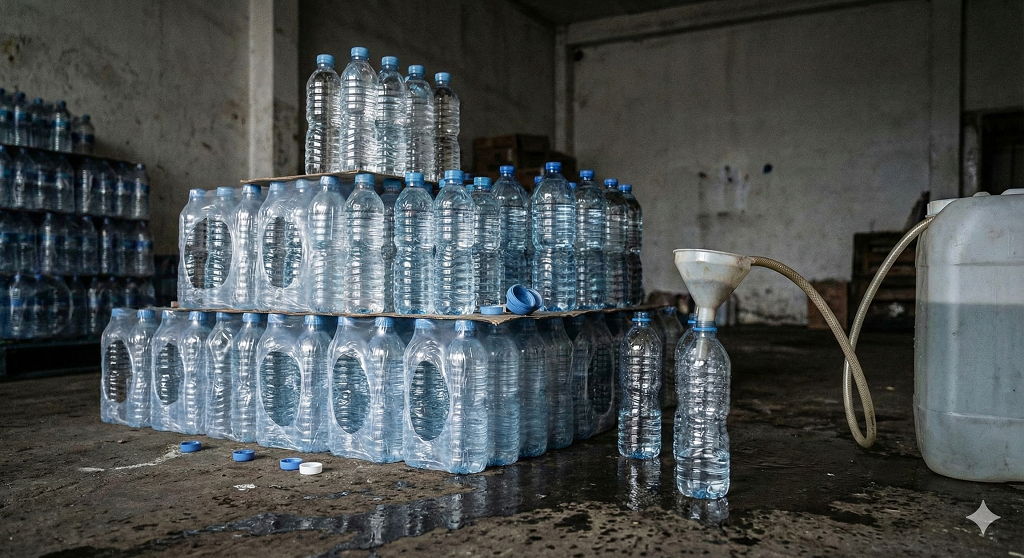
Al-Monitor revealed in an investigation published in July 2024 that there is weak oversight of mineral water in Egypt. According to experts who spoke to the newspaper, much of the mineral water in Egypt is not actually mineral water but bottled water, mostly either groundwater or from ordinary taps that are boiled, cooled, and have nutritional supplements added, requiring sanitary conditions for storage and preservation. Some of these factories, according to them, do not comply with standards, necessitating strict oversight.
Read more
This section contains related articles, placed in the Related Nodes field
There are multiple methods of fraud and adulteration in the bottled water market. Among these is an incident from February of last year when the Beheira Supply Directorate seized 6,000 bottles of mineral water of unknown origin during a campaign on markets in Kafr El Dawwar city. Water adulteration operations in Egypt are known as "back-alley factories."
In August 2024, a factory in Matrouh was seized operating without a license, reusing empty mineral water bottles and filling them with water to resell. A report from the province's Health Directorate showed that the water used was unfit for drinking due to the presence of fungi and impurities.
About three years ago, inside an unlicensed factory in Al-Marg, 13,000 mineral water bottles of various sizes were found, all of unknown origin and without documents indicating their source, along with 2,000 empty bottles ready for filling and large quantities of labels. Prior to that, regulatory bodies of Egypt's Ministry of Supply and Internal Trade had seized a famous factory for filling water bottles with ordinary tap water.
The circulation of adulterated water was not limited to remote areas; its products reached one of Egypt's most tourist-attractive cities. A campaign targeting bottled water companies in Sharm El Sheikh in May last year resulted in the seizure of 3,670 gallons of water, weighing 70 tons, at one of the city's water companies for violating Egyptian regulations and laws, as these stations imitated packaging of major companies to fill natural drinking water.
Original source: Independent Arabia




Comments (0)
Be the first to comment.