From 'Devil's Island' to a Haven for Rare Seals: How Nature Changed the Face of a Greek Island
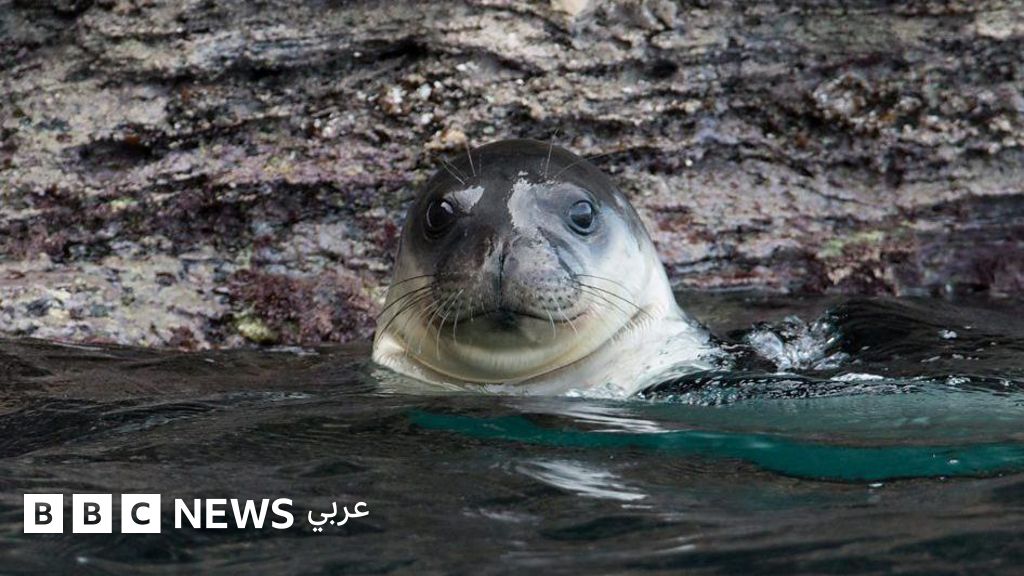
A Greek island, once a prison and military shooting range, has been transformed by its long isolation into a rare haven for wildlife.
From 'Devil's Island' to a Haven for Rare Seals: How Nature Changed the Face of a Greek Island
Image caption, A Mediterranean monk seal looks toward the photographer from the waters of Gyaros island.
Published 3 hours ago
Reading time: 9 minutes
For half a century, the island of Gyaros remained closed to the world, after being used as a military prison and naval shooting range. Then a stunning image changed everything.
The sun is already high above the speedboat when Gyaros appears on the horizon, like a barren mass in the middle of the Aegean Sea.
As we approach, a huge red-brick building appears, the prison that earned the island the nickname 'Devil's Island'.
The journey here takes only half an hour from the island of Syros, the administrative center of the Cyclades, located southeast of the Greek mainland. From there, you can sail in any direction to reach typical Greek islands like Mykonos or Andros, where white houses spread across hillsides like sugar cubes spilled from a bowl, ferries arrive on schedule, and bars open their doors.
But Gyaros seems to know none of that. Visitors see only rocky gravel and wild shrubs, and it appears empty, almost lifeless. Yet it is not.
The story goes back to one of the darkest and most violent periods in Greek history. An authoritarian regime, followed by the use of the island for military training, kept it away from development projects, turning it into a forgotten relic of a turbulent past.
Then, in 2004, an unexpected image brought attention back to this seemingly desolate place, but for completely different reasons.
It turned out that 'Devil's Island' had transformed into a wildlife sanctuary, providing a safe haven for a rare species of seals that was then threatened with extinction.
No males for 100,000 years: The fish that baffled evolution theory
Are flowers the most cunning and deceitful creatures in nature?
'Devil's Island'
Image caption, The island was used for military training and remained untouched by development projects
Gyaros has long been associated with isolation, violence, and punishment, having been used as a place of exile for political prisoners since Roman times. But its most brutal chapter began in 1948, when the Greek state confiscated the properties of its last 31 residents and turned the island into a prison.
Skip most read and continue reading
Washington ends 'punitive' strikes on Iran for eighth night, Tehran responds with 'extensive' attack on US sites in Kuwait
With orange lips and a roar-like call... New monkey discovered in Congo forests
World Cup: England wins bronze medal for first time after big 6-4 victory over France
World Cup: England's first bronze medal, Mbappé all-time top scorer in World Cup history
Skip podcast and continue reading
Worth paying attention to
In-depth explanation of the most important events and topics, to help you understand the key changes around you and their impact on your life
Episodes
End of podcast
While neighboring islands were building small luxury hotels, Gyaros was completely closed to the outside world. During two waves of political repression, more than 20,000 Greeks were sent there, most of them communists, writers, students, and artists who protested against the ruling authority.
During the first wave of arrests in the late 1940s, after the end of the Greek Civil War, prisoners were forced to live in tents amid scorching summers and freezing winters, and were made to build the prison walls with bricks by hand.
After a period of suspension, the island experienced a second wave of arrests during the military dictatorship known as the 'Regime of the Colonels', between 1967 and 1974.
Officially, Gyaros was presented as a correctional institution where opponents were rehabilitated to become 'true Greeks'. But in reality, it was a place of forced labor and torture, away from the eyes of critics.
After the fall of the junta in 1974, the Greek navy used the island as a bombing range until 2002. To this day, there are no hotels, ferry lines, or permanent residents.
Thus, Gyaros, almost by accident, received the strongest possible form of protection: the absence of humans.
A haven for seals
After the Greek navy stopped its activities on the island, fishermen began talking about sightings of Mediterranean monk seals in the waters around Gyaros.
Then came the image that changed everything. It was taken by an amateur spear fisherman in the early 2000s, and showed a female monk seal and her pup lying on an open beach in broad daylight, a scene that had almost disappeared from the Mediterranean.
Biologist Panos Dendrinos, from the Hellenic Society for the Study and Protection of the Monk Seal, a research group based in Athens, says: 'I personally had never seen such a scene before in Greece. The picture looked like it came from ancient times.'
Once widespread, the Mediterranean monk seal population globally declined by the end of the 20th century to only between 350 and 450 individuals.
For centuries, they were hunted for their fur, meat, and blubber, while coastal urban expansion destroyed their natural habitats, and some fishermen killed them in retaliation after they entered their nets and fed on trapped fish.
Classified then as critically endangered, the surviving seals became ghost-like, retreating to remote sea caves to raise their pups away from humans.
The fisherman's image prompted scientists to organize the first research expeditions to Gyaros, where they discovered a large colony of about 70 adult seals, possibly the largest in the Mediterranean at the time.
But what truly amazed experts was not the size of the colony, but the seals' behavior, as they were seen nursing their pups on open beaches.
Image caption, A spear fisherman captured this image of Mediterranean monk seals on Gyaros in 2004, which was a starting point for systematic research on the island.
Spiros Kotomatas, a biologist and senior marine conservation officer at WWF Greece, who was then working with the Hellenic Society for the Study and Protection of the Monk Seal, says: 'That was their natural behavior. Seals elsewhere were acting like Athens residents: tense and on constant alert. On Gyaros, they were calm and relaxed.'
It is not precisely known how long the seals have been settled on the island, but Kotomatas believes that its long isolation provided favorable conditions. Despite thousands of prisoners passing through Gyaros, human presence remained limited to a confined area, as the camps occupied only a small part of the coast.
He adds that disturbances remained intermittent even during the period when the island was used as a bombing range, and were mainly concentrated in southeastern Gyaros, far from the areas the seals had taken as refuge.
He says: 'Seals are adaptable. I once entered a cave while a speedboat was passing right next to it. The noise was so loud that I couldn't hear anything anymore, but the seal remained asleep.'
Most importantly, the navy's presence made fishing in the area undesirable, providing the seals with a food-rich area.
Original source: BBC Arabic




Comments (0)
Be the first to comment.