Moroccan Official: Technology and Early Warning Lead Fight Against Forest Fires
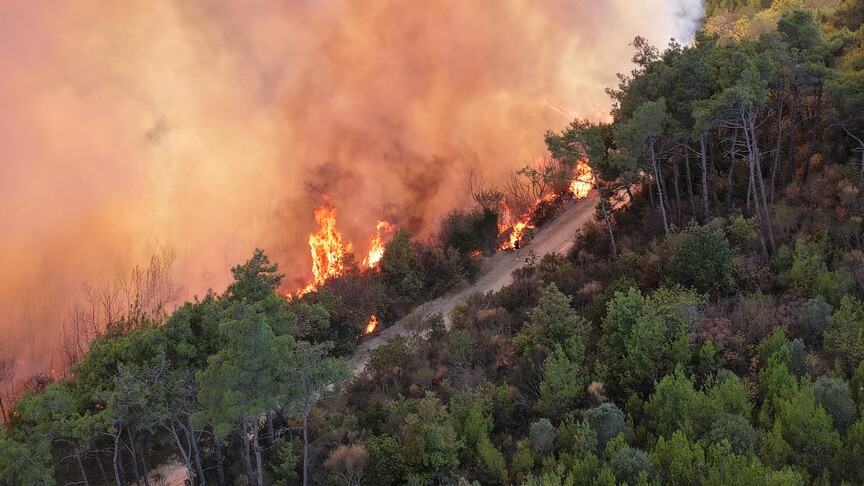
Mohamed Boutahir, an official at Morocco's National Agency for Water and Forests, said the country's top tools for confronting the fire season are drones, an early warning system, field intervention plans and awareness campaigns.
RABAT / Anadolu
Mohamed Boutahir, official at the National Agency for Water and Forests:
- We rely on drones to monitor fires from their first moments.
- We rely on an early warning system to assess forest fire risks, based on analysis of climatic conditions and vegetation cover.
- Mobilizing forest guards and intervention vehicles is part of a proactive plan to tackle fires.
- Citizen awareness and early reporting are key elements in reducing forest fires.
Mohamed Boutahir, official at the National Agency for Water and Forests, said the country's top tools for confronting the fire season are drones, an early warning system, field intervention plans and awareness campaigns.
Large areas of Morocco are experiencing a heatwave that increases the risk of forest fires, prompting reliance on modern technology and early warning systems to detect fires before they spread, as part of a proactive plan to reduce human and environmental losses.
In an interview with Anadolu, Boutahir said technology has become an essential part of the forest fire prevention system.
He explained that the National Agency for Water and Forests uses drones to monitor fires from their first moments, track their development and direction of spread.
He pointed out that these means provide accurate field data that help intervention teams develop more effective plans, contributing to controlling and extinguishing fires as quickly as possible.
The system is not limited to aerial monitoring; Morocco also relies on an early warning system to assess forest fire risks, managed by the National Agency for Water and Forests, based on analysis of climatic conditions and vegetation cover, according to Boutahir.
He added that the system issues periodic maps identifying the most fire-prone areas, where the red level indicates extreme danger, while the orange level indicates high risk requiring maximum caution.
In this context, on July 5, the agency called on residents of areas adjacent to forests in 12 provinces (out of 75) to exercise caution, after classifying them among the areas most susceptible to fire outbreaks.
Among these provinces: Essaouira, Agadir, Taroudant (south), and Taza, Ifrane, Taounate, Nador, Berkane, Taourirt, Jerada, Khénifra, and Al Haouz (north).
These measures come at a time when Morocco's General Directorate of Meteorology warned of a heatwave hitting several areas of the country, with temperatures expected to reach 46 degrees Celsius in some areas, due to the hot 'Chergui' wind coming from the south.
** Race against time
According to the Moroccan official, preparations are not limited to monitoring and warning, but extend to enhancing field readiness before fires break out.
He said the agency has taken a number of measures, including 'mobilizing forest guards, preparing and maintaining fire retardants, as well as equipping and positioning a number of initial intervention vehicles, in coordination with local authorities and other partners, foremost among them civil protection.'
He explained that the aim of these measures is to reduce response time, allowing fires to be contained before they spread and limiting their losses.
In the past few days, some fires broke out in several areas of the kingdom, such as the forests adjacent to Tangier and Larache.
The authorities managed to extinguish these fires using 'Canadair' aircraft specialized in firefighting.
The authorities are also working to extinguish fires that occasionally break out in oases; on Monday, they put out a fire in oases in Errachidia province (southeast), coinciding with rising temperatures in several areas.
** Citizen awareness
Boutahir believes that the success of prevention efforts depends not only on technical capabilities but also on citizen awareness.
Therefore, the agency organizes awareness campaigns in weekly markets frequented by residents of areas adjacent to forests, as well as field tours carried out by its employees to educate forest visitors about fire risks and prevention methods.
It also calls on citizens to report any fire immediately to the relevant authorities and civil protection, ensuring a rapid intervention and limiting its spread.
Boutahir makes a special appeal to forest visitors, stressing the need to comply with safety measures and avoid any behavior that could cause fires.
** Risk factor
Although rain usually means a good agricultural season and denser vegetation, it has another side when summer arrives, according to Boutahir.
He says that abundant rainfall leads to the growth of large quantities of grasses and plants, which increases vegetation density, but in turn raises the likelihood of fires breaking out as temperatures rise and those plants dry out.
These warnings come as the General Directorate of Meteorology continues to issue alert bulletins since last June, with temperatures reaching 46°C in some areas of the kingdom.
According to the National Agency for Water and Forests, forest fires during 2025 have consumed about 1,728 hectares (a hectare is equivalent to 10,000 square meters), with secondary grasses and seasonal plants accounting for about 45% of the total affected areas.
Original source: Anadolu Agency


Comments (0)
Be the first to comment.