Rare hunting behavior observed in killer whales
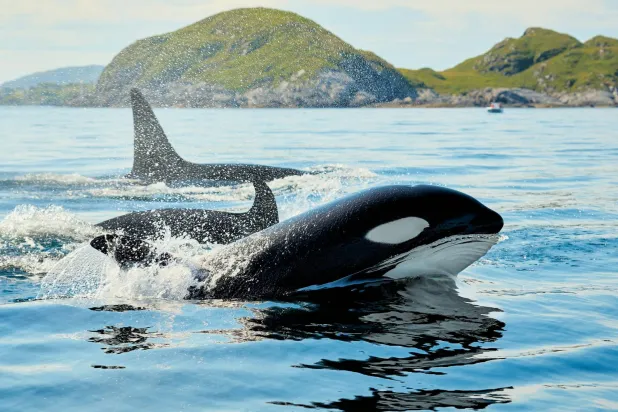
A team of researchers has observed a rare, previously undescribed hunting behavior in orcas in the Gulf of California, where killer whales were filmed ramming one of the heaviest fish in the world.
A team of researchers observed a rare, previously undescribed hunting behavior by orcas in the Gulf of California, USA, where killer whales were filmed ramming one of the heaviest fish in the world with such force that it completely exploded.
Dr. Kathryn Ayres, a researcher at the US organization 'Beneath the Waves' focused on ocean health and lead author of a research paper published in the journal 'Frontiers in Ethology,' said: 'We documented how an orca grabs a sunfish and then releases it before another orca slams into it at high speed, tearing its tissue into thousands of pieces.'
She added in a statement on Thursday: 'We believe this behavior may make it easier for young orcas to feed, or perhaps it is simply play. Orcas are known to toy with their prey.'
Orcas are known for their intelligence and ruthlessness in hunting, using various strategies to catch and kill. They have been observed hunting different types of prey, some larger than themselves.
Meanwhile, the sunfish is over 3 meters (10 feet) long and weighs 2000 kilograms (4400 pounds). These fish move through different water layers but rise to the surface to rest, regulate their body temperature, or rid themselves of parasites. There, they may become vulnerable to predation.
The current observations are based on two separate hunting incidents occurring just over a year apart. In July 2024, Ayres observed how a female orca grabbed a sunfish by its tail fin, while a male orca sped up and swam toward them to complete the collision. The impact caused the sunfish's tissue to disintegrate and float to the surface. Then the young killer whales in the group began devouring the smaller pieces of the sunfish. The adult whales fed on what remained of the carcass, leaving the small bits.
In September 2025, a similar case was observed, documented by Hector Franz, where the whales followed the same behavior of grabbing the carcass, then ramming it and feeding.
As the researchers reported, the strong ramming behavior resulted in significant fragmentation of the prey’s tissue, as ramming has not previously been described as a predation strategy in killer whales. Both cases indicate that the killer whales followed a coordinated and cooperative strategy, with one whale holding the carcass steady so that the other could strike it with greater precision. The sunfish was already dead in both cases, so it is believed that the ramming was a method to prepare the prey for consumption rather than a means to deliver a fatal blow.
Footage documenting the grab of the prey followed by the ramming - Kathryn Ayres (Frontiers in Ethology)
The researchers noted that the observed behavior can be interpreted as a form of parental care, as dividing the carcass into smaller pieces makes it easier for the young to handle.
Ayres said: 'Killer whales often tear apart their prey and share it with other group members, including calves and juveniles.' However, she does not rule out that this interaction may have other social purposes: it could simply be a playful game for the killer whales.
As for sunfish, this interaction may provide new insights into the characteristics of this species, as tissue fragmentation has only been observed in sunfish with pointed tails.
Ayres concluded: 'We are still witnessing new techniques in killer whale hunting and predation. They are among the most famous marine predators in the world, yet they still surprise us.'
"); googletag.cmd.push(function() { onDvtagReady(function () { googletag.display('div-gpt-ad-3341368-4'); }); }); }]
Original source: Asharq Al-Awsat





Comments (0)
Be the first to comment.