Sectarian Attacks Spark Popular Anger in Nigeria
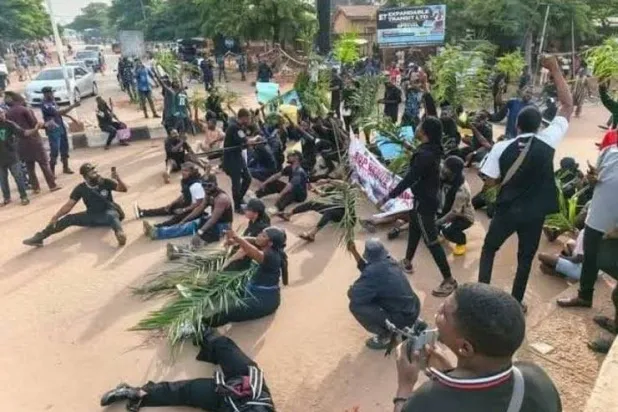
At least 18 people were killed in a series of armed sectarian attacks that erupted Friday and continued through Sunday in Benue State, central Nigeria.
In successive armed attacks of a sectarian nature in central Nigeria, at least 18 people were killed over three days, sparking a wave of popular protests accusing the authorities of failing to protect civilians.
These attacks come in the context of a long-standing conflict between nomadic herders and settled farmers in central Nigeria, where groups compete over natural resources such as land and water.
According to security sources, the coordinated attacks began Friday in Otukpo, when gunmen believed to be local herders raided farmland in Akpachi village, killing two farmers, while a third escaped and alerted villagers.
The sources added that before residents could recover from the shock, gunmen infiltrated Otukpo-Nobi village around 4 a.m. Sunday, opening fire randomly on sleeping residents, killing at least 16 people, with fears the death toll could be higher.
Retaliatory attacks
These attacks come less than two weeks after the assassination of the chairman of the Nigerian Cattle Breeders Association branch in Benue State, Alhaji Ardo Rizqo Muhammad, and his companion Yakubu Isa, who were ambushed in Okoto town while returning from a peace meeting.
Authorities opened an investigation into the killing of the association chairman and arrested several people to identify those involved in the crime, amid great tension between herders and farmers in the state, which is one of Nigeria's most important agricultural regions and is described as the food basket of the largest country in Africa by population (250 million people).
Authorities announced the opening of another investigation following the latest attacks to determine whether they were a retaliatory campaign following the killing of the association chairman. The chairman of the Otukpo Local Government Area, Maxwell Ogueri, confirmed that 'preliminary results indicate a possible link between the attacks and what are believed to be retaliatory operations following the killing of the association chairman.'
The local official said: 'The gunmen came and killed two farmers on Friday, and one survivor informed the community; we recovered the two bodies on Saturday and buried them. After searching the surrounding bushes, we thought they had left the area, but around 4 a.m. Sunday, we received distress calls that they had overrun Otukpo-Nobi, killing several people and wounding many others.'
Popular anger
The attacks sparked widespread anger across Otukpo, where hundreds of young people organized a massive protest on Sunday, during which they carried the bodies of some victims to the palace of the top traditional ruler of the area, while a church service was being held, demanding immediate government intervention to stop these repeated attacks, accusing the authorities and security agencies of failing to protect citizens despite repeated assaults on farming communities.
The protest quickly escalated and expanded, with angry protesters blocking main roads in the city, shops and markets, while security forces monitored the situation without intervening.
Meanwhile, Benue State Governor Hyacinth Alia issued a statement condemning the attacks and expressing sorrow, noting that the government, security agencies, and traditional leaders are making great and continuous efforts to enhance security in the state, and stressed that these attacks are 'a calculated attempt by criminal elements to undermine these efforts.'
Addressing the angry protesters, the governor said: 'My government stands firmly by your side, and we will not allow our communities to be turned into killing fields,' then instructed security agencies to intensify surveillance, enhance cooperation with neighboring states, and pursue those responsible for the attacks to ensure their arrest and prosecution.
Benue region often witnesses clashes between herders, who are mostly Muslim, and Christian farmers, over resources.
Security negligence
Despite official reassurances, the authorities faced accusations of negligence, as the 'Ochituoha Kyduma Global Forum', one of the largest and most important civil society organizations in Benue State, issued a statement on Sunday accusing Nigeria's security agencies of ignoring prior intelligence information that could have prevented the attacks.
In a strongly worded statement, the forum said that 'the massacre that killed at least 20 people could have been avoided.' The forum alleged that 'the authorities failed to act despite receiving a prior warning from the top traditional ruler of the area.'
The forum's statement said: 'The (traditional leader) immediately informed the relevant security officials, but this warning was met with disregard (...) They failed to act,' and the forum called on Nigerian President Bola Tinubu to 'take immediate action to avoid another round of bloodshed.'
Expulsion of herders
Separately, the traditional ruler of Otukpo, Chief John Eimone, issued an order for all herders to immediately vacate all parts of the Otukpo Kingdom, saying that 'the continued presence of herders poses a serious threat to the safety and security of residents throughout the kingdom.'
However, the traditional leader clarified that 'this order should not be interpreted as ethnic profiling or discrimination against any specific group,' but described it as 'an emergency measure aimed at protecting lives and restoring peace,' in his words.
Legally, traditional leaders do not have the authority to issue forced eviction orders enforced by the police or military, but such a decision carries moral, social, and traditional weight within local communities, and may lead to social pressure on herders to leave voluntarily, or push the government to take action.
Benue region often witnesses clashes between herders and farmers over resources. Last year, such clashes killed 150 people in 'Yeliwata community.' This tension between herders and farmers is further complicated by ethnic dimensions, as most herders come from the Fulani tribes, and also takes on a sectarian character as they are mostly Muslim, while farmers come from settled local communities, most of whom are Christian.
The persistence of the attacks indicates the failure of government efforts to contain the conflict, threatening stability in one of Nigeria's most food-producing regions. Observers are monitoring whether the new investigations will lead to accountability for the perpetrators or whether these attacks will remain within the cycle of mutual violence.
Original source: Asharq Al-Awsat





Comments (0)
Be the first to comment.