Sisi Condoles Qatar's Emir on Death of Sheikh Hamad bin Khalifa
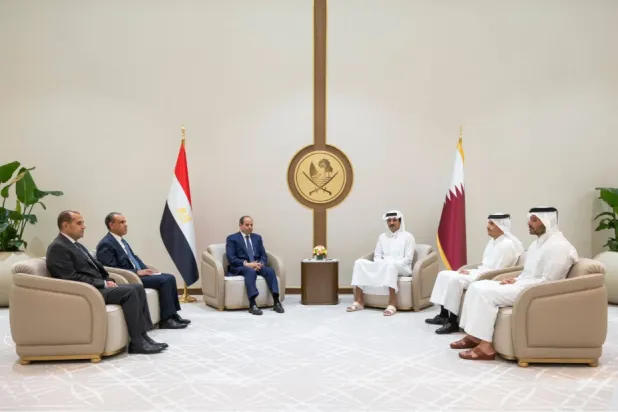
Egyptian President Abdel Fattah El-Sisi on Tuesday extended his sincere condolences to Qatar's Emir Sheikh Tamim bin Hamad Al Thani on the death of Sheikh Hamad bin Khalifa Al Thani.
A video release by the Egyptian military titled 'Shield of the South' highlighted developments in confronting illegal prospectors on the southern border with Sudan, about three months after a military and security operation to foil illegal gold prospecting and arrest foreigners. The release included testimonies from detainees showing they received 'humane treatment.'
That release, which was published by the Egyptian military spokesman, Colonel Ahmed Attman, on his official Facebook page on Tuesday, carries a security and strategic message, according to experts who spoke to Asharq Al-Awsat, most notably 'imposing state sovereignty over remote areas, not allowing areas outside control, preserving the country's resources and sovereignty, and reassuring violators that there is a legal path that respects rights that can be taken.'
The military spokesman said that this video release is 'the first episode of the (Shield of the South) series that monitors how the armed forces and civilian police dealt with elements who surrendered after the major campaign in the southern region, within a legal framework according to international standards and covenants, imposing security and preserving rights.'
Seizures during an Egyptian military campaign last June (Military Spokesman)
Military and strategic expert Major General Adel Al-Omda believes that the release of the 'Shield of the South' operation can be read in a broader context than just pursuing illegal prospectors, explaining that it 'represents a security and strategic message confirming that the Egyptian state views the southern borders as one of the most important theaters for protecting national security, especially with the expansion of desert areas and intertwining challenges of smuggling, illegal migration, and illegal mining.'
State capacity
He added that it 'confirms the state's continued ability to impose its sovereignty over remote areas and not allow areas outside control,' according to Al-Omda, who noted that the series published by the military spokesman reviews how the armed forces and police dealt with those who surrendered after the campaign, emphasizing that the procedures were carried out within a legal framework and with consideration of humanitarian standards.
The release included video testimonies of Sudanese individuals, who confirmed that they received humane treatment after their surrender, calling on others still inside the illegal prospecting areas to hasten their surrender.
Respect for human dignity
Al-Omda pointed out that these testimonies reflect what actually happened and convey a message that applying the law does not conflict with respect for human dignity, and confirm that 'the goal is law enforcement, not revenge, with adherence to legal procedures and the basic rights of detainees.'
He indicates that these messages contribute to building trust among border communities and support the image of state institutions as balancing security firmness with humanitarian considerations and adherence to legal and international standards.
A group of detainees during the Egyptian army campaign last month (Military Spokesman)
Al-Omda emphasizes that calls for illegal prospectors to surrender aim to reduce the likelihood of confrontations or unnecessary human losses, and encourage those involved in illegal prospecting to end the violation through the legal path, thus saving the state time, effort, and costs of extended security operations. It also enhances stability in border areas by combining deterrence with providing an opportunity for voluntary response, supporting the imposition of security and protecting the southern borders and the state's resources.
Last June, the Egyptian army announced the implementation of a 'major campaign' in cooperation with police forces on the country's southern borders against 'criminal hotbeds' accused of engaging in illegal activities, including drug and arms trafficking, illegal gold prospecting, and illegal migration. The campaign resulted in the arrest of more than 200 people, including 136 foreigners.
At the time, activists circulated video clips on social media showing individuals infiltrating Egypt's southern borders with Sudan, amid information about illegal gold prospecting in Egypt and appeals to Egyptian authorities to take necessary action.
The Egyptian army announced last month the implementation of a 'major campaign' in cooperation with police forces on the country's southern borders (Military Spokesman)
The Egyptian army said in a statement at the time: 'Within the framework of the tasks carried out by the armed forces to protect national security and preserve the country's resources and economic gains, the armed forces, in cooperation with elements of the Ministry of Interior, carried out a major campaign in the southern military region sector against a number of criminal hotbeds exploited by criminal organizations and networks to engage in illegal activities, including (drug and arms trafficking, illegal gold prospecting, and illegal migration), which pose a direct threat to national security, in addition to their negative impacts on economic stability, the investment climate, and sustainable development efforts.'
The army also announced at the time that a number of individuals who had infiltrated Egyptian territory illegally 'surrendered to security points and outposts, and were repatriated to their countries with full consideration of their humanitarian needs.'
Military and strategic expert Major General Samir Farag affirmed that what happened highlights one of the inherent tasks of the armed forces: securing the state's international borders and preventing any foreign elements from crossing these borders. In this context, the 'Shield of the South' operation came to confront illegal gold prospecting, noting that Egypt handled the matter with utmost professionalism, as these elements were deported outside Egyptian borders with full adherence to humane and humanitarian standards.
Part of the seizures during an Egyptian military campaign last June on all strategic directions (Military Spokesman)
Regarding the messages conveyed by the illegal prospectors about the army's treatment of them, Farag pointed out that 'firstly, it is a message to the entire world that we are a civilized people. In other countries, an infiltrator who forcibly crosses the border may be treated poorly, but Egypt is a civilized state. Everyone who entered the borders illegally was controlled and quietly deported back to their countries.'
He stressed that the aim of these messages is to educate others that if they encounter security forces or the army, there is no need to resist or open fire, as the Egyptian state takes their interests into account until their return to their countries. He explained that this approach contributes to achieving national security while preserving the civilized image of the Egyptian state.
Original source: Asharq Al-Awsat



Comments (0)
Be the first to comment.