Smartphone light leads to discovery of castle 'hidden' for 800 years
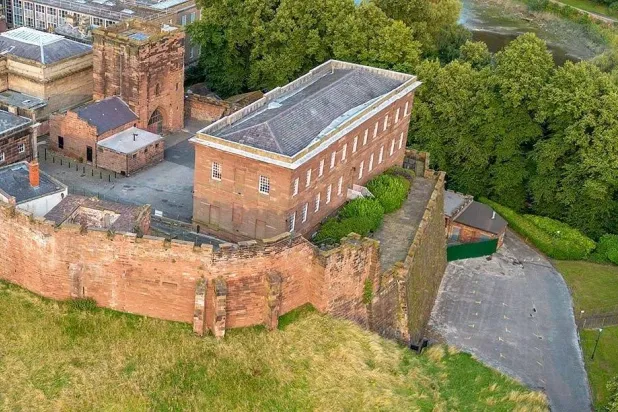
Archaeologists have found an 800-year-old section of a medieval castle beneath Chester Crown Court in Britain, and the discovery came thanks to a smartphone light.
The researchers explained that the discovery was made when an expert was examining stonework at the end of a dark passage beneath the court; when archaeologist Stuart Ainsworth raised his phone to light the passage, he was surprised by a sudden change in the stone construction pattern.
Dr. Ainsworth, from the University of Chester, said: 'Thanks to my phone light, I could immediately notice that a large part of the wall in the darkness ahead was completely different.'
He added, as quoted by The Independent: 'The wall turned at a right angle and disappeared from view, leaving a narrow, very dark gap that I could not pass through.'
When the researchers compared the stones and construction technique with the remaining parts of the 'Norman castle', they confirmed that sections of the underground wall date back to the Middle Ages, not the 18th century, when architect Thomas Harrison built most of the current prison and court complex.
It seems that the ancient fortifications of Chester Castle have survived for centuries, hidden inside the modern building.
Dr. Ainsworth continued, referring to the modern builders: 'The wall I discovered is very large; it is about 3 meters high; so we now know that they left much of the old stonework untouched. I suspect that many other parts may remain under the car park and castle complex.'
A city carrying another... sleeping beneath it (Facebook)
Archaeologists used digital scanners to accurately locate the wall; by comparing old maps and plans, it became clear that this wall was originally part of a bridge built 800 years ago.
According to the researchers, the wall cut through a deep ditch surrounding the inner courtyard, which was equipped with strong fortifications inside the castle; the main gate, spanning 8 centuries, was eventually demolished.
This ancient bridge beneath the court resembles the one that crosses the deep ditch at Beeston Castle, whose remains still stand today.
Archaeologists explained that the drawbridge at Beeston Castle was raised to prevent attackers from reaching the 13th-century gate, and it is likely that a similar arrangement existed at Chester Castle.
Cheshire Police Officer Jonathan Lightfoot said: 'I think it's amazing that through proactive surveys and recording of historic buildings, we can discover previously unknown archaeological evidence.'
He added: 'This clearly proves that we can now protect this piece of history to learn from it, and for future generations to benefit.'
Original source: Asharq Al-Awsat






Comments (0)
Be the first to comment.