Strait of Hormuz between Freedom of Navigation and Sovereignty Claims

Talal Saleh Banan
Strait of Hormuz between Freedom of Navigation and Sovereignty Claims
21 July 2026 - 00:00 | Last updated 21 July 2026 - 00:00
--:--
Follow Okaz channel on WhatsApp
International law and maritime law, along with what is commonly accepted among nations and recognized by the international system, dictate that straits and natural waterways are common areas for use by all, just like international waters in the high seas and outer space, as well as the regions of the Arctic and Antarctic. No state or any legal or private international entity can claim sovereignty over them in any form to prevent or hinder any force or international or private legal entity from using them, especially in times of peace. As for straits and waterways that are bordered by two or more states, such as rivers, lakes, and artificial waterways, it is also not permissible for the states or the state that lies within the territory of another state to apply the variable of absolute sovereignty over them. Instead, they are governed by international agreements and treaties, as is the case with the Suez Canal and the Bosporus and Dardanelles straits in Turkey.
If there is any sovereignty of a state over its coasts adjacent to international seas or oceans in the high seas, or those that share a direct view of straits or natural international waterways, whether exclusively by applying its territory to both banks of the waterway or strait, this geopolitical situation does not grant this state or other states the right to prevent or deny passage in times of peace to other states, with the aim of obstructing international trade or imposing a blockade on the states bordering these international straits and waterways.
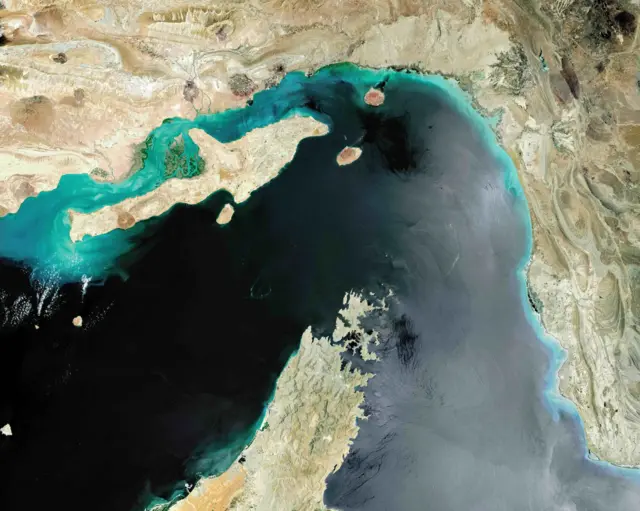
Hence, one can understand the exceptional situation that has arisen around the Strait of Hormuz among the warring states in the Arabian Gulf region, where each party of the warring sides tries to use the Strait of Hormuz card to benefit its combat effort, to prevent the opponent from any sovereignty claims or freedom of navigation through the strait, whether for peaceful reasons or in service of any war effort imposed. In principle, the state of war prevailing in the region does not prevent the use of the strait for strategic (combat) purposes; the argument of innocent freedom of navigation will not withstand the raging war in the region. The variable of force, and force alone, in this case, has the final say. Nevertheless, in any case: the legal nature will not be affected in the interpretation of the strait from the perspective of the law of the sea, nor in the eyes of global public opinion, which must adapt to the raging war in the Arabian Gulf region until the war subsides.
Geopolitically, the geopolitical position of the strait serves Iran's management of the war more than it serves the ability and will of the United States to challenge the geopolitical situation of the strait, which Iran is pressing to impose as a card of high strategic value in managing the war. The strange thing here is that Tehran argues for sovereignty over the strait to justify the logic of closing it and using it as a weapon in its war with the United States. Tehran here ignores the fact that, even if we accept the sovereignty theory it claims, from a geopolitical perspective, it does not have exclusive control over the sovereignty of the strait, since the Sultanate of Oman shares the overlook of the strait from the opposite (western) side. Moreover, the Sultanate of Oman, which is not a direct party to the war, does not share Tehran's claim of sovereignty over the strait. Given Tehran's real inability to implement and enforce its sovereignty claims over the strait, over time Tehran will not be able to continue threatening to close the strait, nor will it be able to collect passage fees for transit through it, coming and going, neither during the fighting nor after the war subsides.
What decides the issue of the status of the Strait of Hormuz, with the war now raging, is force, and force alone. The United States does not wish to invest its surplus power to actually control transit traffic in the strait, for fear of the high material, human, and political cost. For its part, Tehran will not be able, nor does it possess the deterrent power, to impose its sovereignty claims over the strait to control navigation in it indefinitely.
In short: Whatever the outcomes of the war in the region, there will be no change in the international status of the strait as an international waterway after the war, as the law of the sea continues to govern navigation in it.
International law and maritime law, along with what is commonly accepted among nations and recognized by the international system, dictate that straits and natural waterways are common areas for use by all, just like international waters in the high seas and outer space, as well as the regions of the Arctic and Antarctic. No state or any legal or private international entity can claim sovereignty over them in any form to prevent or hinder any force or international or private legal entity from using them, especially in times of peace. As for straits and waterways that are bordered by two or more states, such as rivers, lakes, and artificial waterways, it is also not permissible for the states or the state that lies within the territory of another state to apply the variable of absolute sovereignty over them. Instead, they are governed by international agreements and treaties, as is the case with the Suez Canal and the Bosporus and Dardanelles straits in Turkey.
Original source: Okaz

Comments (0)
Be the first to comment.