Syria gives Trump a way to bypass the Strait of Hormuz
"Using this route (via Syria) will allow countries to bypass maritime trade through the Strait of Hormuz, reducing the leverage Iran currently enjoys by attacking commercial ships—and the billions of dollars worth of oil they carry—while they transit."
Syria gives Trump a way to bypass the Strait of Hormuz – an article in The Telegraph
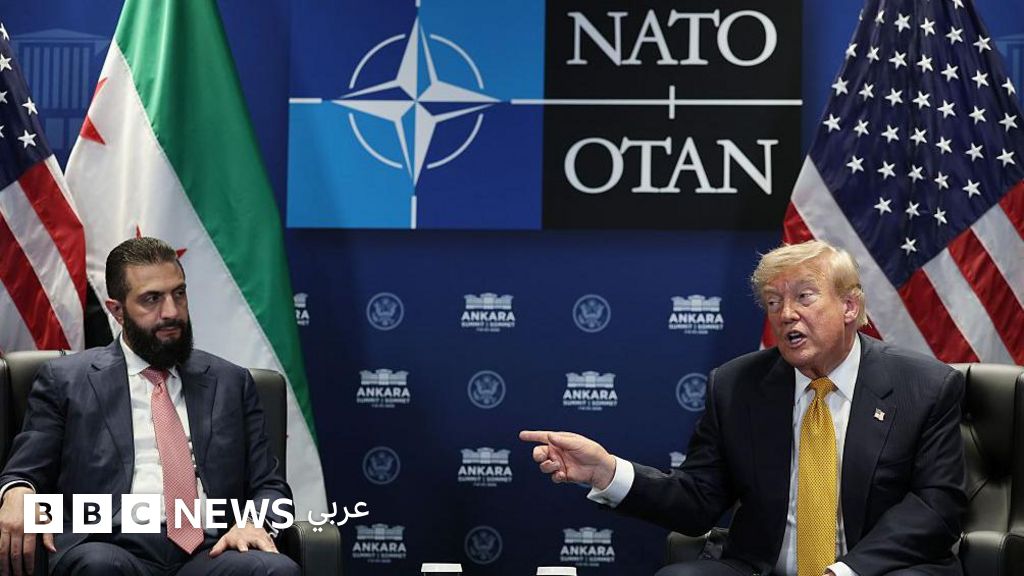
Image caption: Trump (right) met with Syrian President on the sidelines of the NATO summit in Ankara, Wednesday, July 8, 2026
Published 6 minutes ago
Reading time: 6 minutes
In today's press roundup, we read an article about the possibility that Syria could provide an alternative route to the Strait of Hormuz, amid the fragile truce between Washington and Tehran, another article that sees Trump as more in need of a deal than Iran to end the war between the two countries, and a third discussing the reasons for worsening forest fires in Spain.
We begin our roundup with the British Daily Telegraph, and an article titled: "Syria gives Trump a way to bypass the Strait of Hormuz", by Sofia Yan.
The author discusses the meeting between US President Donald Trump and his Syrian counterpart Ahmed al-Sharaa, on the sidelines of the NATO summit in Ankara last Wednesday, at a time when Trump announced the end of the ceasefire with Iran, which "missed the chance for peace".
What is the Strait of Hormuz and why is it important?
Trump praises al-Sharaa and says he "put him there himself"
The author points to what was said in the meeting, as Trump declared his intention to remove Syria from the list of state sponsors of terrorism – in addition to the lifting of sanctions on Syria announced last year – considering that "this facilitates the way for American companies to invest in Syria, encouraged by the US government, which issued a guide for investors, including sector-specific guidelines covering oil, gas, electricity, and banking services."
She wrote: "Mr. Trump told Mr. al-Sharaa, sitting to his right: We have American companies ready to invest in Syria, and contribute to making your country greater and more prosperous than ever."
The author argues that "Syria's strategic location – with its 120-mile coastline on the Mediterranean Sea, and its geographic extension connecting it to oil-rich countries in the Middle East – facilitates its integration into global trade."
Options include land transport or transporting energy supplies via dedicated pipelines, all directed to coastal ports, where goods can be loaded onto commercial ships heading to Europe and beyond, according to the author.
"Using this route (via Syria) will allow countries to bypass maritime trade through the Strait of Hormuz, reducing the leverage Iran currently enjoys by attacking commercial ships—and the billions of dollars worth of oil they carry—while they transit."
Skip most read and continue reading
Why do mosquitoes bite some people more than others?
Abbas Araghchi in Oman to discuss the Strait of Hormuz issue, and Khamenei vows revenge for his father's death
How did Haitham Hassan become the talk of the football world after his impressive performance against Argentina?
Bonnie Tyler... the husky voice that changed the power ballad
Skip podcast and continue reading
Worth noting
In-depth explanation of the most important events and topics, to help you understand the key changes around you and their impact on your life
Episodes
Podcast end
Pipeline projects linking major energy producers in the Gulf, including Saudi Arabia and Qatar, directly to Syria's ports in Baniyas and Latakia are currently being studied, according to the author, who quotes Moayad al-Buni, senior analyst at Karm Shaggar Consulting and a specialist in the Syrian economy, as saying: "Geographically, if we set aside all risk factors, Syria could constitute an alternative option to the Strait of Hormuz."
Al-Buni adds: "But it is not as simple as Trump or even the Syrian government portrays it. Nevertheless, it is a good opportunity for Syria."
The author sees that Syria has immense potential to become a new energy trade hub, "given its potential to export oil and its possession of approximately 2.5 billion barrels of proven oil reserves, with some estimates reaching 27 billion barrels, including offshore areas."
"Additionally, the Syria option has already been tested: Iraq transports about 200,000 barrels of oil daily via trucks through neighboring Syria, but this amount represents only a tiny fraction of the roughly four million barrels per day that were loaded onto ships before the war."
However, this option is not without risks. Terrorist groups, for example, remain active inside Syria, which could hinder oil flow, and there are also other practical problems, according to the author, as "Syria lacks basic financial and banking infrastructure, and the legacy of decades of sanctions makes it difficult to process international transactions and track payments... and prevent them from reaching terrorist groups."
Other obstacles include "the need to deal with Russia, which maintains a military and commercial presence in Syria."
"Perhaps the biggest challenge is that promoting Syria as a new route will require adapting to major geopolitical shifts in the Middle East."
The author concluded her article by citing al-Buni's view, who sees another challenge facing this alternative: "Gulf countries may hesitate to allow Syria to influence their oil supplies to this extent... The crisis in the Strait of Hormuz is what drives them to consider Syria as a potential hub, not the attractiveness of the Syrian market."
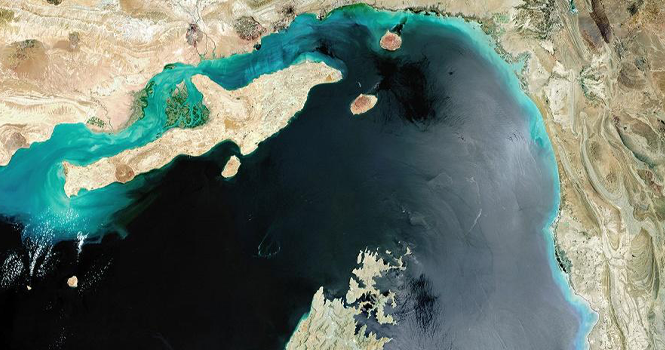
Image caption: The author believes that Syria's strategic location and its Mediterranean coast facilitate its integration into global trade
"Trump needs a deal more than Iran"
We move to The Independent, and an editorial titled: "Trump is right that Iran wants a deal, but he needs it more."
The newspaper addresses the recent escalation between the United States and Iran, which occurred in parallel with the NATO summit in Ankara, as Trump announced the end of the memorandum of understanding that led to a ceasefire with Iran, "then bombs began falling on Iranian targets, in response to Iran's shelling of commercial ships in the Strait of Hormuz. This step was met with similar responses, in what appears to be an escalating military operation from both sides."
The newspaper wrote: "Meanwhile, Trump again claimed—perhaps for the thousandth time—that Iran is desperate for a deal. In this, the US president may be right: it is natural for Iranians to want a deal, and who wouldn't?"
"But the problem is that America needs it more (than the Iranians). The sharp rise in oil prices that followed the war harms the global economy, and the US economy in particular, for Trump. This gives the Iranians leverage."
The newspaper noted that the Strait of Hormuz, which was freely open before February 28 when the US and Israel began military operations against Tehran, "is now under the control of the mullahs," asking: "Who needs a nuclear weapon when you can strangle the global economy?"
The newspaper argues that "the situation that Trump fails to grasp is that while the Iranians have been weakened—certainly—they have become bolder."
It wrote: "They (the Iranians) also know that Trump's ability to reopen the Strait by force would require a massive US ground force. And they are fully aware that this will not happen, given US public opinion, which swings between apathy and outright hostility toward this war of choice."
Original source: BBC Arabic



Comments (0)
Be the first to comment.