Syria's Hasakah Appointments Fuel Anger Among Arab Tribes

Sources in Hasakah province, northeastern Syria, told Asharq Al-Awsat of a state of anger in Arab circles, against the backdrop of recent administrative appointments, noting a feeling of 'injustice' among the Arab majority.
In contrast, Kurdish leadership sources said that implementation of the agreement is proceeding gradually and quietly, but 'the remnants of the chauvinistic Baath' do not want stability in the region.
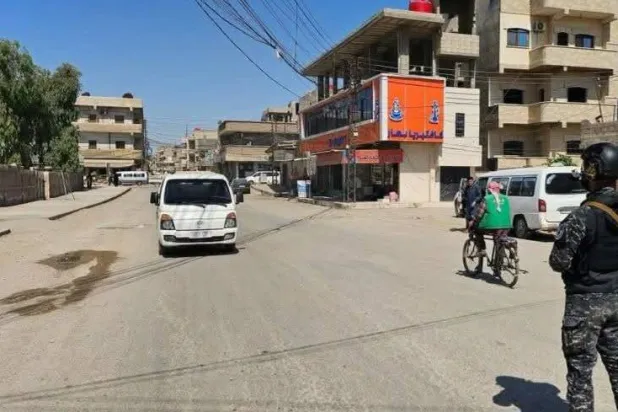
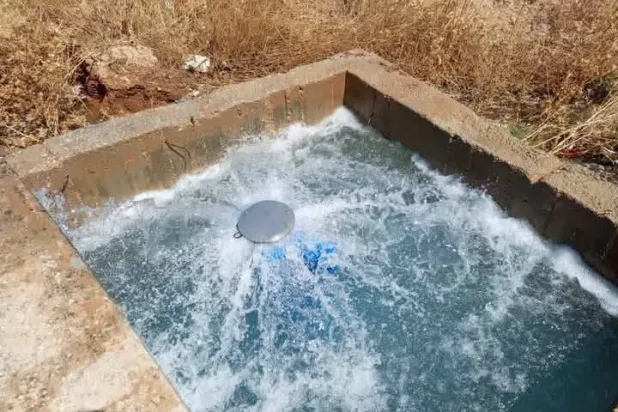
As tensions escalated in Hasakah, Arab protesters in the Ras al-Ain area intercepted the convoy of Hasakah Governor Noureddin Ahmed and the Internal Security Director today while heading to the Alouk water station, throwing stones at the convoy. This came just hours after the Internal Security leadership in Hasakah denied circulating reports of a security alert and targeting of checkpoints in the province.
A protest stand by residents of Ras al-Ain on Sunday in front of the provincial building demanding accelerated preparation of conditions for their return to their city (North Press)
Video clips showed the Internal Security commander in Hasakah province, Brigadier General Marwan al-Ali, speaking to the protesters in an attempt to calm them, and Internal Security forces in the city trying to control the protests.
Activists from northern Syria revealed to the Syrian newspaper Al-Watan that the refusal of Ras al-Ain residents to allow the Hasakah governor's visit to their city was due to provocative statements he made against the city's residents.
The activists also explained to Al-Watan that there are Arab displaced persons in Ras al-Ain demanding to return to their original neighborhoods in Hasakah city, including the Ghwayran neighborhood. They recently held a demonstration demanding to return to their neighborhoods, but this was not achieved because the so-called 'Revolutionary Youth' affiliated with the Kurdish Autonomous Administration controls most of Hasakah city's institutions and refuses their return.
Appointment of Jihan Hussam Saeed as director of Qamishli district in Hasakah province (circulated)
Coinciding with the issuance of the Executive Council appointments by the Hasakah governorate, news emerged of a mobilization of Arab tribes in the province, and a campaign of criticism against the political administration demanding its dismissal in protest against the marginalization of the Arab component, with calls on social media to unite the ranks of the tribes and establish a 'war tent'.
'Notables, military personnel, and civilians in the province also called on the Syrian government to form an independent investigation committee to ascertain the reality of the situation, listen to the demands of the people, and hold accountable those who have failed.'
Deputy Governor of Hasakah and spokesman for the presidential team overseeing the implementation of the agreement, Ahmed al-Hilali, described the campaign he and the presidential team are facing as a 'difference of opinion,' which is 'natural and part of the nature of public work.' In a statement on his Facebook account, he affirmed rejection of 'smear campaigns based on lies and misinformation' that only serve 'those with suspicious agendas.'
Meanwhile, the general course of implementing the agreement, despite 'the slowness and gradual progress it is witnessing,' reflects a mutual commitment to proceed with its implementation and complete the integration steps, according to the representative of the Kurdish Autonomous Administration in Damascus, Abdul Karim Omar, to Asharq Al-Awsat. He considered the formation of the executive office for Hasakah province and the issuance of new appointments for district and sub-district directors in the province as 'a step reflecting the continued restructuring of administrative institutions within the framework of the state.'
Omar said that these developments confirm that the various parties are still committed to implementing the agreement, stressing the importance of 'taking into account the specificity of Kurdish areas and ensuring their effective participation in state institutions.' He noted that 'important steps have been accomplished in several sectors, including military and security aspects, in addition to economy, health, education, women, social affairs, and labor. Work is currently underway to complete the integration of the agricultural sector.'
The Shura Council affiliated with the Sons of Hasakah announced the launch of what it called the 'Tent of Dignity and Return,' calling on the province's residents to gather and unite ranks (social media sites)
In contrast, Mudar al-Asaad, a political writer and one of the province's notables, told Asharq Al-Awsat that 'the political, security, and economic situation is very bad' in Hasakah. In the areas run by the SDF, which include the center of Hasakah city, Amuda, Al-Rumaylan, Al-Darbasiyah, Al-Malikiyah, and Ma'bada, there are still violations against residents and provocations from the 'Revolutionary Youth,' as well as killings and kidnappings. Meanwhile, residents in government-controlled areas suffer from a very harsh living situation in terms of poverty, poor services, and lack of drinking water, electricity, and even bread.
Al-Asaad pointed to the feeling of 'injustice' among the Arab and Christian components, which was reinforced after the recent appointments. The Arabs received three seats in the Executive Council, one seat for the Syriacs, while the Kurds received five seats, considering this an injustice against the majority. Additionally, the appointments were not based on merit, leading to 'an administrative imbalance reflected in services.'
Al-Asaad called on the government to impose integration quickly and resolve outstanding issues, such as the return of displaced Arabs and Syriacs to their homes in Al-Darbasiyah, Amuda, Qamishli, Hasakah city, and Al-Malikiyah, explaining that they have not yet been able to return, and those who return individually are arrested and harassed by the 'Revolutionary Youth.' There is also the file of detainees held by the SDF and detainees who were transferred to prisons in Iraq. Al-Asaad warned that the continued state of anger could cause matters to spiral out of control.
Deputy Governor of Hasakah Ahmed al-Hilali (Facebook account)
Meanwhile, ambiguity still surrounds some aspects of the agreement's implementation, and Asharq Al-Awsat was unable to obtain clarification from the presidential team spokesman, Ahmed al-Hilali, regarding the situation in Hasakah and the course of implementing the agreement. However, Muhammad Aibesh, an official in the Democratic Union Party (the main component of the Autonomous Administration and the SDF), told Asharq Al-Awsat that 'there are things happening that cannot be announced,' considering the recent administrative appointments in the province as an indication that the integration process is 'proceeding quietly,' accusing that 'the mentality of the Arabs from the remnants of the defunct chauvinistic Baath,' in his words, do not want 'stability in the region.'
Aibesh pointed to the existence of 'elements within the current authority influenced by those positions, who are dissatisfied with the appointment of a Kurd as governor, district director, or in the Executive Council, especially the presence of women in leadership positions, such as the appointment of Jihan Saeed Hussam as director of Qamishli district,' stressing that there is an agreement between the government and the Autonomous Administration to proceed with implementing the agreement.
SDF commander Mazloum Abdi recently stated that there will be many changes and a new administrative system, and the SDF will join the new Syria. His statement came after his return from a tour of four European countries: Italy, France, the Netherlands, and Belgium, last month.
The official in the Democratic Union Party, Muhammad Aibesh, denied having information about the results of Abdi's European tour, suggesting that the discussions revolved around 'the integration process and the future of the political process regarding the constitution and the rights of the Kurdish people and their constitutional recognition; because Decree 13 is a positive step but insufficient unless these rights are constitutionally recognized.'
Statement from Internal Security in Hasakah
Original source: Asharq Al-Awsat
Comments (0)
Be the first to comment.