Tense Atmosphere in Lebanese Parliament in First Session Since March
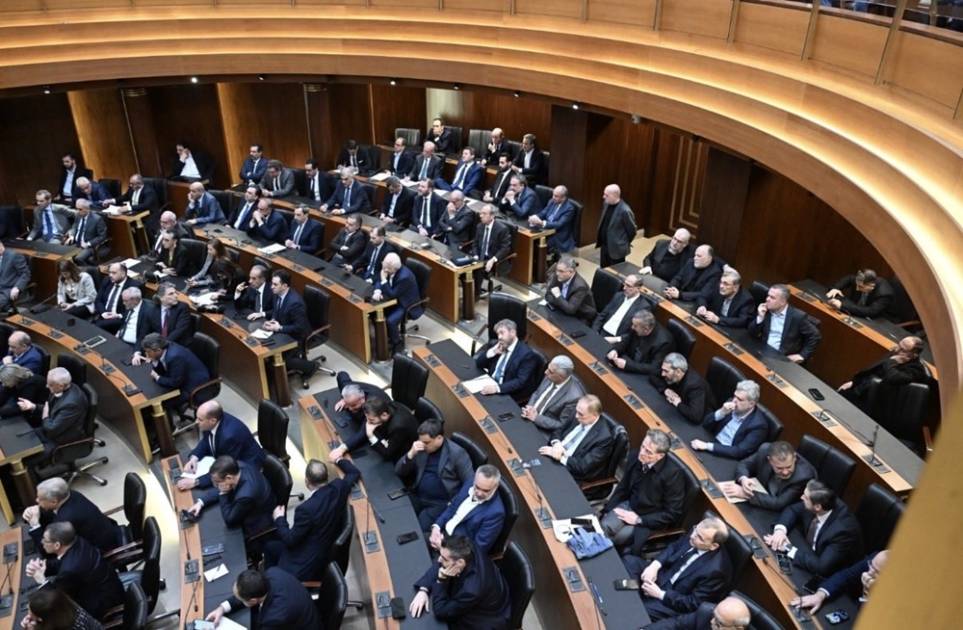
Summary: The Lebanese parliament began its first session since last March on Wednesday by discussing the agenda consisting of 44 proposals and draft laws, most notably the abolition of the death penalty, which is suspended, and granting a general amnesty with exceptional reduction of some penalties. For years, parliament has been trying to pass a general amnesty law, mainly aimed at alleviating overcrowding in prisons, without reaching consensus due to sectarian and political divisions over the beneficiaries.
Lebanon and Israel agreed during a new round of talks in Rome that concluded on Wednesday to finalize the structure of pilot zones and begin implementing them within days, in application of a framework agreement between the two sides, according to a statement by the US Embassy in Beirut. The embassy quoted a US official as saying, 'We agreed on the structure and general principles for the mechanism of the pilot zones, to be completed and implementation begun within days,' adding that the two sides will also begin 'expanded technical talks, which will focus on implementing all the provisions of the tripartite framework agreement' signed last June.
Parliament session
On the other hand, the Lebanese parliament began its general session on Wednesday, which is supposed to last for two days (Wednesday and Thursday), to study several draft laws and proposals, the most notable of which, related to passing a general amnesty, sparks controversy in Lebanon. However, the opening session was quickly suspended due to a dispute inside parliament between the Development and Liberation Bloc (Amal Movement) deputies and a number of change deputies and 'Kataeb' Party deputies over voting on a draft law for contractors to benefit from the retirement system. Parliament Speaker Nabih Berri then adjourned the session for 10 minutes to cool the tense atmosphere. The session then resumed and passed the law aimed at subjecting contractors in the Ministry of Information to the retirement charter, with 61 deputies voting in favor and 30 opposing by acclamation.
General amnesty law
On the other hand, after the end of the civil war (1975-1990), parliament passed a general amnesty law for crimes committed during it, without any real accountability or reconciliation between the warring parties or achieving justice for the victims and their families. The session on Wednesday began by discussing the agenda consisting of 44 proposals and draft laws, most notably the abolition of the death penalty, which is suspended, and granting a general amnesty with exceptional reduction of some penalties. For years, parliament has been trying to pass a general amnesty law, mainly aimed at alleviating overcrowding in prisons, without reaching consensus due to sectarian and political divisions over the beneficiaries. The general amnesty is a demand of the families of what are known as 'Islamist detainees', most of whom are from the city of Tripoli (north), accused of various crimes including fighting the Lebanese army, attacking it, and carrying out bombings. It is also demanded by the families of thousands of detainees and wanted persons from the Baalbek and Hermel regions (east), most of whom are accused of drug crimes, car theft, and cannabis cultivation.
Read more
General amnesty law ignites the Lebanese street
General amnesty law in Lebanon... controversy over justice and impunity
Lebanon arrests a person close to 'Hezbollah' on charges of collaborating with Israel
It is also a demand for hundreds of families from southern Lebanon, whose members fled with their families to Israel after the withdrawal of its forces from southern Lebanon in 2000, fearing reprisals especially from supporters of 'Hezbollah'. Most of these joined what was known as the 'South Lebanon Army', supported by Israel. The draft laws to be studied by parliament include abolishing the death penalty, which was last carried out in 2004. Continuing with the death penalty obstructs Lebanon's ability to extradite wanted persons who fled the country to countries that have abolished the application of that penalty. This is the first legislative session held by parliament since it postponed last March the date of parliamentary elections, which were scheduled to be held in May 2026 for two years, amid the war between 'Hezbollah' and Israel.
Original source: Independent Arabia


Comments (0)
Be the first to comment.