The Secret Women's Cemetery: Why Did Hominins Bury Only Their Women Deep Underground?
Follow Okaz channel on WhatsApp
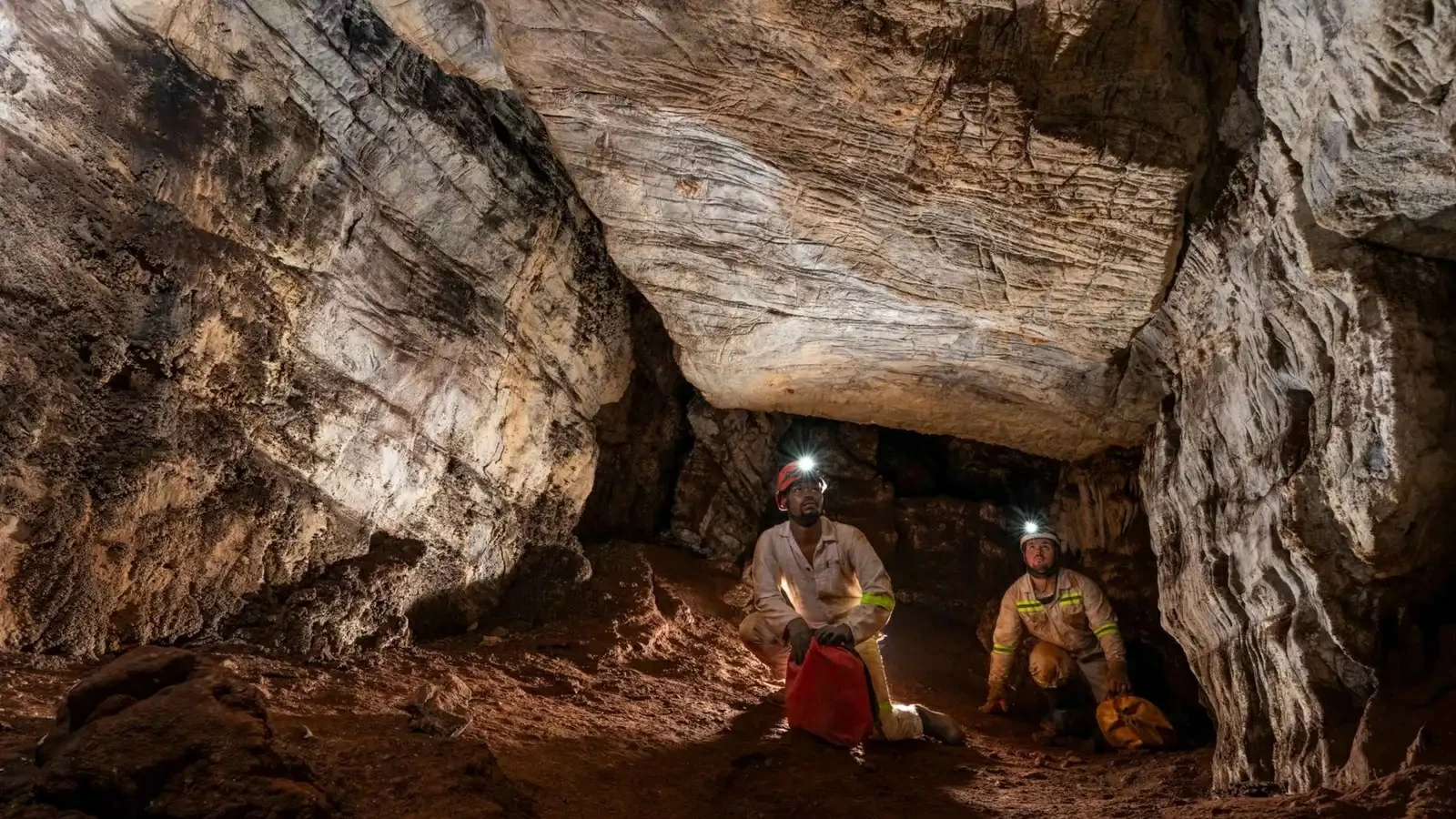
In narrow, extremely dark rocky passages deep inside a terrifying cave that can only be traversed by crawling on hands and knees under dim torchlight, at the end of this suicidal path lies a shocking surprise: an organized mass grave dedicated only to females, dating back hundreds of thousands of years before modern humans left their mark on Earth!
This is not a scene from a thriller or sci-fi movie, but a real archaeological revelation that shocked the scientific community from the depths of the Rising Star cave near Johannesburg, South Africa. The discovery not only puzzled scientists but came to rewrite entire chapters of human history and break one of the most sacred prevailing anthropological theories.
The mystery of funerary rites
Anthropologist Professor Lee Berger, in collaboration with the American National Geographic Society, led an exciting exploratory project deep inside the African cave, where the team found remains dating back about 300,000 years.
But the biggest mystery emerged in the laboratories, as Dr. Palisa Madubi conducted precise tests of ancient proteins at the University of Copenhagen, and the results proved an unexpected fact:
All the skeletons found in that deep chamber belong with high certainty only to females of the hominin species known as Homo naledi.
This laboratory examination raises a stunning hypothesis: these extinct creatures had a strict social and cultural tradition that required burying their females in a designated, sacred place far from sight deep underground.
Transporting the bodies to such extreme depth was not an easy stroll; reaching the cemetery required extraordinary physical effort and astonishing collective planning:
Crawling through deadly passages: they had to cross extremely narrow rock fissures that barely fit one body.
Conquering darkness with fire: the descent required using flaming torches for light, proving their ability to control fire and use it as a vital tool for working in the depths.
This complex funerary behavior reflects the existence of very advanced social beliefs and a cultural identity that long precedes the dawn of modern humanity.
The irony is that for decades, anthropologists believed in a fixed theory that intelligence, complex rituals, and culture only appear in creatures with large brains (such as modern humans and Neanderthals).
But Homo naledi came to completely shatter this rule: although their brain size was much smaller than ours today, they succeeded in establishing complex burial rituals with separation of females, controlling fire, and even carving geometric drawings inside caves.
This exciting discovery not only proves that 'ladies first' might be a very ancient funerary rule, but also proves that brain size was never an obstacle to possessing a mind that venerates the dead, leaving behind mysteries that 21st-century minds cannot decipher!
Original source: Okaz






Comments (0)
Be the first to comment.