Thousands protest against Alternative for Germany party
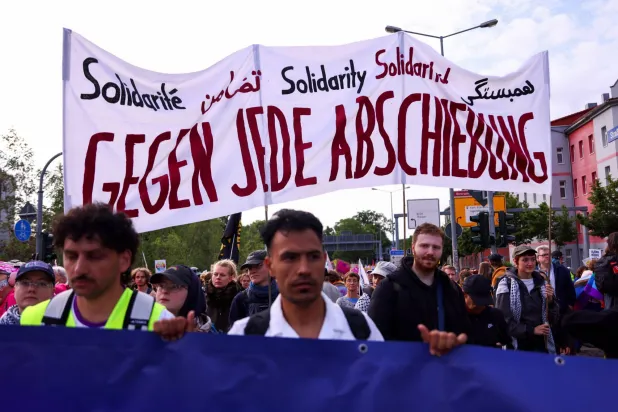
Thousands of opponents of the far-right Alternative for Germany party demonstrated in the streets of Erfurt on Saturday.
Thousands of opponents of the far-right Alternative for Germany (AfD) party demonstrated in the streets of Erfurt on Saturday, blocking roads leading to the venue of the party's annual conference, ahead of regional elections that could pave the way for it to take power at the state level for the first time.
Protesters from trade unions, civil society organizations, and left-wing parties gathered, while police deployed large numbers of officers, reinforced by units from across Germany, to secure the two-day annual conference.
AfD co-leader Alice Weidel greets attendees at the opening of the Erfurt conference after being re-elected to a new term (AFP)
Under the watch of riot police, protesters sat in rows on highways and roads leading to the conference center hosting the meeting, attempting to block access. However, most AfD delegates managed to reach the conference center, where the meeting started on time.
Police estimated the number of participants in the protests in and around Erfurt at around 20,000.
Georg Becker, spokesperson for the alliance 'Widersetzen' (Resist), an anti-AfD coalition, said: 'We want to make clear that we simply will not tolerate this, and that fascism is on the rise here in Germany.'
Protester Line Krogh (19) from Gera, east of Erfurt, told AFP: 'It's important to send a message against' the right-wing option, while Ella (44) said that 'what happened between 1933 and 1945 must never happen again,' referring to the Nazi era.
The conference, which re-elected co-leaders Alice Weidel and Tino Chrupalla, takes place ahead of elections in the eastern states of Saxony-Anhalt and Mecklenburg-Western Pomerania, which the party hopes will help pave the way for national success.
Since its founding over a decade ago, the AfD has strengthened its position in opinion polls, clearly surpassing Chancellor Friedrich Merz's conservatives, relying on a mix of nationalist rhetoric, calls for stricter immigration policies, and attracting voters dissatisfied with successive governments and years of economic stagnation.
A number of protesters against the far-right (Reuters)
Opponents accuse the party of promoting racist policies and positions that contradict Germany's democratic values, warning that it could pose a threat to the country's constitutional order.
Mainstream parties have ruled out any cooperation with the AfD under the so-called 'firewall' strategy aimed at isolating it from government coalitions.
In response, party leaders deny opposing Germany's democratic foundations. Earlier this year, they obtained a court order forcing the domestic intelligence agency to suspend a previous classification of the party as a 'suspected extremist organization.'
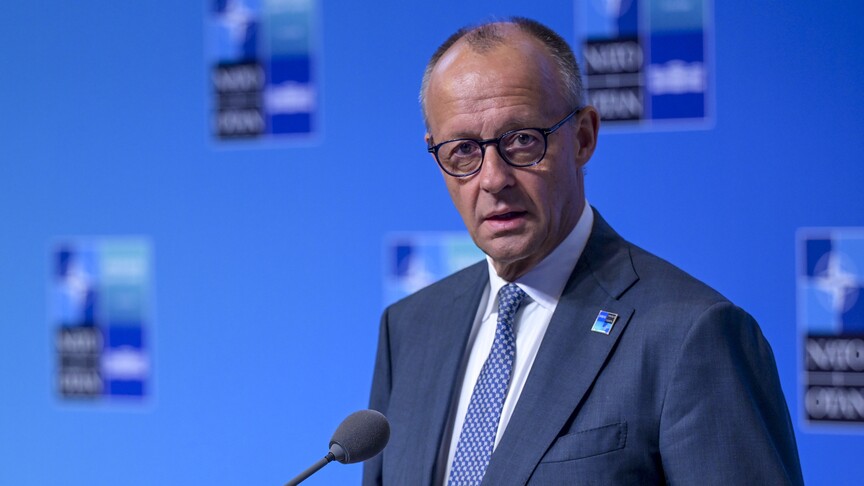
Chancellor Friedrich Merz has made curbing the rise of the AfD a political priority, even as the party remains excluded from power due to the refusal of all other parties to cooperate with it.
"); googletag.cmd.push(function() { onDvtagReady(function () { googletag.display('div-gpt-ad-3341368-4'); }); }); }
Original source: Asharq Al-Awsat



Comments (0)
Be the first to comment.