Turkey: A documentary book on the 6th anniversary of the reopening of Hagia Sophia for worship
Istanbul / Anadolu
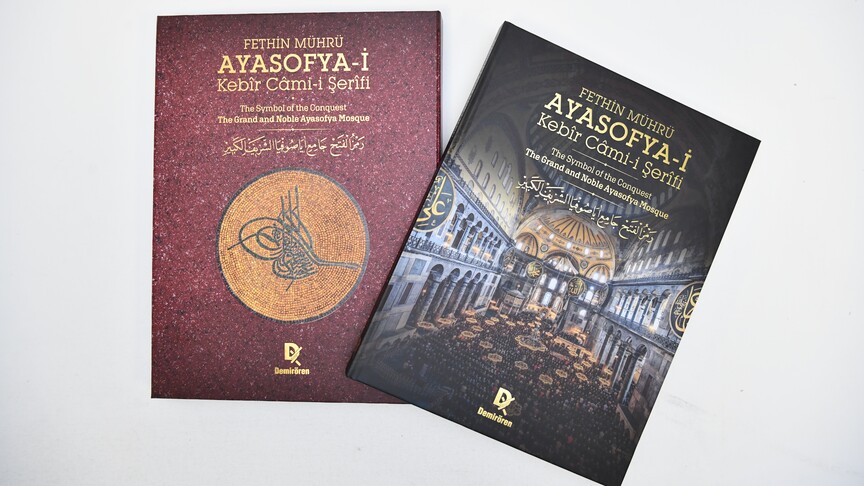
The book 'Seal of the Conquest: The Grand Hagia Sophia Mosque' will be published on Friday by Demir Ören Publishing House in three languages: Turkish, English, and Arabic, and includes a foreword by President Recep Tayyip Erdogan.
The publication of this book documents the journey of one of the most prominent religious and historical landmarks in the world, which was transformed from a cathedral into a mosque, then a museum, and then back into a mosque.
The book presents the history of Hagia Sophia from the Byzantine era to the present day, focusing on its architectural and heritage significance.
On the occasion of the sixth anniversary of the reopening of Hagia Sophia Mosque in Istanbul for worship, a documentary book titled 'Seal of the Conquest: The Grand Hagia Sophia Mosque' will be released on Friday on e-commerce platforms and major bookstores in Turkey.
The book is published by Demir Ören Publishing House and reviews the history of Hagia Sophia from the Byzantine period to the present day, along with its architectural and heritage value, based on scientific sources, archival documents, original photographs, inscriptions, and miniatures.
The book is published in three languages and includes previously unpublished photographs.
The book is authored by researcher Yuksel Yucel and was prepared with contributions from an elite group of experts and specialists, with a foreword by Turkish President Recep Tayyip Erdogan.
The book addresses the conversion of Hagia Sophia into a mosque by Sultan Mehmed the Conqueror after the conquest of Istanbul in 1453.
The decision to reopen Hagia Sophia for prayer on July 24, 2020, signed by President Erdogan, is considered one of the most significant events in modern Turkish history.
In the book's foreword, President Erdogan stated that this work was prepared to convey the centuries-old story of Hagia Sophia, its architectural splendor, spiritual depth, and cultural heritage to future generations.
He explained that the Grand Hagia Sophia Mosque gained a new identity with the conquest of Istanbul, as it witnessed one of the greatest turning points in human history.
He added: 'After the triumphant entry of Sultan Mehmed the Conqueror into Istanbul on May 29, 1453, this edifice, which was in a state of ruin and neglect, was revived in a short time, and life returned to it under the spiritual banner of Islam.'
He noted that Hagia Sophia, which was converted into a mosque with the conquest, became a symbol of the great victory that opened one era and closed another, the 'Seal of the Conquest,' and one of the most magnificent testimonies to our civilization.
Erdogan pointed out that the 'Grand Hagia Sophia Mosque' is not just a place of worship, but an embodiment of the nation's historical consciousness, its civilizational message, its strength of faith, and the spirit of conquest.
He said: 'The provisions of protection and maintenance in the endowments of the Ottoman sultans are among the strongest evidence of the care with which this sacred trust was surrounded.'
He emphasized that his country considers preserving this historical legacy, protecting it and passing it on to future generations as a historical responsibility, stressing that Hagia Sophia will continue to stand tall on the horizon of Istanbul, maintaining its distinguished place in the world cultural heritage.
He expressed his belief that Hagia Sophia, which regained its original identity as a mosque on July 24, 2020, by the will of the people, will continue to play a role beyond being a place of worship, remaining a beacon for human conscience and shared cultural memory.
Hagia Sophia had been converted into a museum in 1934 before being reopened as a mosque in 2020, which sparked mixed international reactions. The book contains documentation of the landmark's significance through the ages and reflects President Erdogan's vision of restoring the Islamic identity of the site. The book is expected to attract wide interest in cultural and academic circles.
Original source: Anadolu Agency


Comments (0)
Be the first to comment.