Aoun and Trump Set to Meet Amid 'Pilot Zones' Plan

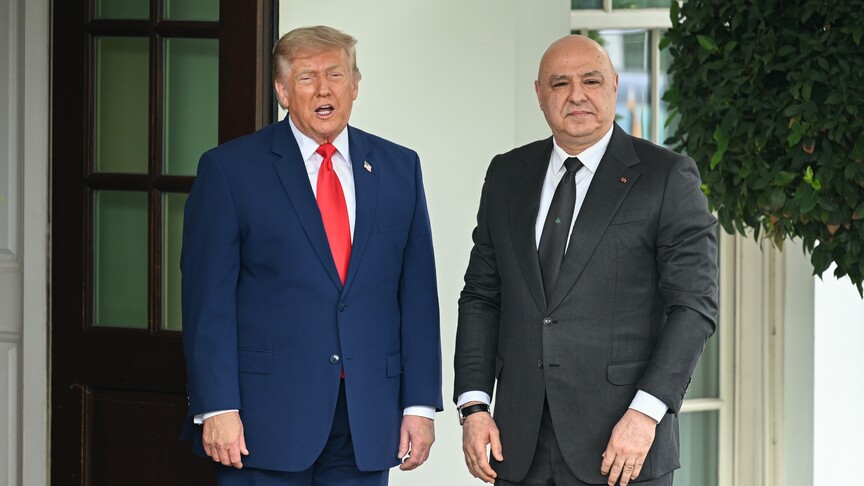
Lebanese President Joseph Aoun is scheduled to meet his U.S. counterpart Donald Trump on Tuesday in Washington as American pressure mounts on Lebanon to disarm Hezbollah.
The visit comes a day after the United States, which sponsors negotiations between Lebanon and Israel, announced the implementation of a framework signed by both countries that includes the Lebanese army extending its authority over 'pilot zones' in southern Lebanon.
These zones are adjacent to territories occupied by Israel in southern Lebanon, and the Israeli army is present at the edges of one of the towns. Israeli soldiers have advanced into wide areas in southern Lebanon since the start of the war between them and Hezbollah on March 2.
The framework agreement also stipulates a gradual Israeli withdrawal from the south, but Israel conditions the withdrawal on the disarmament of Hezbollah. It says it will keep its forces for now in what it classifies as a 'security zone'.
Washington is pressuring Lebanese authorities to disarm Hezbollah, which is backed by Iran.
U.S. Secretary of State Marco Rubio told reporters after meeting Aoun on Sunday: 'As long as this problem persists, Lebanon will not truly enjoy peace.'
In a previous statement by the U.S. State Department, Rubio praised 'the courage of the Lebanese government (...) and its determined efforts to restore Lebanon's sovereignty, disarm Hezbollah, and dismantle its terrorist infrastructure.'
This is the first visit by a Lebanese president to the United States since 2009, when then-President Barack Obama received his counterpart at the time, Michel Suleiman.
Related News
What Will Be Asked of Lebanon?
Director of the Carnegie Middle East Center, Maha Yahya, says that the meeting, while 'showing continued American interest in Lebanon,' 'raises a lot of concern about what Lebanon might be asked to do afterward.'
Aoun, a former Lebanese army commander, pledged since his election as president in early 2025 with Western support to disarm Hezbollah, a major political shift in Lebanon and a step Hezbollah has repeatedly rejected.
The Tehran-backed Hezbollah opened a front with Israel from southern Lebanon in response to the killing of Iranian Supreme Leader Ali Khamenei on the first day of the U.S.-Israeli attack on Iran, and Israel responded with a devastating military campaign.
Israeli strikes since the start of the war have killed more than 4,300 people in Lebanon, according to authorities.
The pace of violence has significantly decreased since the signing of a memorandum of understanding between the United States and Iran last month, coinciding with continued negotiations between Lebanon and Israel.
The Lebanese army is expected to deploy in the 'pilot zones' after Israel withdraws from them, and to work on disarming the party there and banning any military presence for any group outside the legitimate forces, with this serving as a test for a gradual Israeli withdrawal from other areas.
Original source: Sky News Arabia



Comments (0)
Be the first to comment.