Iraq announces signing of memorandum of understanding with Syria to rehabilitate Haditha pipeline
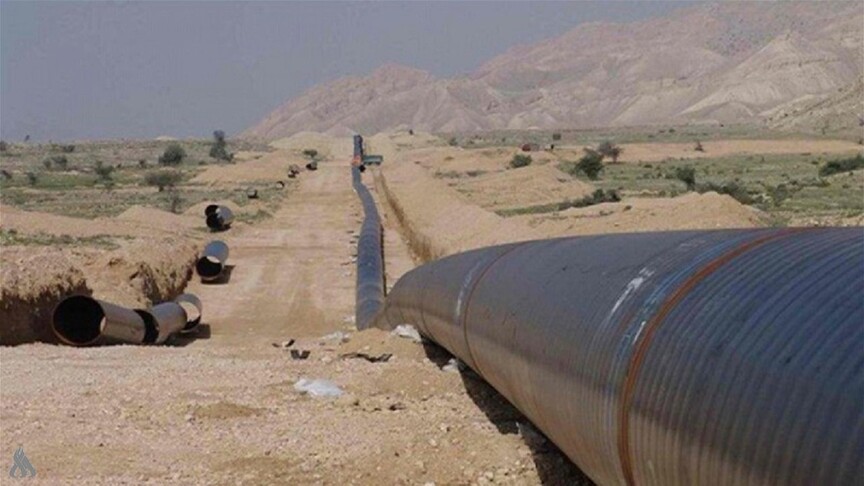
The Iraqi News Agency said that the American company Chevron will undertake the project, while no comment has been issued by the Syrian government on this matter as of 20:30 UTC.
Istanbul / Anadolu
The Iraqi News Agency announced on Friday the signing of a memorandum of understanding between Baghdad and Damascus to rehabilitate the oil pipeline extending from the city of Haditha in western Iraq to the port of Baniyas on the Syrian coast, with the American company Chevron to undertake the implementation of the project.
No comment has been issued by the Syrian government on this matter as of 20:30 UTC.
The Iraqi agency quoted its correspondent in Washington as saying that Baghdad and Damascus signed a memorandum of understanding to rehabilitate the oil pipeline from Haditha to Baniyas, and that Chevron will implement the project.
The agency did not provide details on the location of the signing, its cost, the target export capacity, or the start date of the project.
The project is part of a broader Iraqi plan to connect the oil fields in Basra in the south of the country to the city of Haditha in Anbar province (west), and from there to establish or rehabilitate a route extending west through Syrian territory to the port of Baniyas on the Mediterranean Sea.
According to the Iraqi announcement, this project appears to differ from the historical Kirkuk-Baniyas pipeline in terms of the starting point of the oil; the old line began from the Kirkuk fields in northern Iraq, then passed through the K3 pumping station near Haditha, before crossing Syrian territory to the port of Baniyas.
As for the current project, it aims to transport oil produced in the Basra fields in southern Iraq to Haditha, then direct it to Baniyas, making Haditha a meeting point between the new Iraqi route and the western part of the historical export line.
It was not clear from the Iraqi announcement whether the memorandum stipulates repairing and reusing the existing historical pipeline between Haditha and Baniyas, or replacing it with a new pipeline or creating a parallel route, as the technical details of the project were not immediately published.
The Iraqi government had approved at the beginning of this July to conduct technical and financial studies for two proposed routes to export southern oil: 'Basra-Haditha-Baniyas' via Syria, and 'Basra-Haditha-Kirkuk-Ceyhan' via Turkey, as part of the search for alternative outlets to the Strait of Hormuz.
For its part, the US Embassy in Baghdad said in a statement that the United States welcomes the signing of a 'historic memorandum of understanding' between the governments of Iraq and Syria regarding the rehabilitation and reconstruction of the crude oil pipeline connecting the two countries.
It added that the project would enhance security, stability, regional connectivity, and prosperity, stressing that American companies will play a key role in carrying out the construction work.
On Tuesday, a US State Department official announced Washington's support for the efforts of Iraq and Syria to revive the oil pipeline between the two countries, expecting American companies to play a role in the project, without Chevron having confirmed its official participation at that time.
On July 4, the Iraqi Council of Ministers approved the signing by the Basra Oil Company of a preliminary principles agreement and a confidentiality agreement with a consortium comprising the American companies Capital TI and Chevron and the Qatari company UCC.
The consortium is tasked with preparing technical and financial feasibility studies and comparing the Basra-Haditha-Baniyas route and the Basra-Haditha-Kirkuk-Ceyhan route, without the preliminary agreements imposing final financial or contractual obligations on the Iraqi Ministry of Oil.
These moves come within Baghdad's efforts to diversify oil export outlets and reduce its reliance on southern ports and the Strait of Hormuz, through which most of the country's oil exports pass.
Iraq had begun in recent months to transport shipments of crude oil by land to Syria for re-export via the port of Baniyas, and also announced its readiness to transport about 50,000 barrels per day of Basra crude by tankers.
Iraqi oil expert Asim Jihad said in a report published by Anadolu on July 8 that pipelines represent a more sustainable and less costly option than land transport, explaining that the old oil pipeline between Iraq and Syria is no longer suitable for export without rehabilitation or construction of new infrastructure.
The construction of the historic Kirkuk-Baniyas pipeline dates back to 1952, and it used to transport oil from the Kirkuk fields to the Syrian coast with an estimated capacity of about 300,000 barrels per day.
The pipeline stopped in 1982 due to the dispute between Baghdad and Damascus during the Iran-Iraq war, and it was partially reactivated in 2000, before being damaged during the US invasion of Iraq in 2003 and going out of service.
Original source: Anadolu Agency





Comments (0)
Be the first to comment.