Argentina and Spain: Different Economies United by the Football Industry

As Argentina and Spain vie for the 2026 World Cup title, a comparison of their economies reveals stark contrasts yet a shared powerhouse in the global football industry. Spain boasts a diversified European economy driven by services and tourism, while Argentina relies on agriculture and natural resources. Despite the economic gap, both nations have turned football into a multi-billion dollar business, from broadcasting rights to player transfers.
Before the 2026 World Cup final decides the champion between Argentina and Spain, the economic comparison imposes itself off the pitch.
The match brings together two economies that follow different paths to growth; Spain relies on a diversified European economy led by services, tourism, and industry, while Argentina is based on agriculture, natural resources, and energy.
Despite the large gap in economic size between the two countries, Madrid and Buenos Aires meet in an industry that has transcended sports, as football has become a global economic activity generating billions of dollars through broadcasting rights, sponsorship, sports tourism, and player transfers.
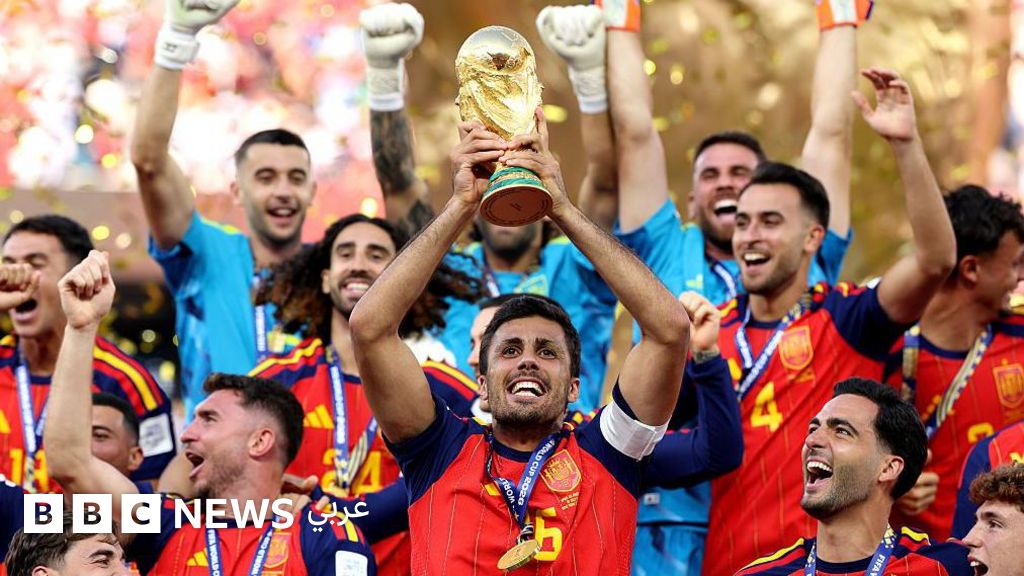
The two teams reached the final through different routes; Spain secured its place by defeating France in the semifinals, while Argentina continued its title defense by overcoming England to reach the championship match.
Between the champions of Europe and South America, the comparison is not limited to performance on the field, but extends to two economic models and two of the most influential football industries in the world.
Contrasting Economies
According to World Bank data, Spain's GDP is about $1.9 trillion, with a population of nearly 49 million, making it one of the largest economies in the European Union.
Its economy is based on a diversified base led by services, along with industry, tourism, renewable energy, and financial services, benefiting from the country's EU membership and the adoption of the euro as its official currency.
In contrast, World Bank data shows that Argentina's GDP is about $683 billion, with a population of around 46 million, making it one of the largest economies in Latin America.
Its economy relies mainly on agriculture, livestock, and food industries, along with oil, gas, and minerals, especially lithium, which is gaining increasing importance with the expansion of the electric vehicle industry.
These indicators reveal a clear gap in economic size, but they do not imply absolute superiority in terms of strengths.
Spain is characterized by diversified income sources and financial stability, while Argentina possesses vast natural wealth that gives it a competitive advantage in food, energy, and mineral markets.
Growth Drivers
The services sector is the main driver of the Spanish economy, and tourism is one of the most prominent sources of income, as data from the National Institute of Statistics (INE) indicates that the sector plays a key role in GDP and supports millions of jobs.
The manufacturing industries, especially automobiles, chemicals, and food products, also maintain an important role in supporting exports and boosting industrial activity.
In Argentina, growth drivers are based on productive sectors; the country is one of the largest producers and exporters of soybeans, corn, wheat, and meat.
The energy sector is also expanding continuously with the development of oil and shale gas reserves in the Vaca Muerta field, along with large lithium reserves, which gives the country opportunities to boost exports and attract new investments.
Despite this, Argentina still faces challenges related to inflation, peso exchange rate fluctuations, and fiscal rebalancing, which are key issues in ongoing economic reforms.
A Global Industry
Despite the different economic structures, football has become a fully integrated industry in both countries, with its effects extending to media, advertising, tourism, transport, trade, and broadcasting rights.
According to LaLiga, professional football is one of the most influential economic activities in Spain, driven by revenues from broadcasting rights, sponsorship, marketing, and matchdays, as well as its impact on tourism, hospitality, and employment.
In Argentina, the economic model of football relies heavily on discovering and developing talent and then transferring them to European clubs, making player transfers one of the main sources of income for clubs, along with sponsorship deals and local broadcasting rights.
The economic value of football does not stop at clubs and federations, but extends to hospitality, aviation, media, and retail sectors, which benefit from major tournaments and increased demand for travel, sports products, and digital content.
Two Different Models
The World Cup final reflects two different models in building an economy and the football industry. Spain has succeeded in developing a domestic league that has become a global brand attracting investors, viewers, and sponsors, while Argentina has built its football reputation on producing talent and exporting it to the biggest European clubs, making its football academies part of the global value chain of football.
Although the Spanish economy is more than triple that of Argentina, football has given both countries a comparable level of global influence, whether through clubs and tournaments or through stars who have become ambassadors for their countries in various leagues.
When the final whistle blows, the competition for the trophy will be on the pitch, but off the lines, the economy will remain present in the details of the scene—from broadcasting rights and sponsorship to tourism and fan spending—reaffirming that football is no longer just a popular game, but a global industry that has become an important economic driver for countries, clubs, and companies alike.
Original source: Aleqtisadiah





Comments (0)
Be the first to comment.