Trump: Iran Agreed to a Deal Then Broke It Within an Hour.. We Responded with Bombing
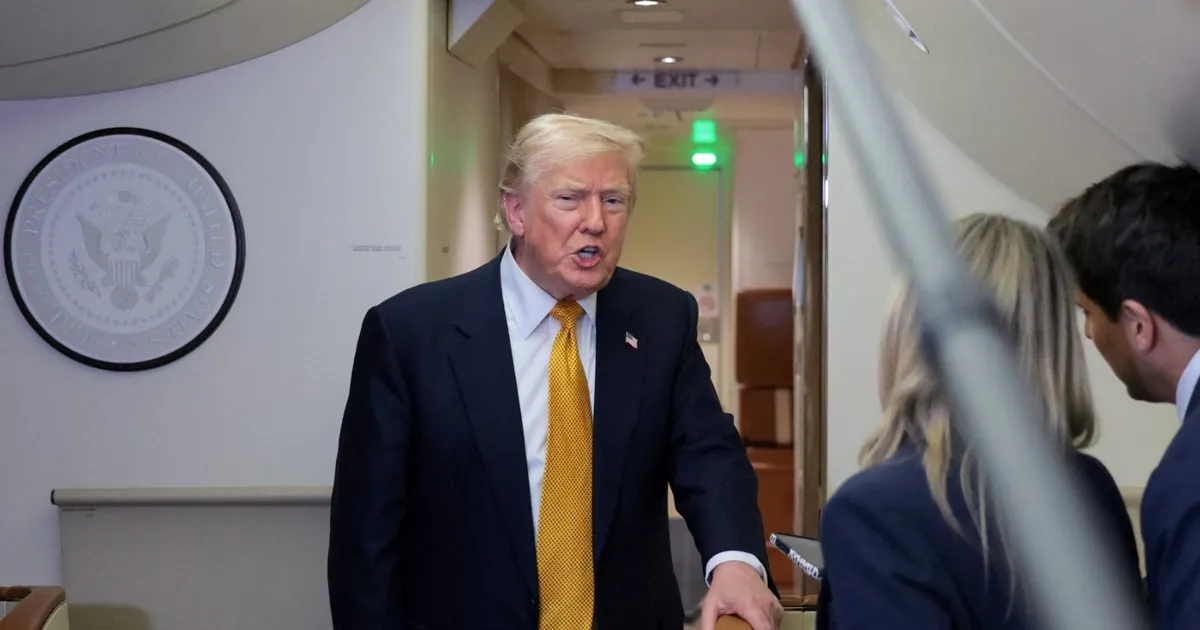
US President Donald Trump said that the United States and Iran reached an agreement on Saturday, but Tehran "broke it within an hour" by launching a drone toward a ship, asserting that the Strait of Hormuz remains open to commercial navigation.
Trump explained, in an interview with NBC News' Meet the Press, that Iran agreed to a deal in which "it gave up everything."
He mentioned holding meetings with the Iranian side, adding: "They agreed yesterday to a deal that was perfect for us: no nuclear program, no this, no that, nothing at all. They gave up everything. But they left the meeting room, and within an hour, they launched a drone toward a ship."
He continued: "I said to them: You are sick. You are sick people," adding: "We bombed them very hard last night. They are very evil and sick people."
Muscat Talks
Trump's remarks came hours after the conclusion of Omani-Iranian talks in Muscat on Saturday regarding navigation in the Strait of Hormuz, chaired by Omani Foreign Minister Badr al-Busaidi and his Iranian counterpart Abbas Araghchi.
The Omani Foreign Ministry stated that the talks covered ensuring the safety and freedom of navigation in light of recent developments and their repercussions, noting that the two sides agreed to continue discussions at the political and technical levels, with the aim of reaching the required understandings in accordance with international law.
The Omani statement did not announce a final agreement, nor was the nature of the meetings Trump referred to or the identity of the participants clear.
ABC News reported, citing a US official and a knowledgeable source, that Araghchi returned to Tehran carrying an Omani proposal to manage maritime traffic in the strait.
According to the two sources, the proposal stipulates allowing ships to pass unhindered through the southern corridor, located in Omani territorial waters, while ships using the northern corridor, located in Iranian territorial waters, must obtain prior approval from Tehran, without paying transit fees.
Escalation After Talks
But escalation resumed hours after the conclusion of the Muscat talks, as the Iranian Revolutionary Guard Navy announced the closure of the Strait of Hormuz "until further notice," and said it targeted a commercial ship after it ignored warnings and attempted to cross via a route not approved by Tehran.
Reuters reported that the ship sustained damage and a fire broke out on board.
Following the attack, the US Central Command (CENTCOM) said it completed a third round of strikes on Iran, hitting about 140 military targets in response to the targeting of the commercial ship in the Strait of Hormuz.
After the strikes ended, CENTCOM affirmed that the strait is "open to all ships seeking to transit lawfully through the international waterway," noting that vessel traffic continues.
It added that US forces are "postured and ready to ensure freedom of navigation remains available, despite Iranian aggressions, harassments, threats, and arbitrary announcements," stressing that "Iran does not control the strait."
Later, Iran launched missile and drone attacks on several Gulf states, with Qatar announcing the interception of missile attacks, the Kuwaiti army saying it repelled an aerial threat, and Oman reporting that sites in the Musandam Governorate were targeted by drones.
Shrapnel from intercepted projectiles injured at least three people in Qatar, while the other countries did not report any casualties.
Waltz Casts Doubt on Iranian Narrative
In this context, US Ambassador to the United Nations Mike Waltz, earlier on Sunday, questioned the veracity of previous statements by a US official that Iran acknowledged that the targeting of commercial ships in the Strait of Hormuz was accidental.
Waltz said in an interview with ABC News: "Are we supposed to believe that some junior officers are acting on their own and firing on ships, yet face no consequences from a dictatorial, hierarchical entity like the Revolutionary Guard? I don't believe that."
A US official had said on Friday that Iran acknowledged, during communications with the United States, that strikes targeting commercial ships earlier in the week were accidental.
Waltz considered that what Iran is doing constitutes "a violation of international law," adding: "Regardless of whether you are a party to a conflict, you cannot fire in all directions, attack your neighbors, target civilian ships and infrastructure, plant mines in international waterways, and act like the irresponsible, genocidal regime that many have long accused Iran of being."
Despite describing dealing with the Iranian leadership as "extremely difficult," Waltz affirmed that technical talks between the United States and Iran continue.
Pakistan Calls for De-escalation
Following the renewed clashes, the Pakistani Foreign Ministry on Sunday expressed its "deep concern" over the recent incidents, which it said are leading to further escalation of regional tensions.
Pakistan, which plays a mediating role in implementing the Islamabad memorandum of understanding, reaffirmed its strong support for the sovereignty and territorial integrity of all sister countries in the region, calling on all parties to exercise restraint and take immediate steps to de-escalate and fulfill their obligations under the memorandum.
The Pakistani Foreign Ministry affirmed Islamabad's commitment to providing all forms of support to achieve lasting peace and stability in the region through dialogue and diplomacy.
Original source: Asharq News


Comments (0)
Be the first to comment.