Asian stocks rise as US inflation slows and rate hike expectations wane
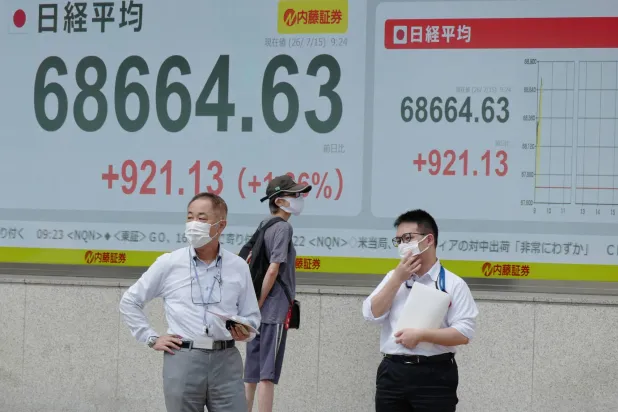
Asian stocks rose on Wednesday after slower US inflation boosted hopes that the Federal Reserve may slow the pace of monetary tightening.
China's economy grew at its slowest pace in over three years in the second quarter, as weak household consumption overshadowed strong manufacturing and exports, raising concerns about the long-term sustainability of its unbalanced growth model.
Gross domestic product grew 4.3 percent in the April-to-June period, down from 5.0 percent in the first quarter, falling below the lower end of China's annual target of 4.5 to 5.0 percent and missing expectations.
Attention now turns to the closely watched Politburo meeting of the Communist Party, scheduled for later this month, where top leaders typically assess economic conditions and adjust policies to maintain the growth trajectory... However, many economists believe that the biggest challenge lies not in the pace of growth, but in its composition.
Data released Wednesday showed retail sales rose 1.0 percent in June and industrial output expanded 5.3 percent, indicating heavy reliance on global demand for manufactured goods, even as trading partners complain about China's imbalances and the Iran war casts a shadow over the global economy.
Jin Hu, who runs a European goods import company in eastern China, says her income has nearly halved since the start of the year due to lower sales, and an apartment she rents out has been vacant for months, reflecting China's massive housing oversupply and prolonged property crisis. Hu adds: 'Apart from essential food expenses, I save as much as possible. I haven't bought a single piece of clothing in six months.' Still, the economy grew 4.7 percent in the January-to-June period, within the target range, reducing the urgent need for a large stimulus package.
Zhang Zhiwei, chief economist at Pinpoint Asset Management, doubts that the Politburo meeting will signal a wider fiscal deficit, given the current strength of exports. Zhang says: 'The government seems reluctant to spend fiscal resources and accumulate debt. There is a general consensus among policymakers and researchers that China needs to boost domestic demand. But there is no consensus on how to achieve that.'
* Investment slowdown and weak domestic consumption
Wages have not kept pace with overall economic growth, and have even fallen in some sectors. Industrial overcapacity, US tariffs, and price wars among producers have led to factory layoffs, while weak demand and rapid adoption of artificial intelligence have slowed new job creation in the administrative sector. The property market downturn has eroded household wealth and reduced construction jobs since 2021. Data showed real estate investment contracted 18 percent year-on-year in the first six months, while home prices also fell. Tens of millions of people have moved from formal jobs to the gig economy, now working long hours on ride-hailing and delivery platforms for low pay and inadequate social security benefits.
Investment is also slowing, as local governments, long a key driver of investment in manufacturing and infrastructure—often blamed for creating overcapacity and misallocating resources—face mounting pressure to cut costs.
Emma Qing, a 28-year-old nurse in Guilin (a major city in Guangxi Province, one of China's less affluent regions), says her income has 'dropped sharply' due to a lack of funding in the local medical sector. Qing added: 'I used to have memberships at sports clubs, beauty salon cards, and Tencent Video subscriptions, and I would replace my phone or iPad. Now I don't dare spend money on such things.'
China's fixed-asset investment contracted 5.7 percent year-on-year in the January-to-June period, with even government sector investment falling 2.3 percent. Andy J, an analyst at ITC Markets, said: 'The main reason for the lower overall growth rate is the deepening decline in domestic investment activity. Overall, an industrial engine driven by advanced technology, combined with a sharp decline in domestic consumption and investment, highlights a significant disparity in economic growth momentum.'
* Strong exports
Reliance on exports to drive growth is increasing; trade data released Tuesday showed external demand has so far compensated for weak domestic consumption, with exports beating expectations with a 27 percent rise, driven by global AI growth. This partly reflects US retailers stockpiling goods ahead of Black Friday and Christmas holiday sales, before expected tariff increases later this year, according to shipping industry executives.
US President Donald Trump's visit to China last May maintained the thaw between the world's two largest powers, but their trade relationship remains fragile.
The United States has imposed a blanket 10 percent tariff, while the tariffs Washington imposed in February are set to expire next February, after the Supreme Court ruled some previous tariffs illegal on July 24 last year, but they are widely expected to be replaced with higher tariffs. The US Trade Representative has proposed imposing tariffs of 12.5 percent on imports from China and other countries, following an investigation into 'forced labor,' which Beijing denies. A final decision is expected in the coming months.
Furthermore, the European Union, whose average trade deficit with China reached $1 billion per day last year, is stepping up protection of its industrial sectors from Chinese competition. The renewed conflict between the United States and Iran adds to uncertainty about global growth.
Larry Hu, chief China economist at Macquarie Group, said Beijing has little incentive to abandon external demand for now. He added: 'What will change the current situation is a failure of exports. When exports slow down, and to achieve the growth target, the government will make more efforts to support domestic demand.'
Original source: Asharq Al-Awsat




Comments (0)
Be the first to comment.