Egypt: Gold Recovers Part of Its Losses Despite Global Market Pressures... What Do Experts Say?
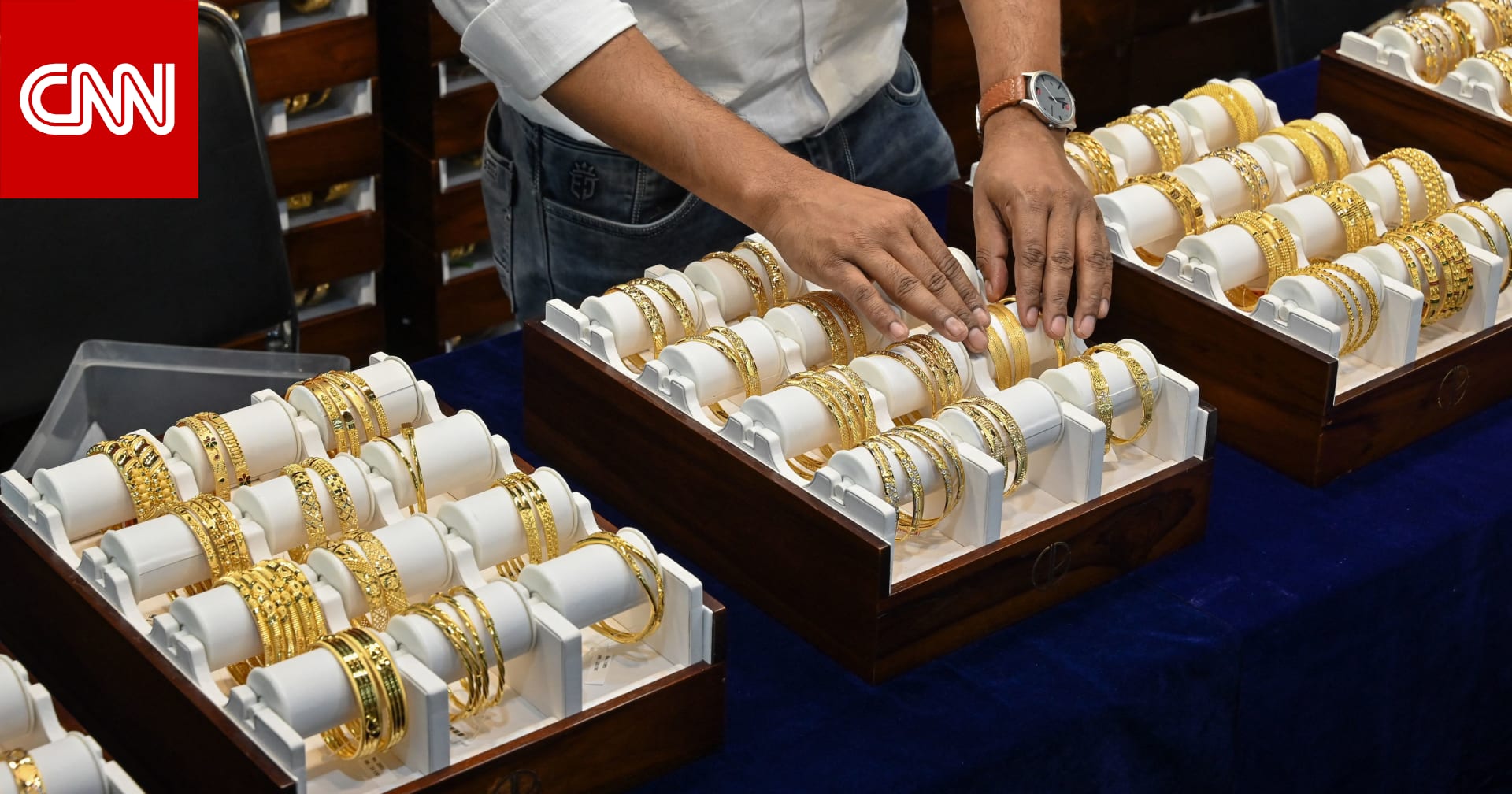
Gold prices in Egypt compensated for part of their losses during this week's trading, supported by continued local demand and a rise in the dollar exchange rate
Archival image Credit: MANJUNATH KIRAN/AFP via Getty Images
Cairo, Egypt (CNN) -- Gold prices in the Egyptian market managed to recover some of their losses during this week's trading, driven by continued local demand and a rise in the dollar exchange rate, coinciding with global stock exchanges facing downward pressure due to rising oil prices, a strong US currency, and growing expectations that US monetary policy will remain tight.
Gold prices are usually affected by a set of complex economic and geopolitical factors that link the movement of local markets to major global financial trends.
The price of 21-karat gold, the most sought-after in Egypt, recorded about 6,000 pounds (equivalent to $117) before falling slightly to hover below that level, while globally the precious metal dropped from its two-week peak to about $4,041 per ounce after exceeding $4,150 in the previous session, amid profit-taking, a jump in Brent crude to near $100 per barrel, and anticipation of the US Federal Reserve meeting to determine interest rate decisions.
Gold's global decline came after it rose on Wednesday to its highest level since July 7, supported by buying and investor appetite for safe-haven assets amid escalating geopolitical tensions in the Middle East. However, these gains quickly shrank with rising oil prices, which heightened fears of continued inflationary pressures and led investors to increase their bets on US interest rates remaining higher for longer, thereby reducing gold's appeal.
The rise of the US dollar also increased the cost of buying gold for investors from outside the United States, while a number of speculators moved to take profits after the recent rally, adding pressure on the yellow metal.
"Temporary Movement"
Saeed Imbabi, Executive Director of the online gold and jewelry trading platform iSagha, confirmed that the current drop in prices does not signify the end of the loss recovery trend, but rather represents a temporary profit-taking wave currently controlling the trading path.
He added that the relationship between gold and oil has become more evident recently, as any tensions or skirmishes in the Strait of Hormuz lead to higher oil prices, while investors and speculators tend to sell gold after rallies to take profits, explaining that these rapid movements have become the dominant feature of market trading.
Imbabi explained, in exclusive statements to CNN in Arabic, that the reasons for price movements differ between the local and global markets. In Egypt, the rise in the dollar exchange rate in recent days has supported gold prices, while global prices were affected by higher energy prices and increased expectations of US interest rates remaining at elevated levels.
He pointed out that the most influential event in the coming period will be the US Federal Reserve meeting, with expectations leaning toward keeping rates unchanged. However, the statement and accompanying press conference will be the decisive factor in determining gold's direction, by revealing the US central bank's monetary policy outlook for the coming months.
He affirmed that any hint of future interest rate cuts would support gold prices, although this scenario is still unlikely at present, predicting that global prices will move in a range between $4,000 and $4,200 per ounce until the Fed's outlook becomes clearer.
"The Egyptian Market Recovers Its Losses"
For his part, gold industry expert Dr. Nagy Farag said that gold prices in the Egyptian market have managed to recover a large portion of their losses over the past two weeks, supported by the dollar exchange rate rising again to exceed the 51-pound level, along with continued strong demand for the yellow metal, as gold retains its status among Egyptians as a safe store of value and a hedging tool against economic fluctuations.
Farag added, in exclusive statements to CNN in Arabic, that the global market has recently faced pressure due to rising oil prices, along with increasing expectations of US interest rate hikes, which led to a decline in the gold ounce from levels exceeding $4,150 to around $4,045.
Farag explained that oil prices exceeding $100 per barrel represents one of the main factors pressuring the precious metal, along with growing expectations of tighter US monetary policy, which negatively impacted gold and silver prices in global markets. However, the Egyptian market maintained some stability thanks to continued local demand, as the country continues to import gold bullion to meet market needs, indicating sustained demand for the precious metal despite global fluctuations.
He added that the price of 21-karat gold fell slightly after approaching the 6,000-pound level (about $117), as this decline reflected global price movements but did not change the relative stability seen in the local market. He also expected price movements in the coming period to be linked to the course of US monetary policy, along with developments in global geopolitical conditions.
Gold markets remain the focus of investors and analysts as a safe haven in times of economic uncertainty and political tensions. The path of the yellow metal is closely linked to the decisions of major central banks, especially the US Federal Reserve, as well as developments in energy prices and inflation. Market watchers continue to anticipate upcoming economic data and awaited meetings to assess future interest rate trends and their direct impact on the value of various assets.
Original source: CNN Arabic



Comments (0)
Be the first to comment.