Surge in Egypt's Gold Imports Raises Questions about Local Manufacturing
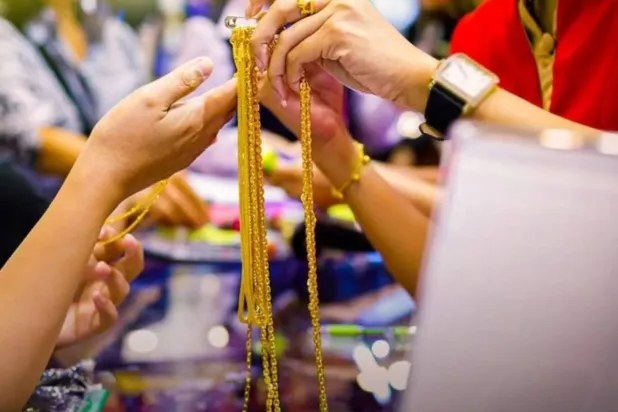
Egypt's gold imports in the first half of 2026 reached about $4.05 billion, compared to $249.6 million in the same period last year.
The doubling of gold imports in Egypt during the first half of this year has raised questions about local manufacturing, as 'imports surged more than 15-fold,' according to official data from the Export and Import Control Authority.
Egypt's gold imports in the first half of 2026 reached about $4.05 billion, compared to $249.6 million in the same period last year, a growth rate of 1523.2 percent, while gold imports accounted for 8.42 percent of Egypt's total non-oil imports during the same period, topping the list of most imported goods.
Hani Milad, head of the Gold and Jewelry Division at the General Federation of Chambers of Commerce, attributed this surge to 'supply and demand in the first place,' telling Asharq Al-Awsat that 'with increased local demand for bullion, imports are increased to meet local demand through manufacturing,' noting that 'the same period last year saw a significant increase in supply, which reduced import operations.'
Meanwhile, Lotfy Moneeb, deputy head of the Gold Division at the Chamber of Commerce, attributed the increase in gold imports to 'some citizens directing part of their savings to buy gold, coinciding with the maturity of high-yield bank certificates at 27 percent in the first months of this year and the decline in returns, which reflected on the markets with increased demand.'
He added to Asharq Al-Awsat that 'many citizens preferred to buy gold with their savings as the most suitable alternative, given the large increases achieved last year and the continued decline in interest rates in banks.'
He also explained that 'imported raw gold is used to manufacture bullion, while semi-finished gold is used in some locally manufactured models,' noting that 'the greatest demand was associated with bullion manufacturing to meet demand in the recent period as a preferred savings method for buyers.'
Large gold bullion bars (BTC Company page on Facebook)
Data from the World Gold Council issued last April showed an increase in demand for gold bullion and coins in Egypt, recording 5.7 tons in the first quarter of this year, a year-on-year increase of 22 percent.
Gold market expert Osama Zarie points to other reasons for the increase in Egyptian gold imports, linked to 'execution of sales at large discounts with the drop in gold prices, which increased imports.' He explains: 'Major companies bought at prices lower than the market price, and with changes in the exchange rate (pound) due to pressures from the Iranian war, there were realized gains for importers.'
He adds to Asharq Al-Awsat that 'the gold jewelry market in Egypt has been suffering for more than two years due to weak demand for jewelry, in contrast to strong demand for bullion as a means of saving and preserving the value of money, which prompted some companies to close their jewelry manufacturing lines and suffice with manufacturing bullion, which sells quickly and is favored by citizens.'
Zarie explains that 'supporting and encouraging local gold jewelry manufacturing requires moves on several levels related to providing support for the industry, which needs many facilities to be competitive.' He points out that 'demand for purchasing jewelry manufactured in Egypt abroad is good, but the industry itself faces obstacles.'
The Egyptian market suffered from a shortage of gold bullion bars (BTC Company page on Facebook)
Economic expert Karim al-Omda also notes that 'the jump in imports of gold ore in its form that requires manufacturing clearly reflects an increase in local manufacturing of some gold jewelry in general and bullion in particular.' He expected 'an increase in exports of jewelry and bullion during the second half of this year after the disruptions caused by the Iranian war affected global trade.'
Al-Omda adds to Asharq Al-Awsat that 'the increase in local manufacturing is reflected in the Egyptian market, which now provides locally manufactured bullion and jewelry with a number of companies operating in the Egyptian market.'
For his part, Mohamed Anis, a member of the Egyptian Association for Political Economy, confirmed to Asharq Al-Awsat that 'Egyptians abroad also played a role in increasing the quantities of imported gold, as a considerable number of expatriates prefer to buy gold instead of returning with foreign currency savings.' He points out that this coincided with remittances from Egyptians abroad recording their highest numbers in the second quarter of this year.
According to data issued by the Central Bank of Egypt at the beginning of this month, remittances from Egyptians abroad during the period from July 2025 to last May recorded 'about $43.1 billion, an increase of 31.2 percent.'
"); googletag.cmd.push(function() { onDvtagReady(function () { googletag.display('div-gpt-ad-3341368-4'); }); }); }]
Original source: Asharq Al-Awsat



Comments (0)
Be the first to comment.