Engineering Financial Deception: How Seibu Misled the Japanese Market?
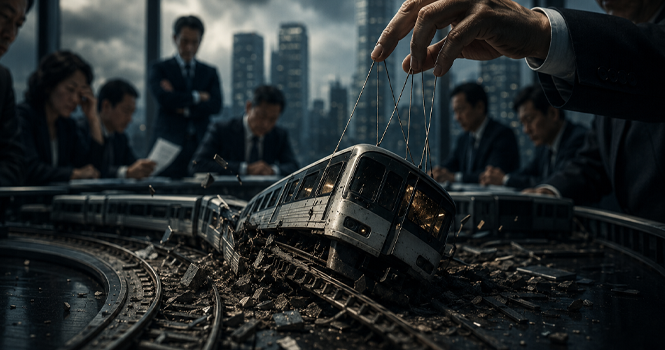
Not all financial manipulation cases start with forged ledgers or phantom profits; sometimes deception is quieter and more complex, as was the case with Japan's Seibu Railway, one of the most famous railway operators in the Tokyo area. For decades, Seibu presented a misleading picture of its ownership structure, until the truth emerged in 2004, turning it into one of the most prominent cases of misrepresentation linked to ownership disclosure in the history of Japan's stock market. A deception that lasted for decades. When investigations in October 2004 uncovered the truth, the accusation was not about profit manipulation…
Engineering Financial Deception: How Seibu Misled the Japanese Market?
Financial manipulation cases are not limited to falsifying ledgers or fabricating profits; some are quieter and more complex, like what happened with Japan's Seibu Railway, the operator of Tokyo's railways.
Cases of manipulation in ownership disclosure are among the most serious violations that threaten the credibility of financial markets.
For many years, the company provided incorrect information about its ownership, until the matter was exposed in 2004, becoming a prominent case in Japanese market history related to disclosure.
Deception that lasted for decades
When investigations in October 2004 revealed the truth, the accusation was not about profit manipulation or hiding losses, but about a deliberate engineering of the ownership structure.
For more than four decades, Kokudo, Seibu's parent company, hid the actual extent of its control. Reports showed that major shareholders owned 63.7%, while the true figure was 88.6%.
At the same time, Tokyo Stock Exchange rules prohibited listing any company where the top ten shareholders owned more than 80% of shares, meaning that Seibu had not met listing requirements for decades.
To give credibility to the picture, the ownership records included hundreds of individuals' names, but it turned out that about 400 of them were just fronts for shares controlled by group subsidiaries, creating the illusion of a broader shareholder base.
Last attempt to save the listing
As the truth approached exposure, the group tried to avoid delisting. Kokudo secretly contacted several companies with which it had long-standing business relationships, encouraging them to buy Seibu shares to lower the group's apparent ownership percentage and formally comply with listing rules.
It also sold part of its stake before announcing the violations, without disclosing to buyers information that could affect the value of their investments, which later prompted several investors to seek compensation after the stock collapsed.
With the gap between declared and actual ownership exposed, the Tokyo Stock Exchange had no choice but to delist Seibu shares in 2004, making it the first company to be removed from the Japanese market since 1980 for providing misleading information in its disclosures.
The then-president of the Tokyo Stock Exchange described the decision as necessary to protect investor confidence, emphasizing that a company over 90 years old had betrayed the trust the market had placed in it.
The key figure
At the heart of the case was businessman Yoshiaki Tsutsumi, who inherited Seibu from his father and transformed it into a huge group encompassing railways, hotels, real estate, and resorts.
Tsutsumi's influence peaked when Forbes magazine ranked him the richest man in the world for four consecutive years from 1987 to 1990, before the collapse of Japan's real estate market greatly reduced his wealth.
But the Seibu scandal was the harshest blow: he was forced to resign, and later convicted of charges related to falsifying company records, manipulating disclosures, and insider trading, after admitting to misleading investors and regulators, and offering a public apology to shareholders in court.
Misleading shareholders was not the only flaw; investigations revealed a deeper governance crisis after the company admitted that its board of directors had not held any meetings for seven years, in clear violation of Japanese law.
The scandal's effects did not stop at Seibu's delisting or its chairman's downfall; they extended to the entire Japanese stock market. After the case was uncovered, the Tokyo Stock Exchange tightened disclosure and governance rules, while the Financial Services Agency demanded that thousands of listed companies review their financial statements, and a large number were forced to correct their disclosures.
Although Seibu later succeeded in restructuring its operations, the case remained a landmark in the history of the Japanese stock market and one of the most prominent examples of how misleading disclosure can be more dangerous than profit manipulation.
Sources: Financial Times – New York Times – Forbes – Wall Street Journal
Economic Events and Issues
Economic Investigations
{{displayname}}
{{profession}}
{{followercount}}
{{aboutme}}
The delisting of Seibu shares in 2004 was the first of its kind since 1980 on the Tokyo Stock Exchange, raising questions about the effectiveness of oversight. The case revealed how companies use fronts to circumvent listing rules. It underscores the importance of transparency in ownership structure to protect investors and ensure market integrity.
Original source: Argaam



Comments (0)
Be the first to comment.