How to Measure Employee Skills?
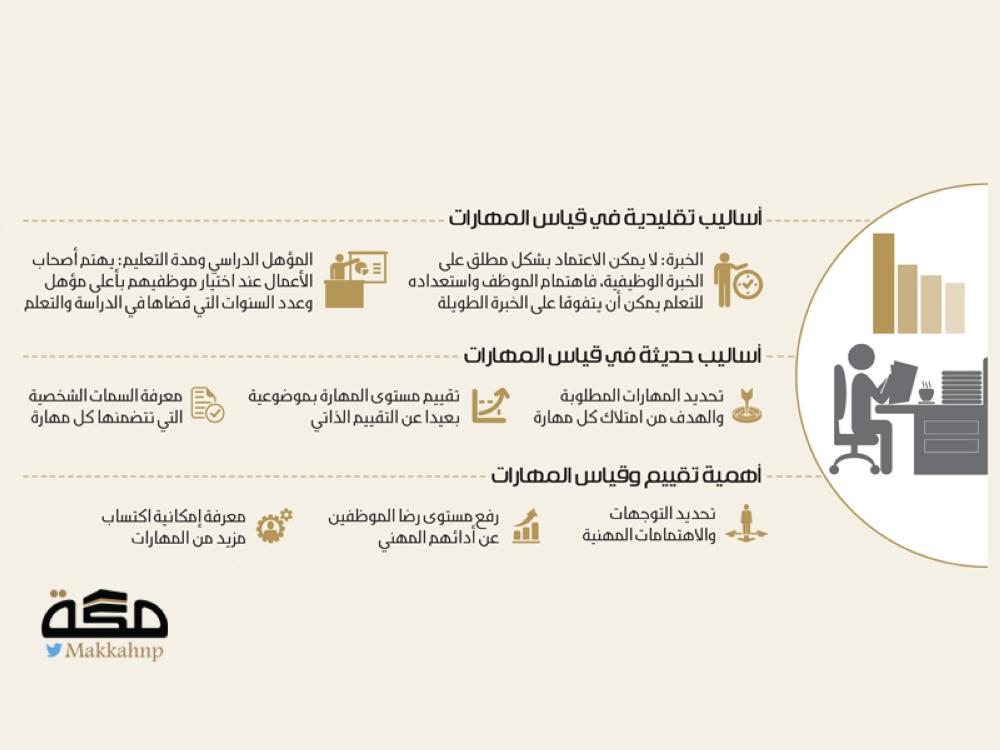
The article reviews traditional and modern methods for measuring employee skills, emphasizing the limitations of conventional techniques and the benefits of personalized, continuous assessment.
Skills represent an individual's real readiness for the future alongside academic and technical knowledge, and evaluating and measuring skills is one of the challenges facing individuals, employers, as well as universities and schools, due to their reliance on tests or personal interviews.
However, these methods are inaccurate because they do not take into account the possibility of skill development and growth, as well as the individual's prior preparation to pass the test or interview, and the level of skills plays a major role in meeting business goals and directly contributing to success and profits.
Traditional Methods of Measuring Skills:
Through research in more than 15 references concerned with skills and their evaluation and measurement, 'Makkah' noted that the evaluation and measurement of skills are mainly divided into two types: traditional and modern, as follows:
1. Experience:
It is not possible to rely absolutely on work experience to evaluate skills or make it an obstacle to employment, as an employee's interest and willingness to learn can outweigh long experience that does not include any keeping up with modern developments.
2. Academic qualification and duration of education:
Employers focus on the highest qualification and the number of years spent in study and learning when selecting their employees. Although educational level is positively correlated with skills, it is difficult to fully reflect the level of skills and abilities.
3. Skills tests:
Tests measure skills directly through complex tasks and questions. Perhaps the most famous is the Program for International Student Assessment (PISA) organized by the Organization for Economic Co-operation and Development (OECD). While tests provide objective measures of skills, they offer narrow information about skills.
4. Self-assessment:
Individuals often talk about their daily or professional skills, which tend to cover a wide range of skills but most of the time lack accuracy in their self-assessment due to reasons related to self-esteem and improving self-image.
5. Job requirements:
Focusing on the skills required to accomplish a task provides an initial measure of the skill levels needed for the job. However, this assessment focuses on a specific set of skills and does not give importance to other skills.
Modern Methods of Measuring Skills:
1. Identify the required skills and the goal of possessing each skill
2. Assess skill level objectively away from self-assessment
3. Know the personal traits that each skill includes
4. Track the development and change of skill over time
5. Classify and rank skills from strongest to weakest
6. Perform real tasks suddenly and unexpectedly
7. Conduct a group discussion with a series of open-ended questions about beliefs and opinions
8. Diversify the required tasks to include individual and group work
9. Set a schedule of tasks and expected results to see if the employee can exceed those expectations
10. Personalize the assessment based on the employee's personality, preferences, and work
11. Continuous and regular assessment alongside training
12. Link assessment of technical and professional skills necessary for job performance with soft skills that improve their interaction with others
13. Group members evaluate each other
14. Obtain customer evaluations
Importance of Evaluating and Measuring Skills:
1. Identify career orientations and interests
2. Increase employee satisfaction with their professional performance
3. Know the possibility of acquiring more skills
4. Identify strengths to reinforce and weaknesses to address
5. Reduce bias against employees and evaluate them only according to their abilities
6. Ensure the employee's interest in work and effort to develop themselves
7. Provide appropriate training courses for each employee
8. Grant the employee the promotion they deserve
9. Avoid errors and inaccuracy of self-assessment in the personal interview
10. Improve productivity as a result of distributing tasks according to employees' abilities
Original source: Makkah






Comments (0)
Be the first to comment.