Lebanon's Printing Presses: Their Ink Has Dried
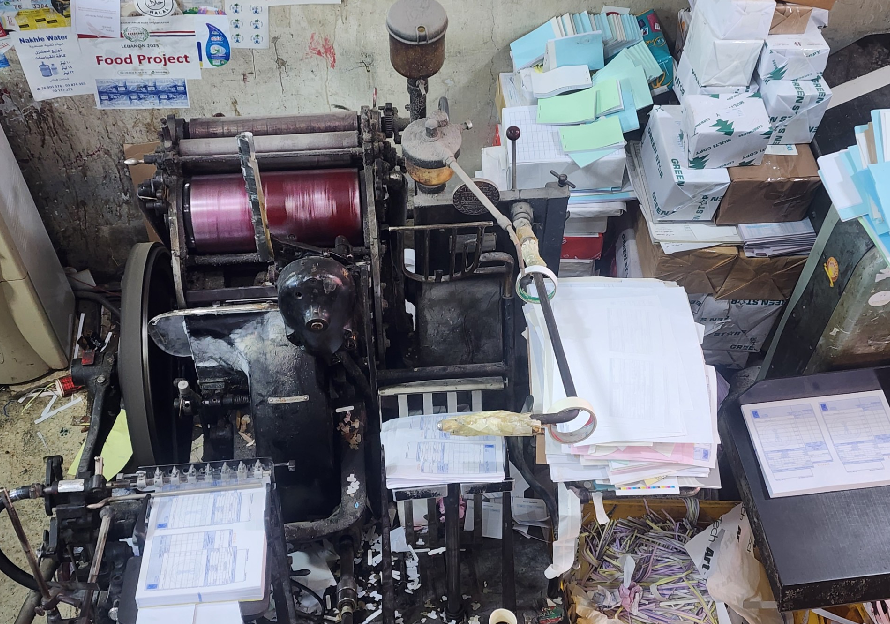
Printing presses have long been associated with the printing of holy books, scientific encyclopedias, and major works by philosophers and thinkers. In the past, it was a laborious task that consumed time, effort, and money, but over the last two decades it has achieved a tremendous technological leap, with the focus now on blending craft with modern techniques.
The printing industry in Lebanon is one of the oldest in the region, but it faces significant challenges in the digital age.
Nothing remains of Printing Press Street in Tripoli, northern Lebanon, but its name. The shops that once produced thousands of publications have changed in form and content. Not a single working printing press remains on that street; it has become a commercial street crowded with shoppers looking for new clothes, food, and sweets. Mohammad Dib al-Halabi recalls 1950, when he first entered the Al-Thamin press in the capital of the north, saying, "At that time, printing presses were spread on both sides of the street, working day and night to produce books, commercial ledgers, and pictures. The work was extremely hard. Dozens of people worked to produce a single printed sheet or an invoice for a commercial enterprise, before technological development completely changed the scene."
The history of printing in Lebanon dates back to the late 16th century (Independent Arabia)
The old printing press
The history of printing in Lebanon dates back to the late 16th century, when the first printing press in the East was established at the Monastery of Saint Anthony of Qozhaya in the ancient Qadisha Valley in northern Lebanon. The country witnessed a notable boom in book production over the following centuries, and the printing press became like a magic box from which free thought and deep scientific research emerged.
Mohammad Dib al-Halabi, 91, is one of the oldest living printing workers in Lebanon. He worked his way up from typesetting to owning his own press, which continued operating until 2008 before he was forced into retirement after witnessing a major shift in the craft. Now, after 76 years, he redraws the scene on Printing Press Street, where numerous presses were once located, most notably the "Adib and Nashaba" press, "Al-Sibai," and others.
Owners of old printing presses say they "sold their presses and typesetting boxes to scrap dealers" (Independent Arabia)
Al-Halabi explains that printing in those days was primitive, saying, "It was a complex process, especially for the Arabic language, due to the different shapes of letters depending on their position—at the beginning, middle, or end of a word. The typesetter had to remain cautious and aware regarding vowelization and diacritics, as well as printing in black and white versus color. The difficulty increased when the task was to produce a newspaper, a large scientific study, or collections of poetry and literature, because it took many days; hence local newspapers were weekly or biweekly."
Changes and development
Mohammad Dib al-Halabi notes that the printing press underwent many changes and significant development: "There was great demand for printing presses due to commercial activity and intellectual publications, and the slow pace of work contributed to an increase in the number of presses to meet various customer needs." He added, "Typesetting was an opportunity to shape the personality and culture of the worker in the press, as we were the first to read theses, various books, and works from all schools of thought."
Printing Press Street in Tripoli turned into a commercial market over time (Independent Arabia)
Al-Halabi rejects the notion that modern technology has greatly eased the burdens, speaking about the importance of manual printing craftsmanship compared to its modern counterpart: "It was written on fine paper that lasted a long time, and bookbinders sewed it by hand, careful to prevent it from coming apart. Workers manually folded the printed sheets before binding, after hours of effort and work." He goes on to explain the subsequent stages, especially typesetting, warning that any mistake, "even a single letter," could restart the entire printing process.
Read more
"The Trump era" was a golden period for book presses and publishing houses
Election propaganda revives the wheels of Iraqi presses that have been idle for years
Artificial intelligence preoccupies Henry Kissinger... heralding a revolution that may rival the invention of the printing press
Algeria's presses: a "historical savior" from Westernization schemes
Al-Halabi acknowledges that printing has undergone a huge revolution, producing giant, high-quality color images in minutes, whereas the same process used to take a full week. "Color printing previously relied on four colors: yellow, red, green, and blue, in addition to black to combine components. The press owner would print one color per day, then the next color, and so on, not to mention drying time to set the colors and their various shades. It was a difficult task requiring precision, creativity, and patience. We had to take part of the work home, where family members would help me fold and arrange simple items like commercial ledgers and carbon paper."
Al-Halabi takes pride that his career in printing witnessed great development, as well as the shift in focus from scientific research to wedding cards and color photos, and the use of more advanced printing machines.
Later, in 1978, al-Halabi founded his own printing press, which operated for four decades. He also headed the Printing Workers Union, which he helped establish at the age of 18 and which became part of a professional movement. He noted that "publications were subject to security censorship, and the source of a publication could be identified by the shape or quality of the typeface or the specific typesetting method of the press." He also recalls the difficulties press owners faced during the Lebanese civil war that broke out in 1975, as they had to travel long distances through the Akkar region (north), Baalbek and the Bekaa (east), and all the way to Beirut to obtain paper and ink canisters.
Scrap pieces
Owners of old printing presses say they "sold their presses and typesetting boxes to scrap dealers," or that some "managed to sell their press equipment in Syria to be installed and operated there about 20 years ago because of its large size." These testimonies indicate that the traditional printing press has disappeared, a victim of modern development.
Rami Younes, owner of a modern printing press and one of "the last to give up typesetting in printing," transitioned to working with modern techniques characterized by flexibility, speed, and creativity. "I started my career with typesetting; every worker must memorize it, master Arabic and advanced spelling skills so as not to fail in their duties, prepare what is required, learn about different fonts, and other essentials that are fundamentals of the profession."
Younes believes that printing evolved quickly: "Preparing an invoice required exceptional effort; drawing a calendar needed a calligrapher and an artist, then making a cliché, assembling templates, and organizing them precisely in terms of length and width, because any miscalculation could ruin the entire print run. Printing some huge volumes required several months, because it was not just a technical process; the text had to be reviewed through reading, correction, and proofreading to avoid any catastrophic typo that could affect the meaning and the entire print run, since a fatal error meant discarding the print and starting over. The financial cost was high."
Original source: Independent Arabia





Comments (0)
Be the first to comment.