Living in Iran: Accelerating Descent into Poverty
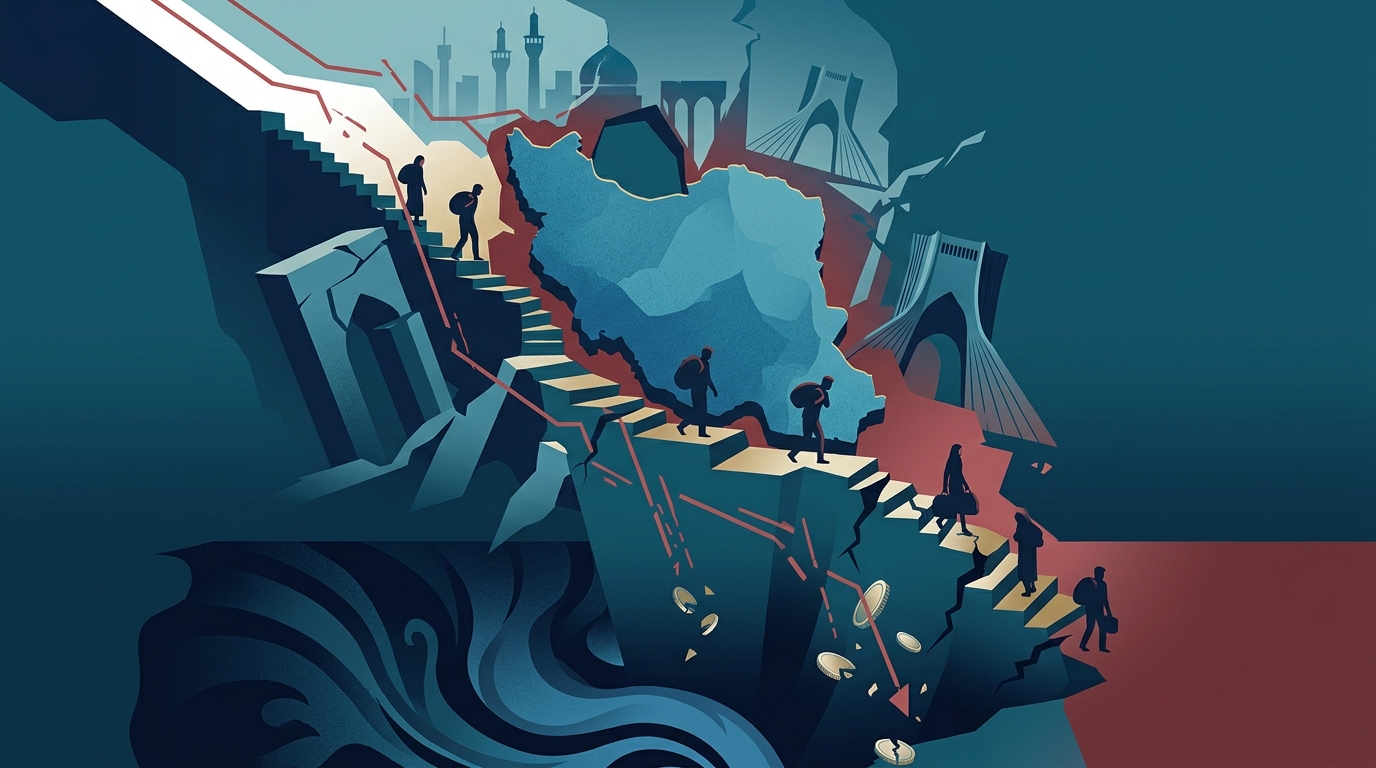
Official data shows Iran's inflation exceeds 100% for the poorest, with 11 provinces in triple digits. Residents report cutting meat, eating out, and basic necessities. Bread prices surge, healthcare costs soar, and middle class slides into poverty amid economic crisis.
Summary: Official data indicates that inflation is imposing a greater burden on lower-income groups, with the annual rate for the first quintile, the lowest income group, exceeding 100 percent, while 11 Iranian provinces recorded three-digit inflation rates, including Ilam, Kurdistan, Lorestan, West Azerbaijan, Kermanshah, Golestan, and North Khorasan.
"I haven't bought anything for myself in months. We have completely given up meat, and we no longer eat out," says a Tehran resident describing his daily life. This is not an isolated story; it is being repeated in various forms in many Iranian cities, reflecting the scale of the living crisis Iranians are experiencing.
A retiree talks about his inability to buy bread and medicine; a mother forced to return to her parents' home with her children after failing to pay rent; a worker who sees a minor illness as the start of his family's financial collapse; and a patient whose medication costs have multiplied several times in just a few weeks. All paint the same picture of the Iranian economy today.
The Central Bank of Iran announced in its latest report that the annual inflation rate until last June reached 57.7 percent, while the year-on-year inflation rate compared to the same month of 2025 reached 83 percent.
Meanwhile, food price inflation jumped to about 135 percent, meaning that food prices in June were on average two to three times higher compared to the same month of 2025.
But for Iranians who face daily increases in the prices of bread, chicken, rent, medicine, and transportation, these figures are not just economic indicators; they reflect a daily reality of continuous erosion of purchasing power and the gradual elimination of basic goods from the family basket.
A Tehran resident told 'Independent Persian' that his family has completely stopped buying meat, hasn't purchased any non-essential items for months, and has entirely eliminated eating out and going to cafes from their lifestyle.
Nevertheless, he insists that his family's situation is still better than that of many others—a statement reflecting that poverty in Iran is no longer limited to low-income groups; even the middle class is being pushed day by day into more forced austerity, giving up basic needs, and seeing their living standards decline.
Poverty in Iran is no longer limited to low-income groups; the middle class itself is paying the price. (AFP)
In another account, a mother supporting her family tells how rising rents and food prices have disrupted the normal family lifestyle, confirming she was forced to move back to her parents' home after failing to pay her rent, and explaining that her entire income goes to securing the bare minimum of basic food, so much so that she can no longer afford even a simple toy for her child.
Under these circumstances, bread—which for years was the last resort for low-income Iranian families—has become one of the most prominent indicators of the living crisis. Families that had already reduced or eliminated consumption of meat, chicken, dairy, and rice are now facing a new crisis with the sharp rise in bread prices. The price of a barbari bread loaf has reached about 30,000 tomans (about $0.20), while a taftoon loaf costs 15,000 tomans (about $0.10), meaning that the last remaining staple on these families' tables is also under inflationary pressure.
The current crisis is not limited to food alone; it has also extended to the health sector, which has become one of the main factors pushing more families below the poverty line.
The 'ILNA' news agency quoted labor activist Maziar Kilani Nejad as saying that even a simple medical diagnosis can mark the beginning of a complete financial collapse for working-class families. He added that the lack of comprehensive insurance coverage, high treatment costs, and loss of income during illness together represent three main factors that push working families into poverty within a short period.
The pharmaceutical market provides a clear example. A comparison of two receipts for the same prescription for 'NovoMix FlexPen', a diabetes medication, shows that the amount paid by the patient rose in just about 50 days from 159,000 tomans (about $1.06) to over 3.9 million tomans ($26)—an increase of more than 24 times.
In contrast, the total price of the drug increased by 40 percent, but insurance companies' contributions remained at previous levels, shifting the bulk of treatment costs directly to patients.
For those with chronic diseases, this increase is no longer just a price hike; it has become a threat to the continuation of treatment itself. When a diabetic patient is forced to choose between buying medication, paying rent, or providing food for their family, it means that Iran's economic crisis has entered its most dangerous phase.
A 54-year-old man who worked for many years at an auto parts factory on the outskirts of Tehran said, 'Until two years ago, I was able to cover my rent and family living expenses thanks to overtime, but today my income is no longer enough, even when working on official holidays.'
He added, 'Previously, I had nothing left to save at the end of the month, but now I have to borrow in the middle of it. Every time I receive my salary, I feel like I am only paying off the previous month's debts.'
Read more
Iran bets on Hormuz to change rules of engagement with Washington
In Iran... even bread and cheese are bought in installments
Bread prices double in Iran due to government subsidy shortfall
Iranian patients: The cost of wars is paid from the treatment bill
In another testimony, a 62-year-old woman with a retired husband says the doctor prescribed several medications, but the family can no longer afford to buy the entire prescription at once. She added, 'Every time we go to the pharmacy, we first ask about prices, then decide which medicines to buy and which to postpone until next month. Even treatment is bought in installments. Had I not sold my gold jewelry, I wouldn't have been able to buy these medicines at all.'
Workers affected by the war represent another face of the living crisis in Iran. Kamal Qoli Zadeh, a former employee of a company, told ILNA that his home was severely damaged in a missile attack and became uninhabitable, but despite official promises, he and his family remained homeless for months. He added that instead of providing suitable housing, authorities suggested they sleep in a sports stadium, library, or mosque.
At the same time, Qoli Zadeh revealed that the company has not yet paid his accumulated financial dues, noting that the real value of these dues has fallen to less than half due to inflation over a few months, while the company still refuses to pay.
In the real estate market, pressure on Iranian families increases day by day. Turaj Sarbaz, a board member of the Union of Real Estate Consultants, said housing prices have risen by about 80 percent since before the war that lasted 39 days.
Original source: Independent Arabia




Comments (0)
Be the first to comment.