Strait of Hormuz Conflict Redraws Iraq's Oil Export Map
Iraq faces a fateful test to secure the almost sole artery of its economy after the closure of the Strait of Hormuz, pushing it to redraw its oil export map...
Geopolitics once again imposes its harsh verdict on the Middle East; with the ongoing conflict that led to the closure of the Strait of Hormuz and the halt of navigation in the Arabian Gulf, Iraq, the second largest oil producer in OPEC, finds itself facing a fateful test to secure the almost sole artery of its economy.
Iraq typically exports about 3.4 million barrels of oil per day, but the closure of Hormuz has put about 95 percent of these exports at a dead end, as the country's export infrastructure is almost entirely dependent on this vital sea passage, costing the Iraqi budget billions of dollars monthly.
Faced with this reality, alternative export outlet projects, many of which remained stuck in studies for years, have become a strategic priority for Baghdad, with accelerated efforts to redraw the oil export map via land corridors and pipelines reaching the Red Sea and the Mediterranean, reducing the historical dependence on the Strait of Hormuz. This trend gained additional momentum during Iraqi Prime Minister Ali al-Zaidi's visit to Washington, which ended on Saturday, where the file of "energy security and diversification of export routes" topped the agenda of talks with US officials.
An oil field in the Dibs area on the outskirts of Kirkuk, Iraq (Reuters)
The fastest available alternatives
Since giant pipelines require years to build, Baghdad resorted to the fastest solution that can be implemented on the ground: convoys of trucks and tankers. Since late April 2026, Iraq began opening complex and costly land logistical corridors to direct oil tanker convoys through the border crossings of Al-Walid and Rabia-Al-Yaarabiya, heading directly to the Syrian port of Baniyas on the Mediterranean, from where they are shipped on vessels that the Hormuz tensions cannot reach.
The Iraqi Oil Marketing Company (SOMO) contracted to transport 650,000 tons per month of fuel oil via this immediate route during the period from April to last June. Recent field data shows that Baniyas exports of Iraqi fuel oil reached 122,000 barrels per day in last May, and jumped to 140,000 barrels per day in early the following June, driven by the passage of hundreds of trucks daily that have already transported millions of barrels.
The success of this route encouraged the Iraqi government to expand its use; it began a plan to transport 50,000 barrels per day of crude oil through Syria, along with exporting naphtha, while Damascus works to increase the capacity of the port of Baniyas to about 900 tanker trucks per day to accommodate the growing flows.
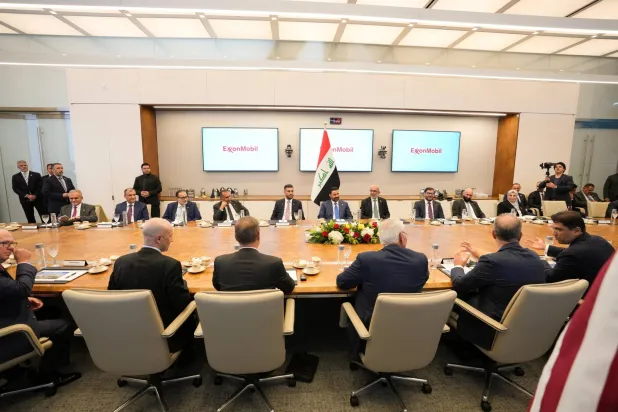
Chevron Vice Chairman Mark Nelson during his attendance at a meeting with Iraqi government officials at the company's headquarters in Houston, United States (Reuters)
Redrawing the export map
Despite the importance of these temporary solutions, they represent only a transitional phase within a broader strategy aimed at permanently reducing Iraq's dependence on the Strait of Hormuz. The main axis of this strategy is the establishment of a network of cross-border pipelines, giving Baghdad multiple export outlets and reducing the geopolitical risks revealed by the 'Hormuz crisis'.
In this context, the Basra-Aqaba pipeline project gained unprecedented momentum, after talks held by Iraqi Prime Minister Ali al-Zaidi in Washington with Jordanian Foreign Minister Ayman al-Safadi, with US support, resulted in an agreement to accelerate the project's implementation procedures.
The project, estimated to cost about $18 billion, is one of the largest oil infrastructure projects in the region; it extends about 1,600 kilometers from the Basra fields in southern Iraq to the Jordanian port of Aqaba on the Red Sea, passing through the Saudi region of Haditha, with a design capacity of up to 2.25 million barrels per day.
In the same context, the project to revive the Kirkuk-Baniyas pipeline, halted since 1982, gained new political momentum after al-Zaidi's visit to Washington. The United States supported the revival of the project as one of the strategic routes to diversify Iraqi oil export outlets towards the Mediterranean, within a broader vision to strengthen economic partnership with Baghdad and reduce its dependence on threatened sea lanes.
The project aims to rehabilitate the pipeline with a design capacity of about 300,000 barrels per day, providing an additional outlet for Iraqi exports outside the Strait of Hormuz. The US State Department welcomed the Iraqi-Syrian agreement on the project, calling it an important step to enhance regional energy security. US Special Envoy Tom Barrack also said that developing these corridors could make the Strait of Hormuz 'just a secondary idea' for oil flows in the region.
A man works to unload oil from trucks coming from Iraq at the Baniyas oil terminal in Syria (Reuters)
Investments to solidify 'post-Hormuz corridors'
The moves were not limited to political understandings; the Iraqi prime minister's visit witnessed the signing of a broad package of agreements with US companies, with a total value of about $60 billion, covering energy, infrastructure, communications, and health sectors, with the energy sector taking the largest share, as part of Baghdad's efforts to diversify oil export outlets and reduce its dependence on the Arabian Gulf.
In this context, Chevron signed three agreements with the Iraqi government, two of which focused on developing oil fields in southern Iraq, while the third addressed studying the establishment of a new pipeline network linking the southern fields to the Haditha region, reaching the Mediterranean coast, providing an alternative export outlet away from the Strait of Hormuz.
During his meeting with Chevron officials in Houston, al-Zaidi stressed that Iraq seeks 'long-term partnerships and investments, not just contractors,' indicating the new government's direction to create strategic infrastructure that redraws Iraq's oil export map.
Mutual interests
The dimensions of these projects go beyond Iraq's oil needs, intersecting with major political and economic interests of its neighbors. For Syria, the return of Iraqi oil flow gives the country reliable and continuous revenues from transit fees, and secures crude for local refineries to address severe fuel shortages, helping to cover reconstruction costs. US support for this interconnection also paves a faster path for Damascus to regional economic integration.
For Jordan, the project enhances its position as a stable security and logistical hub for international energy lines on the Red Sea (Aqaba port); ensuring stable supplies and financial returns that support its economic stability amid surrounding crises.
In return, the United States views these projects as part of a broader strategy to enhance regional economic interconnection, diversify energy corridors, and expand the presence of US companies in the Iraqi energy sector.
Implementation challenges
Despite the political momentum this trend enjoys, the road is still fraught with challenges. The proposed land corridors pass through areas where cells of the ISIS organization are still active; imposing significant security requirements to protect the infrastructure.
Original source: Asharq Al-Awsat




Comments (0)
Be the first to comment.