Hormuz.. The Battle That Never Ended

With Iran resuming the bombing of gas and oil tankers in and near the Strait of Hormuz, it may be premature to believe that the recent war between the United States and Iran has truly ended. It is true that the large-scale direct military confrontation has stopped.
And while rounds of negotiations continue behind closed doors in search of new understandings, the essence of the conflict seems to have shifted from one arena to another. The battle today is no longer about exchanging strikes, but rather about drawing the rules of influence in the Gulf, and the Strait of Hormuz lies at the heart of this equation.
In the Iranian reading, Hormuz is not just a waterway through which oil and gas tankers and commercial ships pass; it is a strategic card that can redefine Iran's regional standing. Hence, the Iranian insistence on granting itself an exceptional role in managing the strait, even to the point of entrenching a perception that makes passage through it subject in one way or another to its political will.
Therefore, ideas about imposing transit fees, service charges, or special arrangements are persistently repeated from time to time. They appear on the surface as technical measures, but in reality, they are an attempt to reinterpret established rules of international law, granting a single country a privilege inconsistent with the legal nature of international maritime straits.
This approach cannot be separated from internal calculations in Tehran. The regime faces accumulated economic pressures, and the power centers that hold decision-making need to present something that can be marketed to the domestic public as a political achievement after a costly phase of escalation. Thus, the Hormuz issue appears to be the leading candidate to be the headline of this 'victory' over other powers, even if similar progress is not achieved in other files.
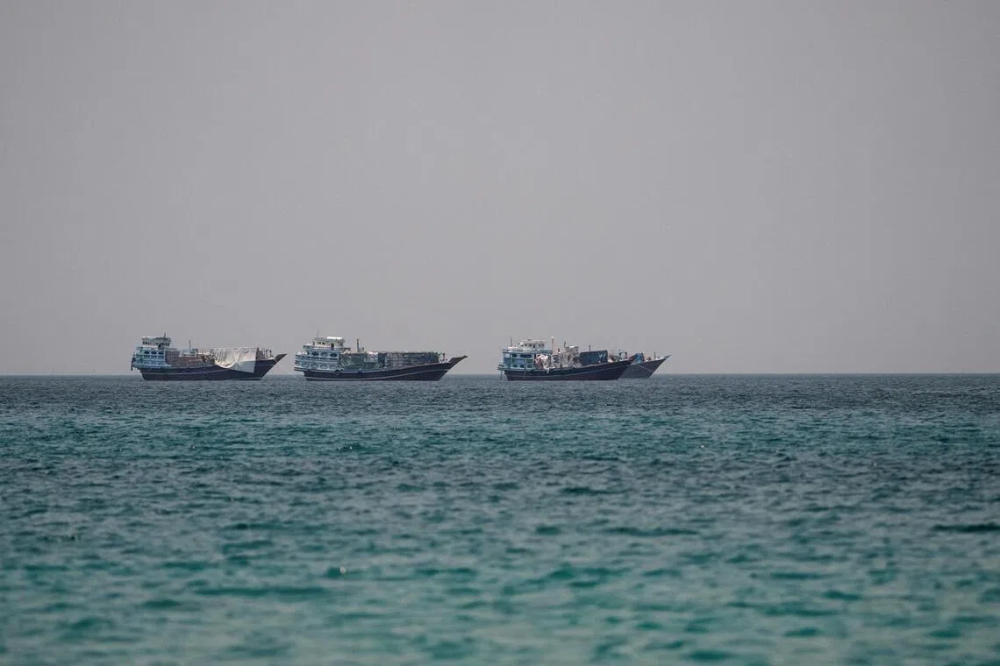
Perhaps what is noteworthy is that this vision is no longer just political rhetoric; it has manifested in practical applications. Iran has rushed to intervene and turn back ships that attempted to cross through the Omani route of the strait, and some have been bombed with drones, an action that reflects its perception of its role in controlling navigation.
That is, monopolizing influence in the Gulf. The irony is that this occurred even in the Omani route, while Oman was making a distinguished diplomatic effort to mediate between the conflicting parties, putting some of its security and stability at stake to keep the door for dialogue open.
Nevertheless, any infringement on freedom of navigation in this area not only threatens Gulf interests but also places Omani security itself before additional challenges and sends worrying messages to the international community, which remains mostly on the sidelines.
However, such ambition collides with an equally firm reality: the texts of international law. The Strait of Hormuz is not an Iranian matter; it is an international waterway on which global energy markets, supply chains, international trade, and communication lines depend.
Therefore, any attempt to change traffic rules or impose a new interpretation of maritime law will not only be met with rejection by the Gulf states but will also face objection from major powers that see freedom of navigation as a fundamental pillar of the existing international order.
Therefore, the next phase is likely to be a long political and legal struggle rather than a direct military confrontation. The issue is no longer just about a nuclear deal or lifting sanctions, but about redrawing the balance of influence in the Gulf.
And the competing powers within the Iranian system will try to present any gain in Hormuz as evidence of their success, while the international community will be keen to prevent turning sea lanes into tools of influence or political blackmail. The battle has moved from the sky to the sea, from missiles to international law, and perhaps this shift is more complex, longer-lasting, and more costly, because the dispute is no longer about geographical borders, but about who has the right to shape the rules of influence in the region.
Quoted from Al-Bayan
Advertisement
Advertisement
Note: All published articles represent the views of their authors only.
Original source: Al Arabiya


Comments (0)
Be the first to comment.