US futures plunge after Trump declares 'end of understanding' with Iran
US stock index futures fell sharply during Wednesday's trading, with Nasdaq futures hitting their lowest levels in nearly four weeks...
The global economy entered a new and complex phase of geopolitical and financial uncertainty after US President Donald Trump dropped a heavy political bombshell from the Turkish capital Ankara during his participation in the NATO summit. This came with his official and final announcement to end the war and cancel the memorandum of understanding and temporary ceasefire signed with Tehran to end the Gulf conflict, describing any new attempts to negotiate or deal with the Iranian leadership as 'mere folly and a waste of time,' while warning that Washington might initiate serious and open military options to respond to attacks on commercial shipping.
This sudden dramatic shift, accompanied by Washington's threat to launch new and extensive military strikes, caused a violent logistical and financial shock to the global economy; oil prices immediately jumped more than 7% to breach the $79 per barrel mark, threatening to freeze two years of gains in fighting inflation and undermining hopes for monetary policy easing.
In contrast, Wall Street indices and European and Asian markets turned red as investors fled en masse to safe havens, placing the renewed conflict in the Strait of Hormuz on the brink of a volcano. The International Monetary Fund warned again that continued losses would force it to cut further into global growth rates, which are stubbornly stuck at 3%.
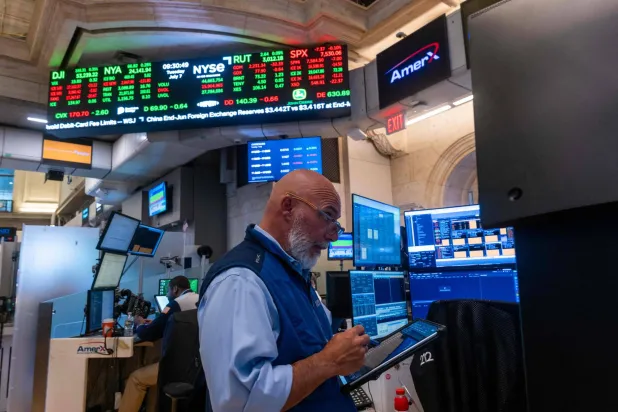
Traders working at the New York Stock Exchange (AP)
Oil market on fire
Trump's harsh remarks rekindled fears of a complete and prolonged blockage of the global energy artery in the Strait of Hormuz, which traders immediately translated into panic buying that sent prices soaring. Brent crude strengthened to rise 7.4% to settle at $79.64 per barrel, while US West Texas Intermediate crude followed with a gain of about 7.3% to reach $75.58 per barrel.
Although these levels remain below the $120 peak recorded at the start of the conflict, their rapid jump of between 25% and 32% compared to pre-war levels has re-injected inflation risks into bond markets.
Oil concerns were heightened by official data released this week, which revealed that US strategic petroleum reserve stocks have fallen to their lowest levels since 1983, depriving the global economy of any maneuvering room to absorb the inevitable upcoming shocks in the event of a full naval blockade.
Selling wave sweeps stocks
Global stock exchanges reacted to US military threats of overnight ground and sea strikes against Iran with immediate jitters, triggering a broad sell-off of high-risk assets. New York opened sharply lower; the Dow Jones Industrial Average lost about 1% (514 points), followed by the broader S&P 500 down 0.46%, and the tech-heavy Nasdaq down 0.31%.
In Europe, Paris and Frankfurt markets fell sharply by 1.8%, while London dropped 1.2%. In Asia, Seoul's KOSPI led declines with a violent drop exceeding 5%.
Airlines and cruise lines were the direct victims of the sudden surge in fuel prices; United Airlines shares fell 3.2% and Delta dropped 1.9%. Cruise operators such as Carnival also tumbled 3% over fears of evaporating profit margins and rising operating costs.
The energy crisis coincided with increased investor skepticism about the high valuations of the semiconductor and artificial intelligence sectors; Samsung Electronics shares continued their decline for the second consecutive day by 6% in Seoul, despite announcing a massive profit jump of 19-fold, amid real concerns about slowing demand for memory chips in the second half of the year. In contrast, US-based Broadcom shares managed to rise 3%, supported by a huge $30 billion supply deal with Apple, partially offsetting Nasdaq losses.
Traders near screens showing foreign exchange rates at a trading room of Hana Bank in Seoul (AP)
Yen wobbles, dollar seeks safety
Foreign exchange markets were not immune to this shock; the war rhetoric reordered traders' priorities toward holding the US currency as a safe haven during crises.
The US dollar index held relatively stable against a basket of major currencies, moving around 101.1 points, supported by expectations of keeping interest rates higher for longer to curb potential oil-driven inflation.
In contrast, the Japanese currency continued to wobble; the yen hovered around 162.49 yen per dollar, affected by the wide gap in bond yields between Washington and Tokyo, and approaching its lowest levels in about 40 years, putting additional pressure on the Bank of Japan to intervene in markets.
Experts and strategists agreed that international markets are now completely at the mercy of sharp and violent fluctuations due to 'geopolitical blindness' resulting from the ongoing tactical shifts in the current US administration's positions. Financial group analysts see the biggest fear not in the current momentary drop in stock prices, but in the possibility that the cancellation of the ceasefire could lead to a complete diplomatic rupture, resulting in a return of an open and comprehensive 'tanker war' that would force international powers to impose mutual naval blockades.
Original source: Asharq Al-Awsat


Comments (0)
Be the first to comment.