Canadian filmmaker Vermette: I treat darkness as a space for contemplation
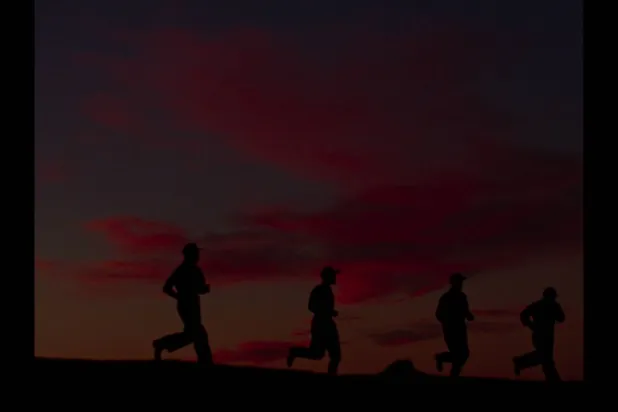
Canadian filmmaker Ryan Vermette said that her feature film 'Levers' does not present darkness merely as a backdrop for events.
Canadian filmmaker Ryan Vermette said that her feature film 'Levers' does not present darkness merely as a backdrop for events, but transforms it into a complete cinematic language, through which she sees humanity and the world at a moment when they lose everything they once considered fixed.
The Canadian filmmaker explained in an interview with Asharq Al-Awsat via Zoom that the work, which took about six years to complete, was the result of a long journey of research, contemplation, and writing, during which she sought to present a visual experience that transcends traditional storytelling and invites the viewer to live the film rather than just watch it. She noted that the idea of darkness has accompanied her for years, as she has previously made several experimental films that treated black spaces as an aesthetic element in their own right, but in recent years she felt that this idea gained new meaning with the transformations the world has witnessed.
She emphasized that the COVID-19 pandemic, with the isolation and anxiety it imposed, prompted her to rethink the concept of darkness, not as an absence of light, but as a space for contemplation and revealing what lies hidden within humans.
Canadian filmmaker Ryan Vermette (the production company)
Vermette believes that modern cinema has become captive to the clear image and full lighting, while she was seeking the opposite direction, constantly asking herself: How can an image be built from darkness? How can darkness itself become a means of storytelling? Therefore, her goal was not to hide things within the frame, but to give the viewer a chance to discover them gradually, and to make the eye participate in creating meaning, just as the mind does.
Total Darkness
The plot of 'Levers' takes place in a small town in the Red River Valley in Canada, where residents prepare to unveil a new statue, before a mysterious explosion completely changes their lives, as the earth is plunged into total darkness lasting a full day. When the light returns, the world is no longer the same, and the town's inhabitants find themselves facing existential questions about death, memory, stability, and human fragility.
The last edition of the Toronto International Film Festival in Canada saw the world premiere of the film, and it was recently screened at the Karlovy Vary International Film Festival in the Czech Republic.
Vermette revealed that the screenplay did not start as a film script in the conventional sense, but began with a collection of poems, after she wrote 22 poems during a long period of isolation and reading, to discover that these texts, despite their independence, belonged to one world. From there, she began transforming them into scenes, characters, and visual rhythm, emphasizing that poetry preceded cinema in this experience, and that the words were searching from the beginning for images to embrace them.
The film continues its participation in film festivals (the production company)
She added that her journey with the film was also influenced by events in North America, especially the toppling of statues of several colonial figures during popular protests, such as the statue of Christopher Columbus and the statue of Queen Victoria, explaining that those scenes were not just political events for her, but prompted her to reflect on the way society rewrites its history, and how a single image can change our relationship with memory, identity, and the symbols we long believed were permanent.
Contemplative Rhythm
Her sources of inspiration were not limited to current events; the Canadian filmmaker affirmed that she spent years reading poetry and philosophical and spiritual writings, as well as works by several Black writers, and jazz music accompanied her throughout the writing stages, considering that these elements together created the film's internal atmosphere and gave it that contemplative rhythm that dominates its scenes.
On the visual level, the filmmaker explained that she deliberately avoided ultra-high-definition digital images because they do not express the world she wanted to present, so she chose to shoot on 16mm film, using old Bolex cameras, some of which were already malfunctioning, noting that the visual roughness and grain that fill the image are not technical flaws, but part of the film's spirit, as they give the viewer a sense that the world they see is fragile and incomplete, like the characters themselves.
The film's director played many roles in its making (the production company)
She emphasized that the hardest thing she faced was not just the technical aspect, but the nature of the project itself, as she took on writing, directing, producing, and cinematography at the same time, which made her responsible for every stage of implementation, from idea development and fundraising to editing and post-production, noting that this multiplicity of roles imposed enormous pressure on her, but also gave the film its distinctiveness, as every detail passed through her personal vision.
She said that the crew was not formed according to traditional production standards, as it mostly included her friends and family members, while some participants experienced their roles in the production team for the first time, noting that she was looking for an environment based on trust and collaboration rather than relying solely on experience.
She pointed out that the execution journey was not without obstacles, as the team faced frequent camera malfunctions, problems with film stock, as well as many challenges during post-production, so much so that she sometimes felt that the project resisted completion, and that she had to start over every day and bring it back to life.
Original source: Asharq Al-Awsat




Comments (0)
Be the first to comment.